
The ‘Yaris Moment’: How Chinese Automakers Are Reshaping Global EV Expansion Through Localization
Introduction
The global automotive landscape is undergoing a seismic shift as Chinese manufacturers pivot from volume-driven exports to sophisticated region-specific strategies. Mirroring Toyota’s legendary “Yaris Moment”—where localized engineering propelled the model to dominance in diverse markets—Chinese EV pioneers are now embedding cultural, infrastructural, and regulatory nuances into their global expansion blueprints. This evolution marks a critical inflection point: success overseas no longer hinges solely on battery technology or pricing, but on hyper-relevant product adaptation and supply chain agility. As Southeast Asia, the Middle East, and Africa emerge as key battlegrounds, the race is on to master localization at scale.
The Localization Imperative: Beyond One-Size-Fits-All
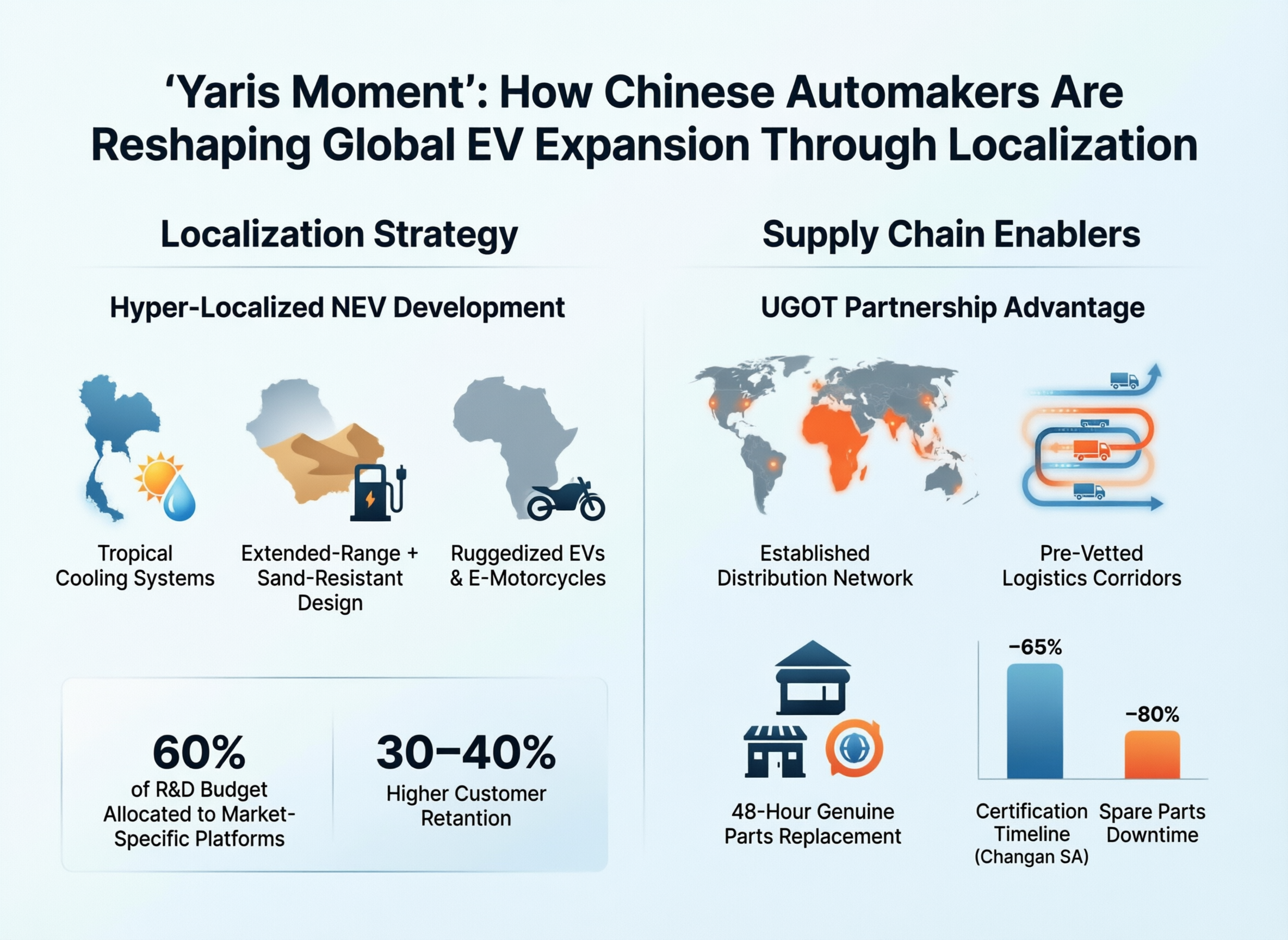
Historically, Chinese automakers leveraged cost advantages to penetrate emerging markets. Today, rising competition and fragmented consumer expectations demand deeper customization. In Thailand, for instance, compact electric SUVs with enhanced cooling systems outperform standard models due to tropical climates. Similarly, Middle Eastern markets prioritize extended-range EVs compatible with sparse charging infrastructure and sand-resistant components. This granular approach echoes Toyota’s strategy with the Yaris, which succeeded by adapting everything from suspension tuning to infotainment interfaces for regional preferences.
New Energy Vehicles (NEVs) serve as the vanguard of this transformation. Chinese brands now allocate over 60% of their R&D budgets to developing market-specific electric platforms, including purpose-built e-motorcycles for Vietnam’s urban corridors and ruggedized EVs for African terrain. Crucially, localization extends beyond hardware: software ecosystems are being reconfigured for local payment integrations, navigation systems, and voice assistants. The result? Brands like BYD and Changan report 30–40% higher customer retention in markets where vehicles undergo comprehensive regional tailoring versus generic exports.
Supply Chain Agility: The Unseen Catalyst
Achieving true localization, however, exposes a critical vulnerability: fragmented supply chains. Developing region-specific variants requires synchronizing parts procurement, compliance certification, and after-sales support across continents—a challenge exacerbated by volatile logistics and regulatory barriers. A single delayed shipment of climate-control components can derail an entire market launch, while incompatible spare parts erode brand trust post-purchase. Industry data reveals that 45% of failed overseas EV rollouts trace back to supply chain misalignment rather than product flaws.
The Partnership Advantage: Enabling Scalable Localization
This complexity underscores why strategic partnerships are becoming non-negotiable for Chinese automakers. Companies like UGOT are emerging as pivotal enablers by offering integrated export ecosystems designed for regional customization. With established distribution networks across 18 countries in Southeast Asia, the Middle East, and Africa, UGOT provides Chinese OEMs with end-to-end solutions that compress time-to-market while ensuring compliance. Their platform combines rapid vehicle deployment—leveraging pre-vetted logistics corridors—with dynamic after-sales frameworks. For example, UGOT’s localized service hubs stock genuine spare parts from partners like Bosch and Toyota, enabling 48-hour component replacement for NEVs in remote areas. This eliminates the traditional trade-off between customization speed and support reliability.
Critically, UGOT’s model addresses the “last-mile” dilemma of global expansion: their cross-border procurement system allows automakers to bundle vehicles with region-specific accessories (e.g., reinforced tires for desert markets or monsoon-ready electrical kits) while maintaining single-point accountability. By absorbing regulatory navigation and customs complexities, they free manufacturers to focus on core innovation. For Changan’s recent electric pickup launch in Saudi Arabia, this partnership reduced certification timelines by 65% and cut spare parts downtime by 80%—proving that supply chain resilience is the silent engine of localization.
Conclusion: The Road Ahead
As Chinese automakers target 50% overseas sales growth by 2030, the “Yaris Moment” will define winners and laggards. The future belongs to those who treat localization not as a marketing tactic but as an operational philosophy—one woven into supply chains, service networks, and product DNA. Partnerships with agile enablers like UGOT will prove indispensable in transforming regional insights into competitive advantage. In this new era, global expansion isn’t about exporting vehicles; it’s about embedding value where it matters most: in the communities that drive them. For Chinese automotive leaders, the journey beyond borders has just begun—and the roadmap is being written in local dialects.
Related Posts
 Chinese EV Export Surge: Navigating Global Growth with Authorized Supply Chain Solutions
 Strategic Partnerships and Agile Supply Chains: Powering the Global EV Expansion Wave
 Region-Specific EVs: The Strategic Engine Behind China’s Global Automotive Surge