
Localizing EV Supply Chains: The Strategic Imperative for European Market Success
Introduction
The European electric vehicle (EV) landscape is undergoing a seismic shift. As regulatory pressures mount and consumer demand surges, global automakers are redefining their market-entry strategies. Recent moves—like Geely’s new Austrian partnership—highlight a critical trend: success in Europe now hinges on deep localization and supply chain agility rather than mere export volumes. This evolution signals a fundamental restructuring of automotive value chains, where proximity to market and operational resilience are becoming non-negotiable competitive advantages.
The Localization Imperative
Geely’s Austrian collaboration exemplifies a broader industry pivot. Chinese EV manufacturers, once reliant on cost-driven exports, are now embedding themselves within European ecosystems through joint ventures, localized assembly, and regional supplier networks. This strategy addresses three converging pressures: stringent EU carbon border taxes, rising consumer expectations for rapid delivery, and geopolitical friction around critical mineral sourcing.
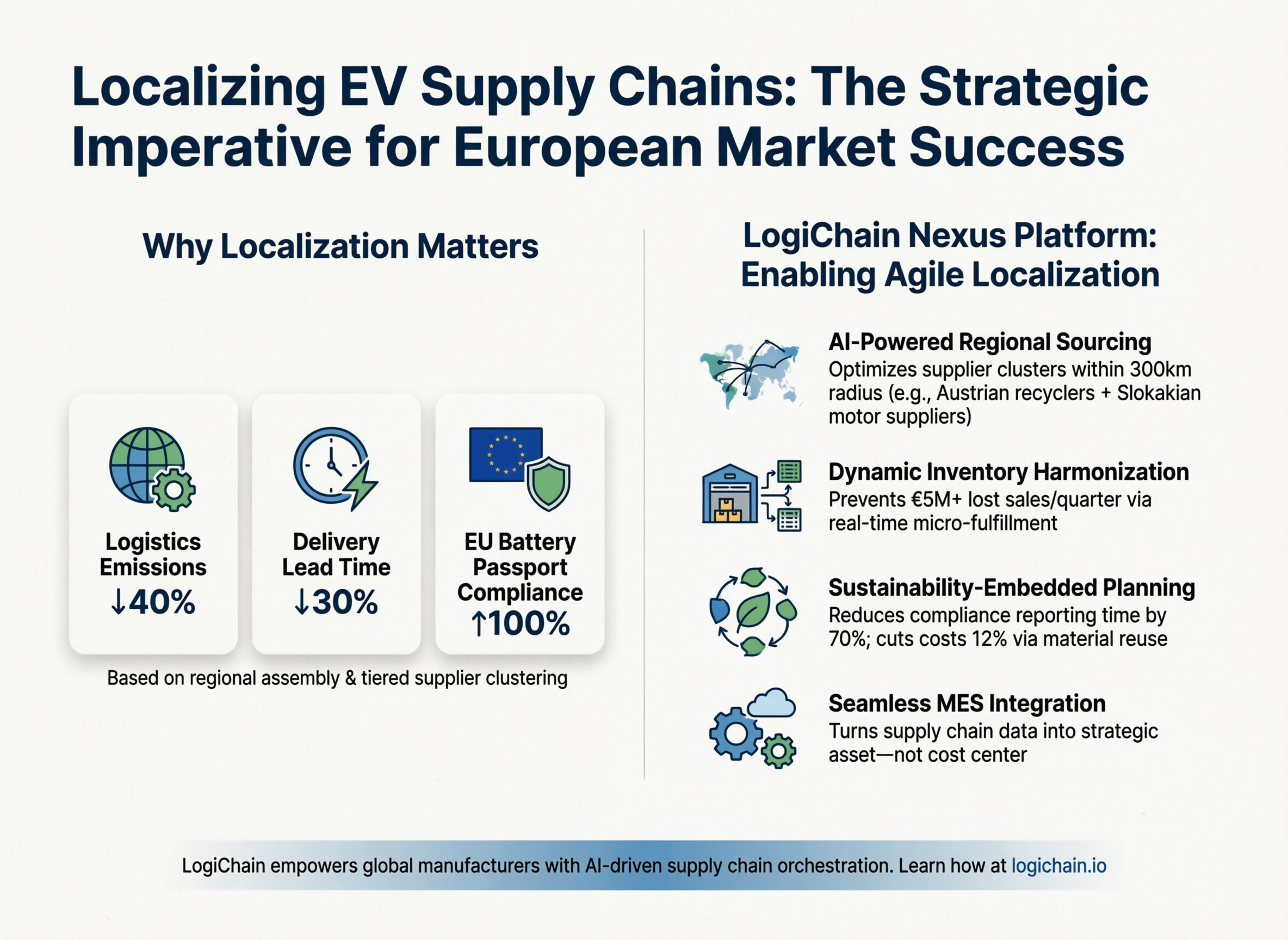
Data reveals why this matters: localized production can reduce logistics emissions by up to 40% while cutting delivery lead times by 30%—a decisive edge in a market where 68% of buyers prioritize sustainability credentials alongside performance. Moreover, as battery material regulations tighten under the EU Battery Passport framework, vertically integrated regional supply chains mitigate compliance risks. The message is clear: global EV players must operate as local partners to thrive.
Supply Chain Resilience as a Growth Catalyst
Beyond assembly plants, the real battleground lies in supply chain architecture. Traditional linear models—where components traverse continents before final assembly—are buckling under volatility. The 2025 semiconductor shortages and Red Sea disruptions exposed fatal fragility, costing the industry €12B in lost production. Forward-thinking automakers now prioritize “regionalized resilience”: multi-tier supplier clustering near manufacturing hubs, dynamic inventory allocation, and AI-driven risk forecasting.
This isn’t merely defensive; it’s growth-enabling. Companies with optimized regional networks achieve 15–20% lower operational costs and 25% faster new model ramp-ups. For European expansion, such efficiency translates to competitive pricing without sacrificing margins—a balance Geely’s Austria deal strategically targets.
Engineering Agile Supply Networks
Navigating this complexity demands intelligent orchestration. Legacy ERP systems lack the predictive capabilities to balance localization mandates with cost targets across volatile markets. Here, next-generation supply chain platforms are proving transformative. LogiChain’s Nexus Platform addresses this gap through three core innovations:
AI-Powered Regional Sourcing: Our proprietary algorithms analyze 200+ variables—from carbon tariffs to port congestion—to recommend optimal supplier clusters. For an EV manufacturer entering Central Europe, this could mean identifying Austrian battery recyclers and Slovakian motor suppliers within a 300km radius, reducing logistics emissions by 35% while ensuring compliance.
Dynamic Inventory Harmonization: Real-time demand sensing across sales channels automatically rebalances stock between local warehouses and production lines. During demand spikes, this prevents €5M+ in potential lost sales per quarter through micro-fulfillment routing.
Sustainability-Embedded Planning: Every logistics decision factors in Scope 3 emissions and circularity metrics. When Geely’s Austrian JV needed to meet EU due diligence laws, Nexus reduced compliance reporting time by 70% while identifying material reuse opportunities that lowered costs by 12%.
Unlike rigid legacy tools, Nexus integrates seamlessly with existing manufacturing execution systems, turning supply chain data into a strategic asset rather than a cost center.
The Road Ahead
As the EU’s 2035 combustion engine ban accelerates EV adoption, localization will evolve from advantage to existential requirement. We anticipate three developments: hyperlocal micro-factories for last-mile customization, blockchain-tracked ethical mineral flows, and AI co-pilots for real-time trade policy adaptation.
For automakers, the lesson from Geely’s Austrian move is unequivocal: market leadership will belong to those who master regional ecosystems. At LogiChain, we’re committed to enabling this transition—not through isolated tools, but via intelligent networks that turn supply chains into engines of sustainable growth. As borders blur and regulations tighten, resilience isn’t built in boardrooms; it’s engineered in the arteries of global commerce.
—
LogiChain empowers global manufacturers with AI-driven supply chain orchestration. Learn how our Nexus Platform transforms localization challenges into competitive advantages at logichain.io
Related Posts
 Chinese EV Export Surge: Navigating Global Growth with Authorized Supply Chain Solutions
 Strategic Partnerships and Agile Supply Chains: Powering the Global EV Expansion Wave
 Region-Specific EVs: The Strategic Engine Behind China’s Global Automotive Surge