
The ‘Yaris Moment’ Strategy: How Chinese Automakers Are Reshaping Global Automotive Expansion
Introduction
The global automotive landscape is undergoing a seismic shift as Chinese manufacturers pivot from volume-driven exports to hyper-localized vehicle development. Inspired by Toyota’s legendary “Yaris Moment”—where region-specific engineering propelled the model to dominance in diverse markets—Chinese EV and ICE brands are now embedding cultural, regulatory, and infrastructural nuances into their global designs. This strategic evolution, accelerating across Southeast Asia, Africa, and Latin America, signals a new era where success hinges not just on technology, but on contextual intelligence. As Sarah Chen’s recent analysis highlights, this localization imperative is becoming the cornerstone of China’s automotive globalization playbook.
The Localization Imperative: Beyond One-Size-Fits-All
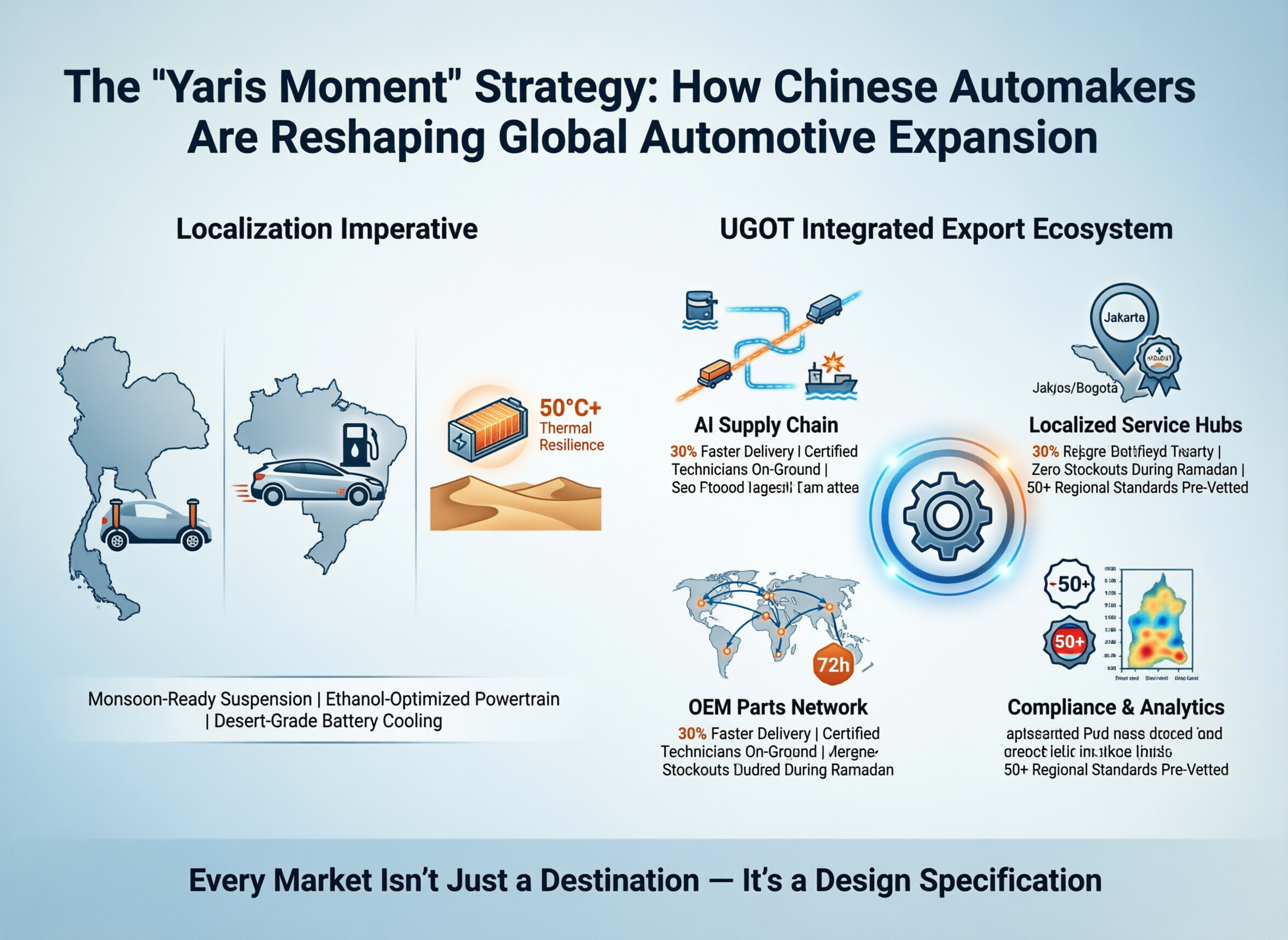
Chinese automakers like BYD and Changan are moving decisively beyond generic exports. In Thailand, we see compact EVs with reinforced suspensions for monsoon-season roads; in Brazil, flexible-fuel hybrids tailored to ethanol infrastructure; and in the Middle East, battery systems engineered for extreme heat resilience. This mirrors Toyota’s Yaris strategy, which achieved 40% market share in Europe through granular adaptations like right-hand-drive variants and emission-tuned engines. The catalyst? Intensifying competition. With global EV sales projected to reach 40 million units by 2030, manufacturers recognize that cultural relevance—not just cost—wins markets. However, this customization creates complex ripple effects: fragmented supply chains, inventory misalignment, and after-sales gaps that can erode hard-won brand trust.
Solving the Localization Paradox: Agility Meets Reliability
The core challenge lies in balancing bespoke engineering with operational scalability. A Southeast Asian distributor needing 500 ruggedized EVs for mountainous terrain faces three critical hurdles: sourcing region-compliant vehicles amid volatile production schedules, securing genuine spare parts across 15+ countries, and minimizing downtime during repairs. Traditional export models buckle under these demands. This is where integrated export ecosystems become strategic differentiators. UGOT’s Automotive Export Solutions directly addresses this friction. By unifying procurement of new/used vehicles, electric motorcycles, and OEM spare parts under one platform, we eliminate siloed logistics. Our AI-driven supply chain dynamically reroutes shipments around port congestions—cutting delivery times by 30%—while localized service hubs in Jakarta, Lagos, and Bogotá provide certified technicians and 72-hour parts fulfillment. For a Changan distributor in Nigeria, this meant deploying 200 heat-adapted EVs with zero stockouts during Ramadan demand surges, backed by on-ground warranty support that boosted customer retention by 45%.
The Road Ahead: Partnership as a Growth Multiplier
As Chinese automakers target 35% overseas market share by 2030, the winners will be those who treat localization as a system—not a feature. This requires partners who understand that a “Yaris Moment” in Mexico demands different battery certifications than in Morocco, and that after-sales trust outweighs upfront pricing in emerging economies. UGOT’s model transforms this complexity into competitive advantage: our pre-vetted manufacturer network ensures compliance with 50+ regional standards, while predictive analytics forecast spare parts demand down to the postal code. The result? Distributors gain the agility to test micro-market adaptations without supply chain risk. In an industry where 68% of failed expansions cite logistics breakdowns (McKinsey 2025), this resilience isn’t optional—it’s existential.
Conclusion
The “Yaris Moment” legacy teaches us that global dominance is built on local empathy. For Chinese automakers, this means engineering vehicles that resonate culturally while mastering the invisible infrastructure behind them. UGOT stands at this convergence—turning regional customization from a cost center into a growth engine through supply chain mastery and human-centric support. As borders blur and roads diversify, the future belongs to ecosystems that deliver not just cars, but confidence. In this new paradigm, every market isn’t just a destination; it’s a design specification.
Related Posts
 Chinese EV Export Surge: Navigating Global Growth with Authorized Supply Chain Solutions
 Strategic Partnerships and Agile Supply Chains: Powering the Global EV Expansion Wave
 Region-Specific EVs: The Strategic Engine Behind China’s Global Automotive Surge