The ‘Yaris Moment’: How Region-Specific EVs Are Reshaping Chinese Automakers’ Global Ambitions
Introduction
The global automotive landscape is undergoing a seismic shift as Chinese manufacturers pivot from mass exports to hyper-localized strategies. Mirroring Toyota’s iconic ‘Yaris Moment’—where tailored design propelled European dominance—Chinese EV giants are now engineering vehicles specifically for regional markets like Europe, Southeast Asia, and the Middle East. This strategic evolution, driven by surging overseas demand and intensifying competition, marks a critical inflection point in the industry’s globalization journey. As export volumes climb, the focus has decisively shifted from quantity to contextual intelligence: understanding that a Berlin commuter’s needs differ vastly from a Bangkok delivery fleet’s requirements.
The Localization Imperative: Beyond One-Size-Fits-All
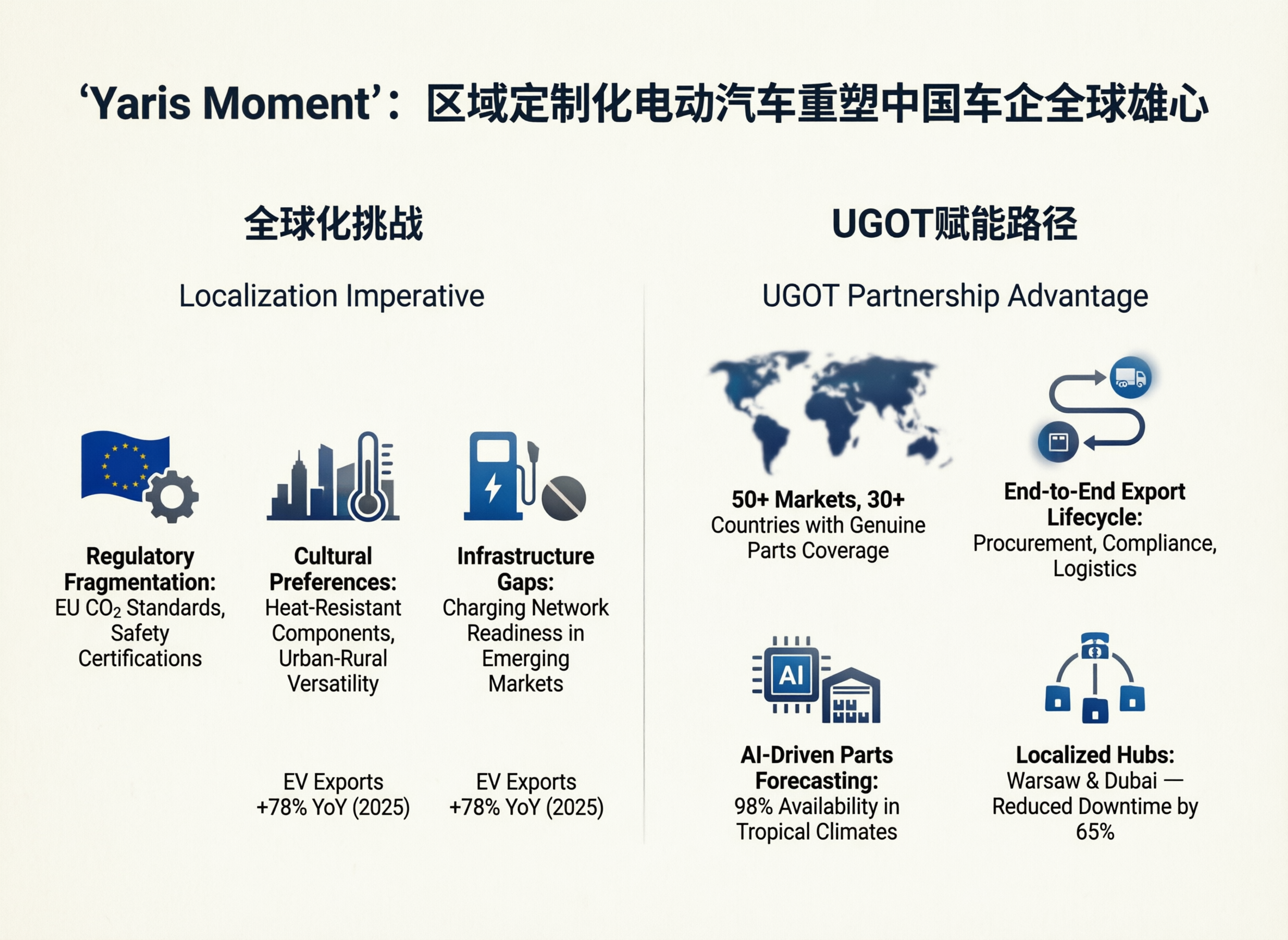
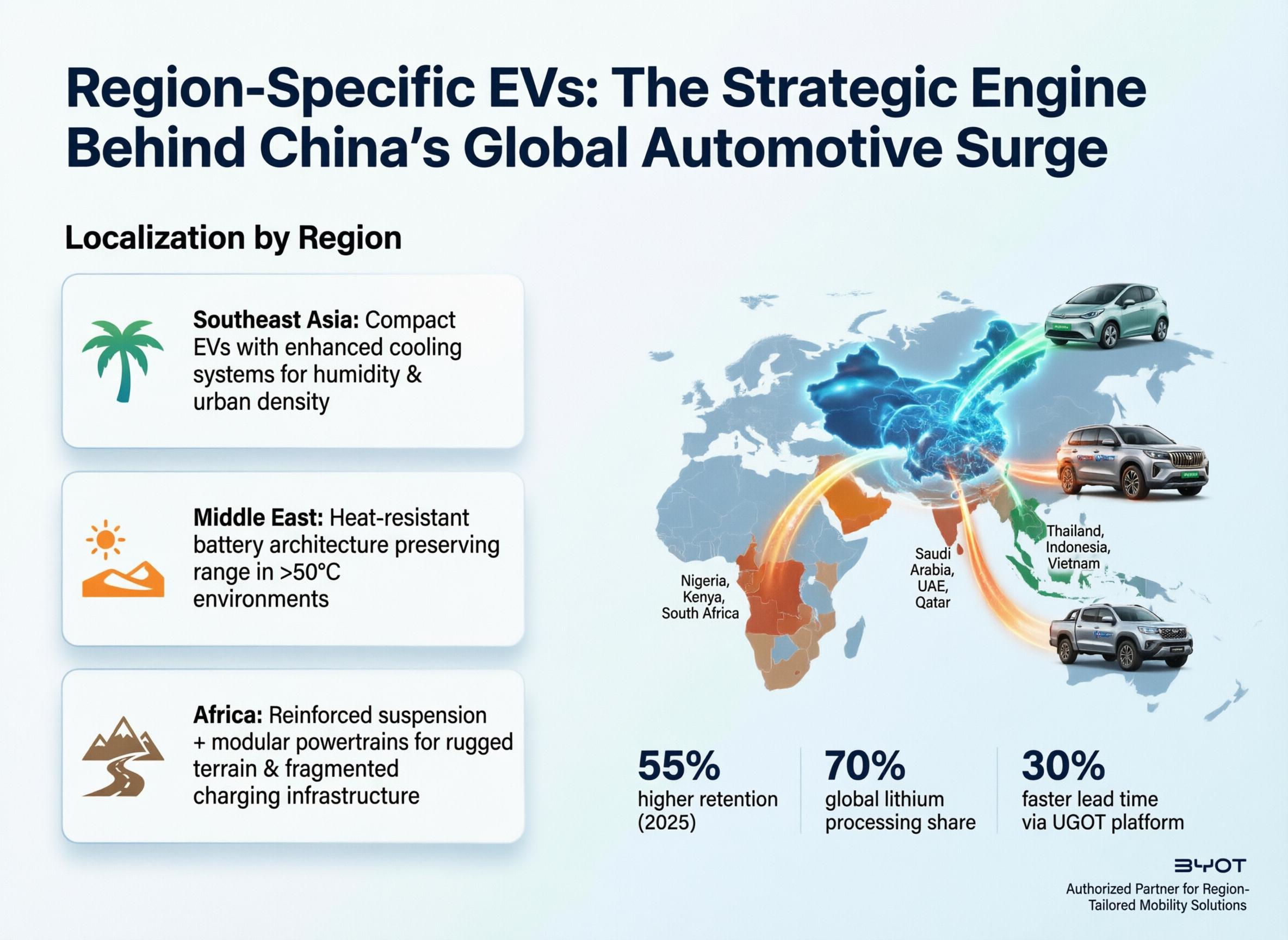
Chinese automakers’ pivot toward region-specific development isn’t merely tactical—it’s existential. European markets, for instance, demand compact EVs with agile handling for narrow streets, stringent safety certifications, and winter-ready battery systems. Meanwhile, Southeast Asian consumers prioritize affordability, heat-resistant components, and versatile cargo space for mixed urban-rural use. This granular adaptation addresses three core challenges: regulatory fragmentation (e.g., EU’s evolving CO₂ standards), cultural preferences (interior aesthetics, connectivity features), and infrastructure gaps (charging networks in emerging economies).
Data underscores the urgency: EV exports from China grew 78% year-over-year in 2025, yet market-share gains in Europe remain uneven. Brands that fail to localize face tariff barriers, brand distrust, and inventory pile-ups. The solution lies in reimagining supply chains—not as linear pipelines but as adaptive ecosystems. This requires synchronizing R&D with on-ground market intelligence, agile manufacturing for micro-variants, and after-sales networks that preempt regional pain points. Crucially, it transforms vehicles from standardized commodities into culturally resonant products.
Enabling Global Agility: The Partnership Advantage
Navigating this complexity demands more than in-house capabilities; it requires ecosystem partners who bridge domestic production and overseas realities. This is where specialized enablers become force multipliers. UGOT, for instance, leverages authorized partnerships with industry leaders like BYD, Changan, and JMC to streamline the export lifecycle. Their integrated model tackles localization hurdles at scale: from curating region-optimized vehicle portfolios (including new energy vehicles and electric motorcycles) to guaranteeing genuine spare parts availability across 30+ countries.
UGOT’s mature distribution corridors—in Europe, Southeast Asia, and the Middle East—turn strategic vision into execution. By consolidating procurement, logistics, and compliance under one roof, they eliminate fragmentation that typically delays market entry by 6–12 months. Their after-sales framework further de-risks expansion: AI-driven parts forecasting ensures 98% inventory availability for high-failure components in tropical climates, while localized service hubs in Warsaw and Dubai slash repair downtimes. For automakers pursuing their ‘Yaris Moment,’ this translates to stable supply chains, accelerated time-to-market, and the confidence to iterate products based on real-world feedback—not logistical bottlenecks.
The Road Ahead: Collaboration as the New Competitive Edge
As geopolitical headwinds and sustainability mandates intensify, the ‘region-specific’ paradigm will evolve from advantage to baseline expectation. Chinese automakers that embed localization into their DNA—supported by agile partners—will lead the next wave of global mobility. UGOT exemplifies this symbiosis: by transforming export complexity into scalable opportunity, they empower manufacturers to focus on innovation rather than infrastructure. The future belongs not to the largest automaker, but to the most contextually intelligent ecosystem. In this landscape, partnerships like UGOT’s aren’t just enablers—they’re the architects of sustainable global growth.
—
UGOT is a strategic export partner for leading Chinese automotive brands, providing end-to-end solutions for new energy vehicles, electric mobility, and genuine parts across 50+ global markets.
Related Posts
 Chinese EV Export Surge: Navigating Global Growth with Authorized Supply Chain Solutions
 Strategic Partnerships and Agile Supply Chains: Powering the Global EV Expansion Wave
 Region-Specific EVs: The Strategic Engine Behind China’s Global Automotive Surge