
Powering Global EV Growth: China’s Export Surge and Integrated Supply Chain Solutions
Introduction
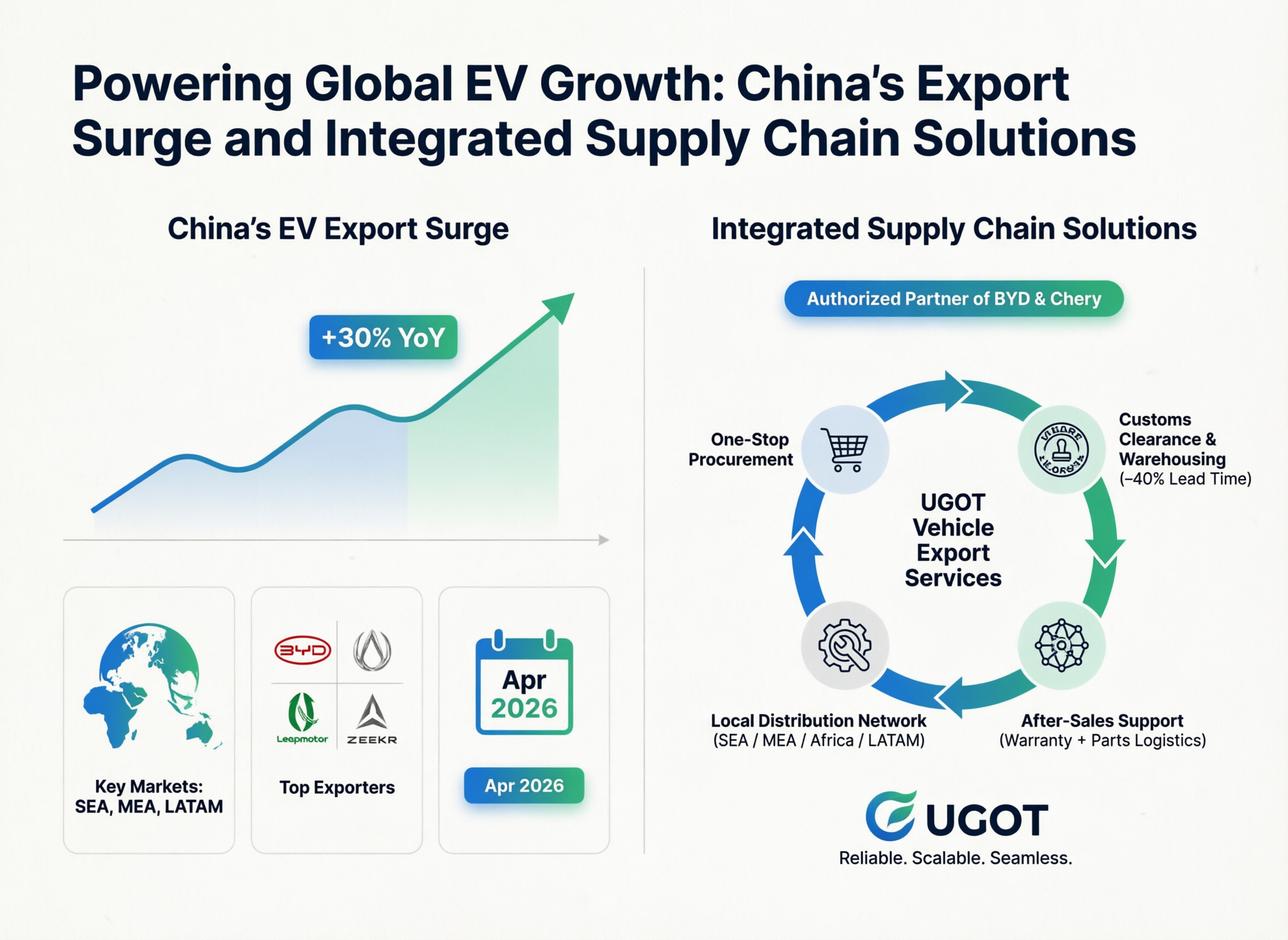
In April 2026, China’s electric vehicle (EV) manufacturers achieved remarkable overseas milestones, with export growth solidifying as the industry’s primary engine. Brands like BYD, Chery, Leapmotor, and Zeekr reported record shipments, particularly in emerging markets across Southeast Asia, the Middle East, and Latin America. This surge, documented in industry reports, underscores a strategic pivot toward global expansion amid intensifying competition. As geopolitical and logistical complexities mount, the sector faces a critical question: how can stakeholders sustain this momentum while ensuring reliability and scalability? The answer lies not just in production prowess but in reimagining the export ecosystem itself.
Industry Trends: Beyond the Export Boom
The April 2026 data reveals more than impressive numbers—it signals a structural shift in global automotive trade. Chinese EV makers are leveraging cost efficiencies and technological advancements to capture market share rapidly, with exports growing over 30% year-on-year. However, this acceleration exposes underlying vulnerabilities. Supply chain fragmentation, from component shortages to customs delays, threatens delivery timelines, especially in high-growth regions like Africa and South America. Simultaneously, consumer demand is evolving: buyers now prioritize end-to-end solutions, including after-sales support and spare parts availability, rather than standalone vehicle purchases. This trend highlights a new competitive frontier where seamless logistics and localized service networks become as vital as the vehicles themselves. Industry analysts note that brands excelling in these areas—such as BYD’s partnerships in Thailand and Chery’s foothold in Saudi Arabia—are setting benchmarks for sustainable global growth, proving that scalability hinges on integrated operational frameworks.
Solutions: Enabling Reliable Global Access
Amid these dynamics, specialized export services are emerging as indispensable enablers. Companies must navigate complex regulatory landscapes, volatile shipping costs, and diverse market requirements without compromising speed or quality. This is where integrated solutions bridge the gap. UGOT Vehicle Export Services, as an authorized partner for leading manufacturers including BYD and Chery, addresses these challenges through a high-quality, one-stop procurement platform. Covering new and used vehicles, e-motorcycles, and spare parts, UGOT leverages stable supply chains and established distribution channels across Southeast Asia, the Middle East, Africa, and South America. For instance, its streamlined customs clearance and warehousing network reduces delivery lead times by up to 40%, while comprehensive after-sales support—including warranty management and parts logistics—ensures partner confidence. By consolidating sourcing, shipping, and post-delivery services under one roof, UGOT transforms export complexities into strategic advantages, empowering dealers and fleet operators to capitalize on the EV boom without operational friction.
Conclusion
Looking ahead, China’s EV export trajectory shows no signs of slowing, with emerging markets poised to drive the next wave of adoption. As global demand diversifies, the industry’s success will increasingly depend on agile, end-to-end partners who prioritize resilience over rapid scale. UGOT Vehicle Export Services exemplifies this evolution, turning supply chain vulnerabilities into opportunities for growth. By combining authorized manufacturer relationships with tailored logistics expertise, UGOT doesn’t just facilitate transactions—it builds sustainable pathways for global electrification. In an era where seamless international trade defines competitive leadership, such integrated solutions will be the cornerstone of a truly connected EV future.
Related Posts
 Chinese EV Export Surge: Navigating Global Growth with Authorized Supply Chain Solutions
 Strategic Partnerships and Agile Supply Chains: Powering the Global EV Expansion Wave
 Region-Specific EVs: The Strategic Engine Behind China’s Global Automotive Surge