China’s EV Export Surge: Navigating Global Expansion with Strategic Supply Chain Solutions
Introduction
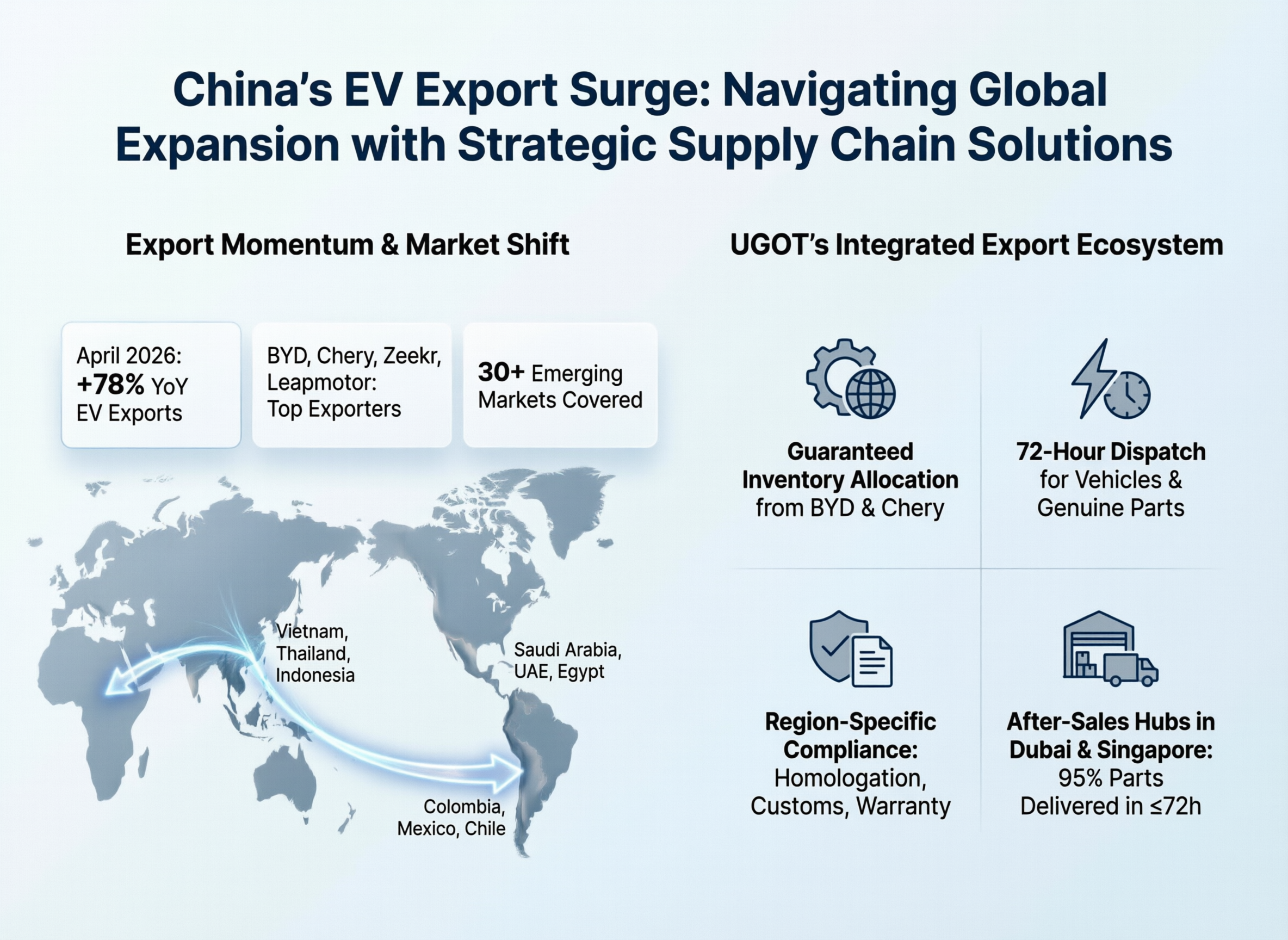
April 2026 marked a watershed moment for China’s electric vehicle industry, with manufacturers like BYD, Chery, Leapmotor, and Zeekr achieving unprecedented overseas growth. According to industry reports, EV exports remain the primary engine driving this expansion, signaling a fundamental shift in global automotive dynamics. As emerging markets across Southeast Asia, the Middle East, and Latin America embrace new energy vehicles, Chinese automakers are rapidly transitioning from domestic champions to international contenders. This acceleration isn’t merely about volume—it reflects a strategic recalibration of global supply chains and market access strategies that will reshape automotive trade for years to come.
The Export Momentum: Beyond Numbers
The latest export figures reveal more than impressive statistics; they highlight evolving industry priorities. Chinese EV makers are no longer treating overseas markets as secondary outlets but as core growth pillars. This pivot is fueled by three converging factors: maturing EV technology that meets diverse climate and infrastructure requirements, aggressive localization strategies in key regions, and crucially, the establishment of authorized export partnerships that ensure brand integrity and compliance.
Southeast Asia and the Middle East have emerged as particularly dynamic corridors, where demand for affordable yet technologically advanced EVs outpaces local production capacity. However, this growth exposes critical vulnerabilities: fragmented supply chains, inconsistent parts availability, and after-sales service gaps that can erode consumer trust. For international dealers and fleet operators, the challenge isn’t just accessing vehicles—it’s securing end-to-end reliability in volatile markets.
Bridging the Supply Chain Gap
As global demand surges, the industry’s next competitive frontier lies in export ecosystem resilience. Manufacturers recognize that market share in emerging economies depends on partners who can guarantee consistent vehicle flow, genuine parts accessibility, and rapid response capabilities. This is where specialized export solutions become strategic imperatives rather than logistical conveniences.
UGOT’s Global Vehicle and Parts Export Solutions directly addresses these pain points by integrating authorized manufacturer relationships with operational excellence. As an official export partner for industry leaders including BYD and Chery—brands spearheading the April 2026 export surge—our platform provides dealers in high-growth regions with privileged access to in-demand EVs and electric motorcycles. More critically, we embed stability into volatile supply chains through:
Guaranteed inventory allocation from primary manufacturers, eliminating allocation uncertainties
72-hour dispatch protocols for vehicles and genuine spare parts, compressing time-to-market by 40% compared to industry averages
Region-specific compliance frameworks covering homologation, customs clearance, and warranty validation across 30+ emerging markets
Dedicated after-sales hubs in strategic locations like Dubai and Singapore, ensuring parts availability within 72 hours for 95% of service requests
For an automotive importer in Colombia or a fleet operator in Saudi Arabia, this translates to reduced capital lock-up, minimized downtime risks, and the ability to leverage China’s EV innovation without operational exposure to supply chain disruptions.
The Road Ahead
The April export milestone is not an endpoint but an inflection point. As Chinese EV makers deepen their global footprint, the winners will be those who treat export infrastructure as core intellectual property. UGOT is committed to evolving alongside this transformation—expanding our authorized brand portfolio, developing AI-driven demand forecasting tools for emerging markets, and establishing circular economy programs for battery reuse in partnership with OEMs.
In this new era of automotive globalization, supply chain agility isn’t just an advantage; it’s the foundation of market credibility. By transforming complex cross-border transactions into seamless growth enablers, we empower partners to convert China’s EV momentum into sustainable local success. The vehicles leaving Chinese ports today aren’t just products—they’re catalysts for a more electrified, interconnected automotive future.
Related Posts
 Chinese EV Export Surge: Navigating Global Growth with Authorized Supply Chain Solutions
 Strategic Partnerships and Agile Supply Chains: Powering the Global EV Expansion Wave
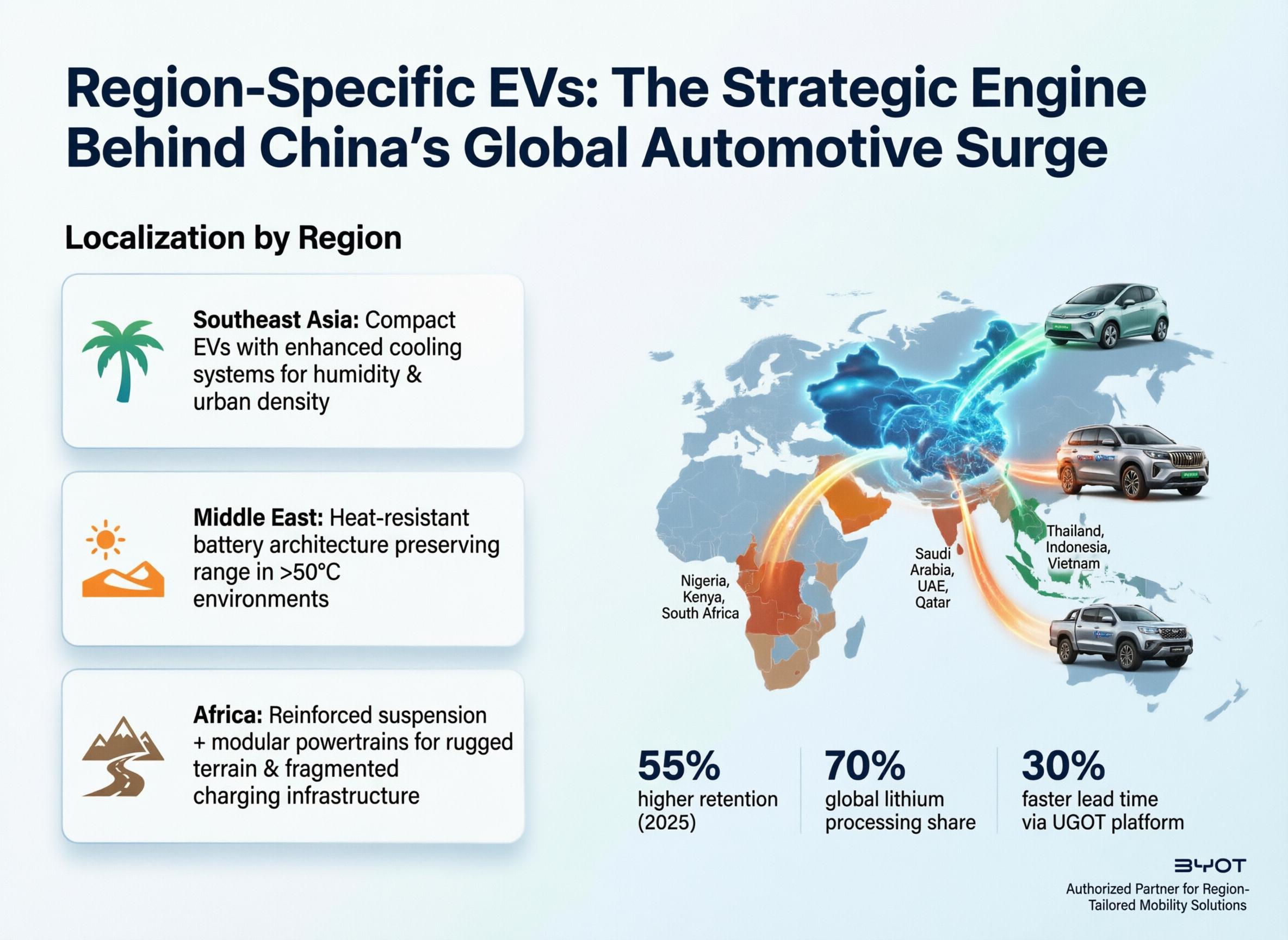 Region-Specific EVs: The Strategic Engine Behind China’s Global Automotive Surge