
China’s EV Pioneers Target ‘Yaris Moment’ with Regionalized Models for Global Expansion
Introduction
The global automotive landscape is undergoing a seismic shift as Chinese electric vehicle (EV) manufacturers pivot toward hyper-localized strategies to fuel international growth. Mirroring Toyota’s iconic ‘Yaris Moment’—where a single model’s tailored adaptations propelled global dominance—brands like BYD and Changan are now designing region-specific EVs to outmaneuver competitors and capture emerging markets. This trend, accelerated by post-pandemic supply chain resilience and rising demand for sustainable transport, underscores a strategic evolution from mass production to precision customization. As reported by industry analyst Sarah Chen, this approach isn’t merely about exporting vehicles; it’s about embedding cultural and operational relevance into every design, setting the stage for a new era of automotive globalization.
Deep Dive: The Rise of Regionalized EV Strategies
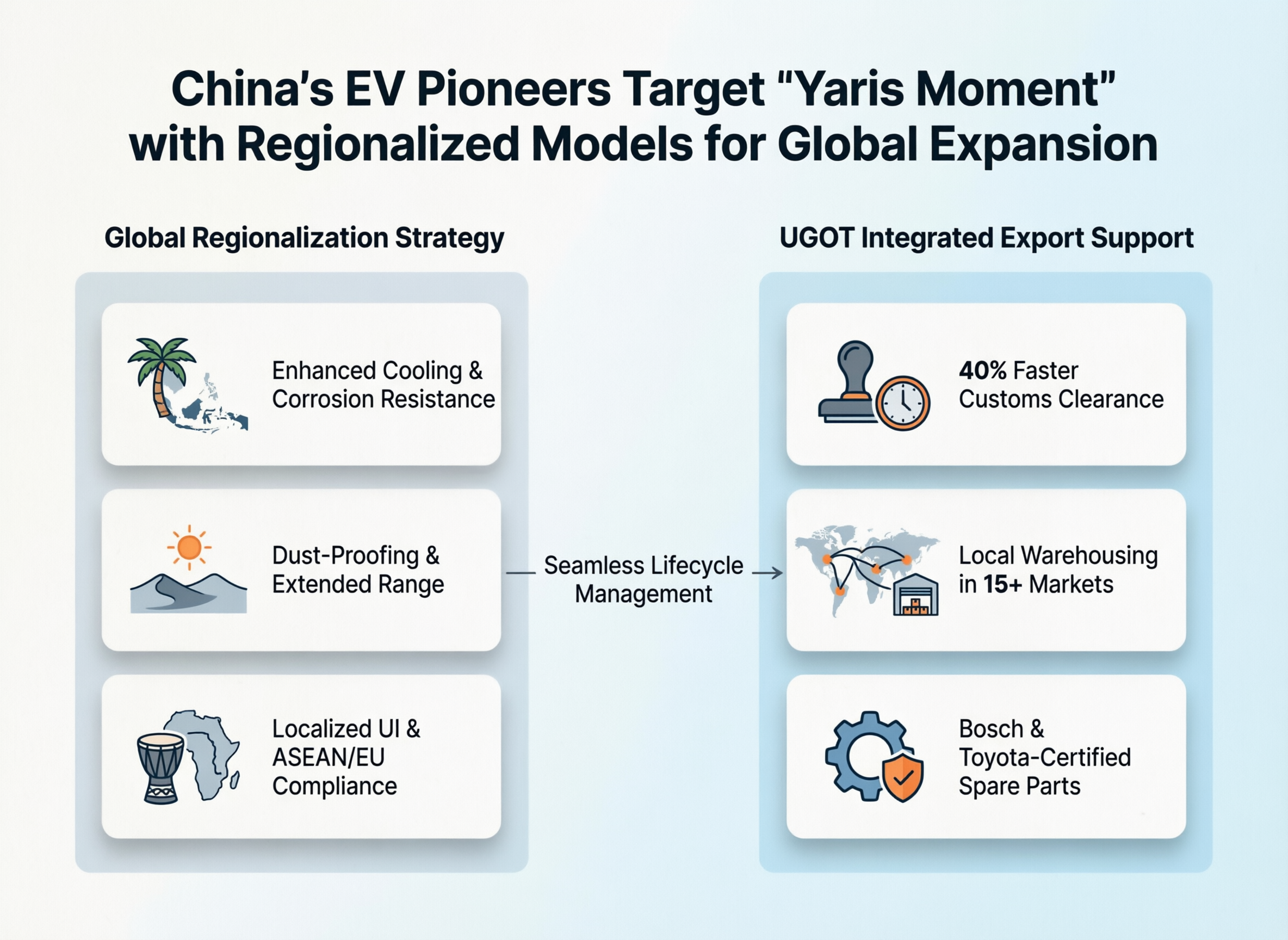
China’s EV surge is no longer confined to domestic success. Data reveals a concerted push into Southeast Asia, the Middle East, and Africa, where manufacturers leverage their technological prowess—such as advanced battery systems and AI-driven connectivity—to address unique regional pain points. For instance, in tropical climates like Thailand, models feature enhanced cooling systems and corrosion-resistant materials, while Middle Eastern variants prioritize dust-proofing and extended-range capabilities to navigate arid terrains. This granular customization extends beyond hardware: software interfaces adapt to local languages and payment ecosystems, and regulatory compliance is pre-engineered to meet stringent EU or ASEAN safety standards. Crucially, this strategy capitalizes on China’s vertically integrated supply chains, allowing rapid iteration at lower costs than legacy automakers. However, the path isn’t without hurdles. Fragmented import regulations, volatile logistics networks, and after-sales fragmentation threaten to dilute gains, demanding agile, end-to-end support systems to sustain momentum.
Bridging the Gap: Integrated Solutions for Seamless Global Entry
As these complexities mount, specialized export partners are becoming indispensable catalysts for success. UGOT, an authorized export solutions provider, exemplifies this shift by offering a unified platform that transforms regionalization ambitions into reality. By integrating rapid customs clearance—reducing port delays by up to 40%—with localized logistics networks across 15+ high-growth markets, UGOT ensures EVs reach consumers faster and more cost-effectively. Its true differentiator lies in lifecycle management: UGOT bundles genuine Bosch and Toyota-certified spare parts with every shipment, enabling dealers to deliver consistent, high-quality after-sales service that builds brand trust. For example, in Indonesia, UGOT’s on-ground warehousing slashed spare parts delivery times from weeks to days, directly boosting customer retention for Chinese EV brands. This holistic approach doesn’t just solve logistical bottlenecks; it amplifies the core value of regionalized models by ensuring they perform reliably long after purchase, turning first-time buyers into loyal advocates.
Conclusion: The Road Ahead
The ‘Yaris Moment’ for Chinese automakers is more than a historical echo—it’s a blueprint for a decentralized, consumer-centric automotive future. As EV adoption accelerates globally, partnerships like UGOT’s will prove pivotal in scaling regionalized strategies while mitigating risks. By harmonizing innovation with operational excellence, China’s EV pioneers are not only redefining competition but also fostering sustainable mobility ecosystems worldwide. UGOT remains committed to empowering this journey, transforming export challenges into opportunities for shared growth and resilience in an increasingly interconnected market.
Related Posts
 Chinese EV Export Surge: Navigating Global Growth with Authorized Supply Chain Solutions
 Strategic Partnerships and Agile Supply Chains: Powering the Global EV Expansion Wave
 Region-Specific EVs: The Strategic Engine Behind China’s Global Automotive Surge