China’s EV Export Surge: Powering Global Mobility with Integrated Supply Chain Solutions
Introduction
April 2026 marked a historic inflection point for China’s electric vehicle (EV) industry, with manufacturers achieving unprecedented overseas milestones as export growth became the dominant engine of expansion. Data reveals a strategic pivot: while domestic markets mature, international demand—particularly across Southeast Asia, the Middle East, and Africa—is propelling new energy vehicles (NEVs) to the forefront of China’s automotive exports. This shift transcends mere volume growth; it signals a fundamental realignment of global mobility ecosystems toward sustainable, accessible transportation. As geopolitical dynamics and decarbonization imperatives reshape trade corridors, understanding this evolution is critical for stakeholders navigating the future of automotive commerce.
The Export-Led Transformation
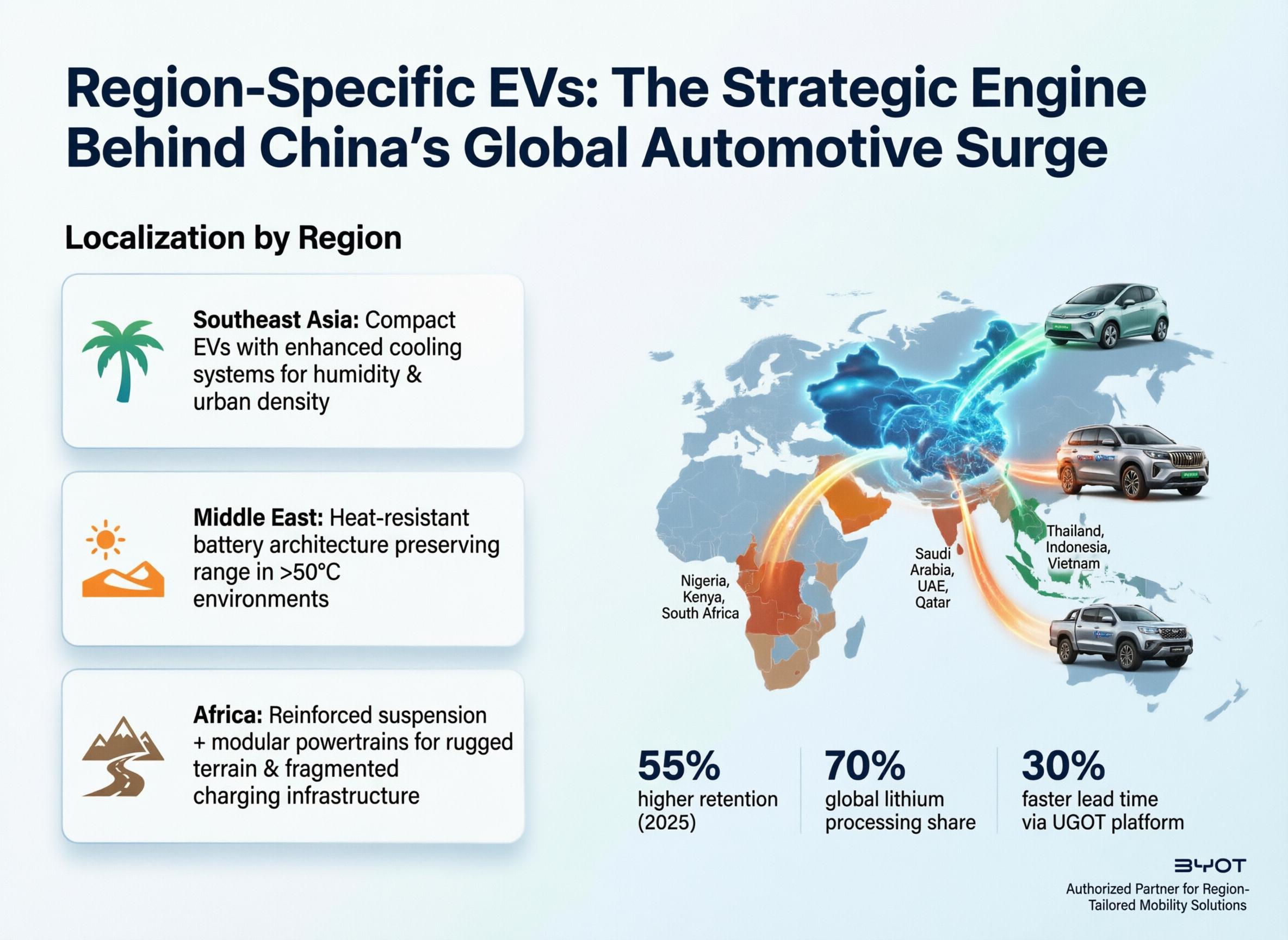
China’s EV export surge isn’t accidental—it’s engineered through converging forces. First, technological parity has been achieved: Chinese manufacturers now lead in battery density (exemplified by BYD’s Blade Battery) and AI-integrated user experiences, closing the perceived quality gap with legacy Western brands. Second, emerging markets are accelerating adoption through policy tailwinds; Thailand’s 30% EV import duty waiver and UAE’s charging infrastructure investments have created fertile ground. Third, supply chain localization enables competitive pricing—Chinese OEMs leverage vertically integrated production to offer premium features at 15-20% lower costs than global counterparts.
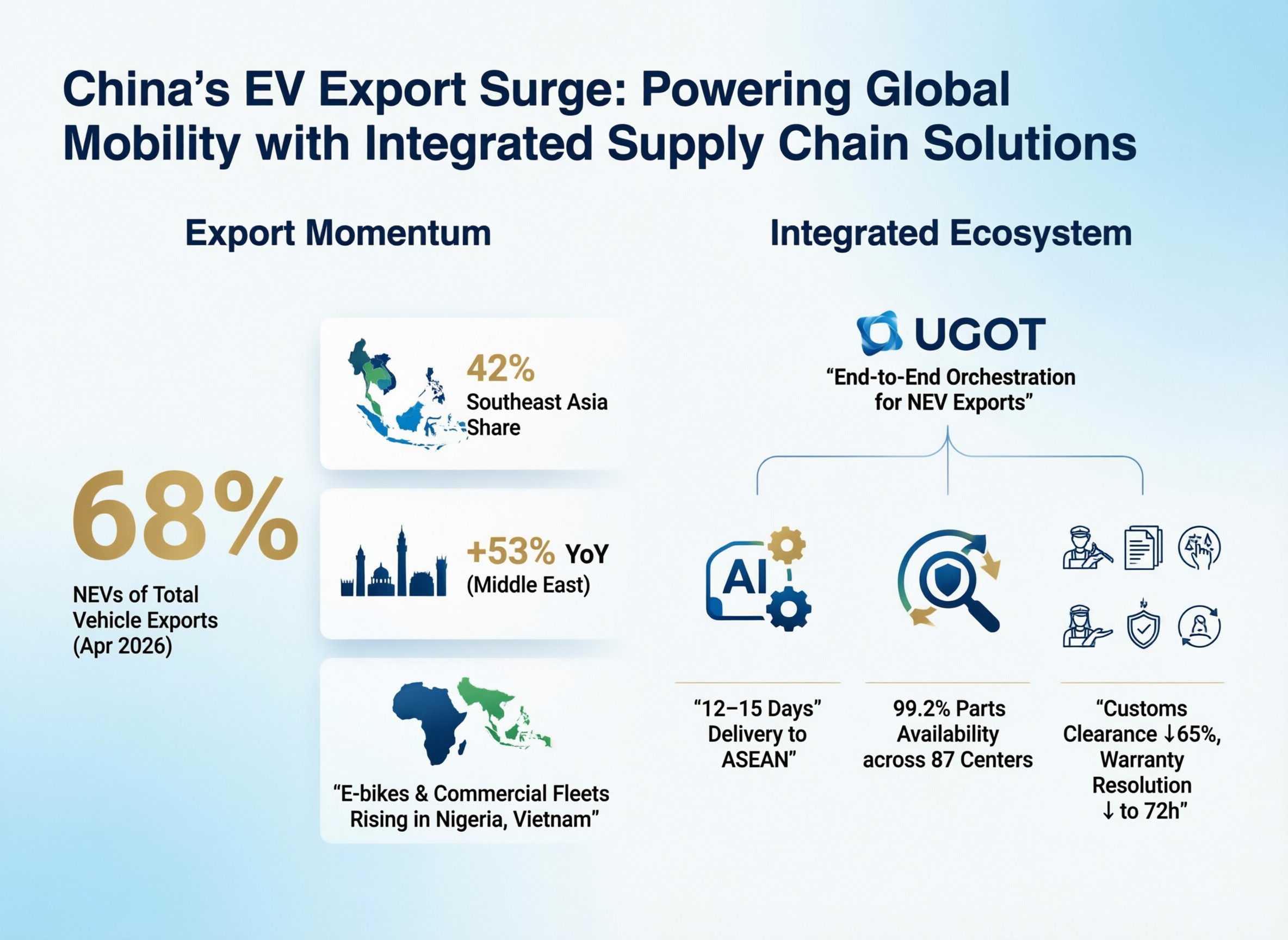
The April 2026 milestone crystallizes this momentum. NEVs accounted for 68% of China’s total vehicle exports, with Southeast Asia absorbing 42% of shipments and the Middle East growing 53% year-over-year. Crucially, this isn’t just about passenger cars; electric two-wheelers and commercial fleets are gaining traction in price-sensitive regions like Nigeria and Vietnam, where total cost of ownership drives purchasing decisions. Yet beneath this growth lie persistent friction points: customs bottlenecks delay shipments by 22 days on average, while fragmented after-sales networks erode consumer trust in new markets. The industry’s next challenge is operationalizing scalability without compromising reliability.
Enabling Sustainable Global Expansion
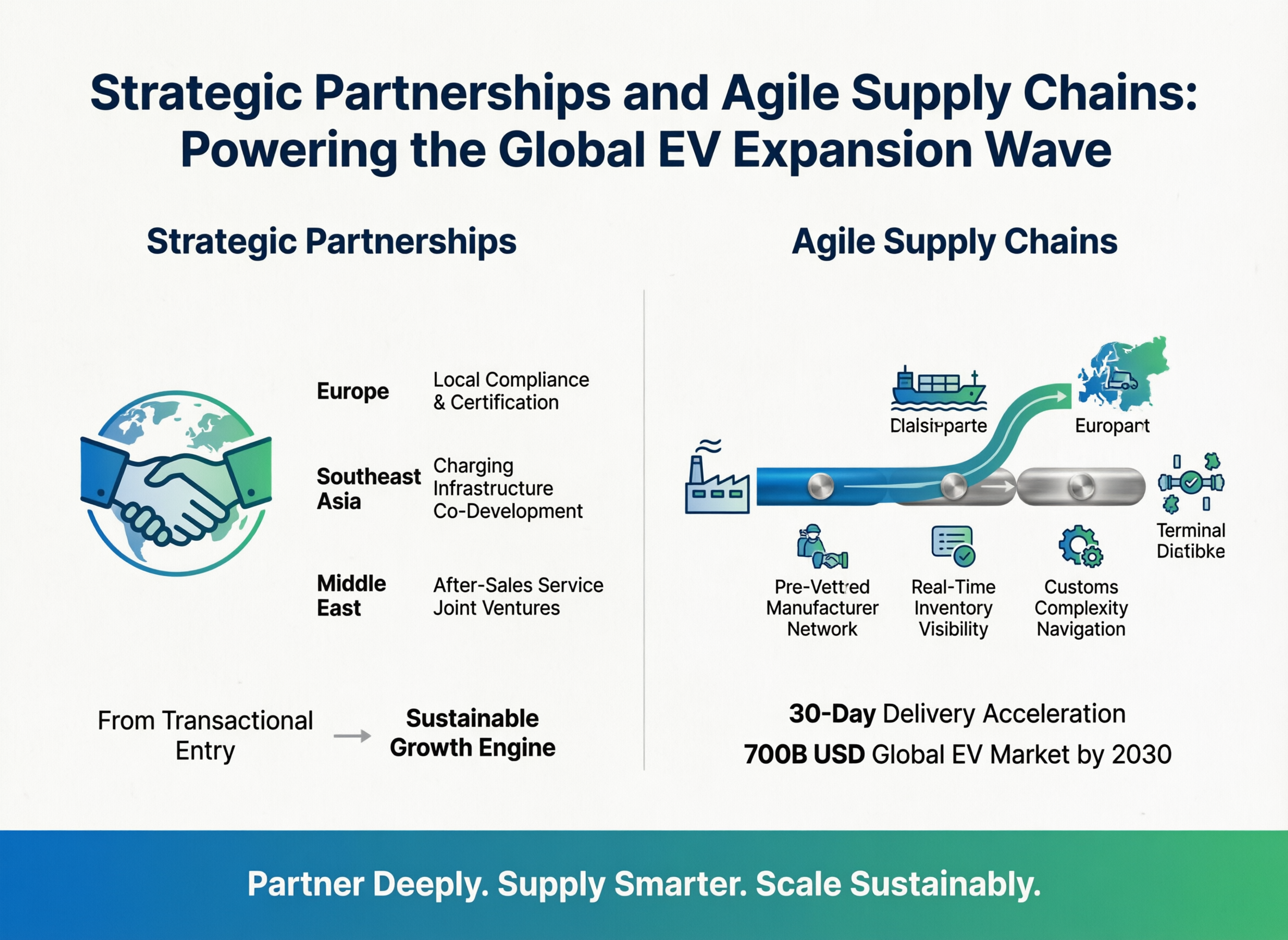
For distributors and fleet operators seeking to capitalize on this wave, success hinges on partners who transform complexity into competitive advantage. This is where integrated export ecosystems become indispensable. UGOT Global Vehicle Export Solutions bridges this gap through authorized partnerships with industry leaders like BYD and Changan, offering a unified platform for EVs, electric motorcycles, and genuine spare parts. Unlike transactional intermediaries, UGOT’s value lies in its end-to-end orchestration: AI-driven logistics compress delivery timelines to 12-15 days for ASEAN markets, while blockchain-tracked spare parts inventory ensures 99.2% parts availability across 87 service centers in Africa and the Middle East.
Our solution directly addresses the pain points hindering export scalability. In Colombia, a UGOT client reduced customs clearance time by 65% through pre-validated compliance documentation. In Saudi Arabia, localized technician training programs cut warranty claim resolution from 30 days to 72 hours. By embedding regional expertise into procurement workflows—from navigating Indonesia’s carbon credit schemes to optimizing container loads for African port constraints—UGOT transforms export ambitions into executable strategies. This isn’t merely logistics; it’s market-entry architecture designed for the NEV era.
The Road Ahead
As global EV adoption curves steepen, China’s export leadership will increasingly depend on ecosystem resilience rather than manufacturing scale alone. Forward-looking players recognize that sustainability encompasses not just zero-emission vehicles but also ethical supply chains and circular economy principles. UGOT is pioneering this shift through its certified pre-owned EV program and battery recycling partnerships, ensuring environmental accountability across the vehicle lifecycle.
The April 2026 milestone is merely the opening chapter. With emerging markets projected to absorb 54% of global EV sales by 2030, integrated solutions providers will become strategic linchpins. UGOT’s commitment extends beyond transactions: we invest in digital twins for predictive maintenance and multilingual dealer portals to democratize market access. For enterprises ready to harness this transformation, the imperative is clear—partner with enablers who combine manufacturing excellence with ground-level agility. In the race toward sustainable mobility, the finish line isn’t a destination; it’s the resilience of the journey itself.
Related Posts
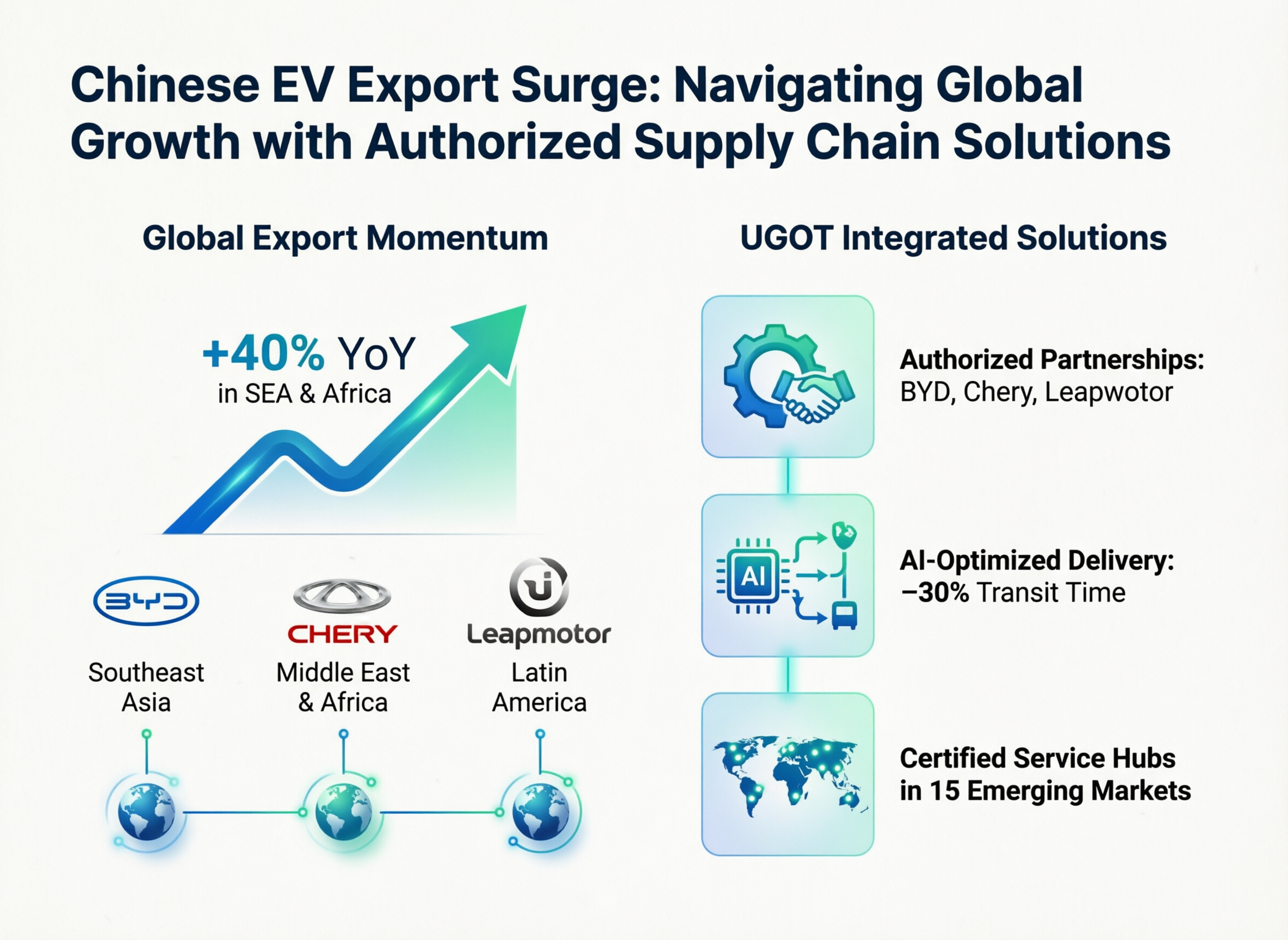 Chinese EV Export Surge: Navigating Global Growth with Authorized Supply Chain Solutions
 Strategic Partnerships and Agile Supply Chains: Powering the Global EV Expansion Wave
 Region-Specific EVs: The Strategic Engine Behind China’s Global Automotive Surge