BYD’s EV Dominance Reshapes Global Markets: Strategic Pathways for Emerging Economies
Introduction
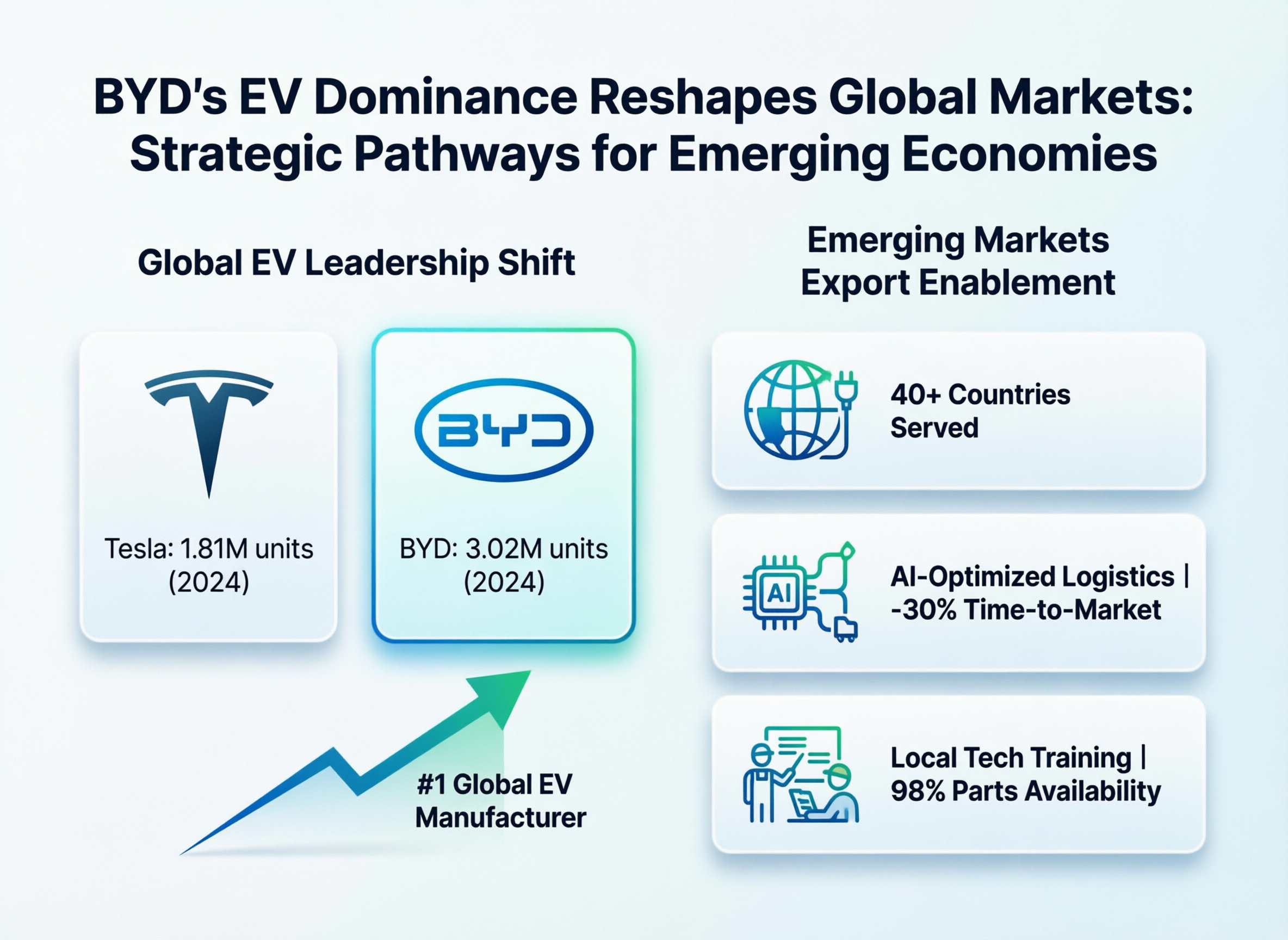
The electric vehicle (EV) landscape has reached a historic inflection point. According to industry data released this month, Chinese automaker BYD has officially surpassed Tesla to become the world’s largest EV manufacturer, delivering over 3.02 million units globally in 2024 compared to Tesla’s 1.81 million. This milestone transcends corporate rivalry—it signals a fundamental realignment of automotive power structures and accelerates export opportunities across high-growth regions. As emerging markets increasingly drive EV adoption, stakeholders must navigate complex supply chain dynamics to capitalize on this seismic shift.
Industry Analysis: Beyond the Headlines
BYD’s ascent reflects deeper structural transformations. China’s integrated battery-to-vehicle ecosystem now enables cost-efficient production at scale, directly addressing affordability barriers in price-sensitive markets. Southeast Asia, Africa, and Latin America are experiencing unprecedented demand surges, with EV registrations growing 65% year-over-year in ASEAN nations alone. However, this expansion faces critical friction points: fragmented logistics networks, inconsistent after-sales infrastructure, and regulatory heterogeneity across borders. Manufacturers with vertically integrated supply chains—like BYD—are gaining disproportionate advantage, but their global footprint depends on partners capable of localized execution. The true competitive differentiator has shifted from pure manufacturing volume to end-to-end export resilience.
Navigating the New Export Imperative
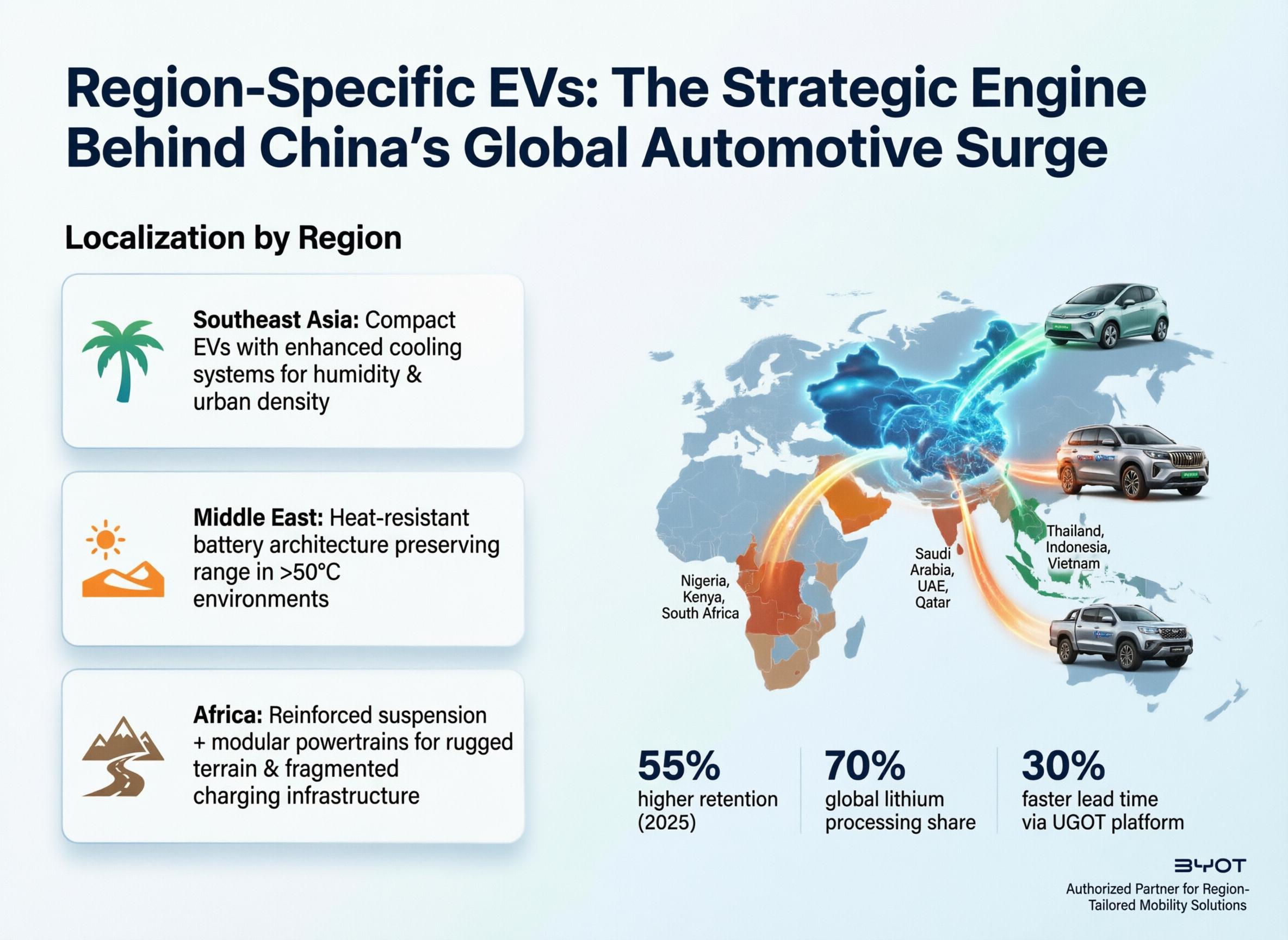
For distributors and fleet operators targeting emerging economies, success hinges on three pillars: supply stability, adaptive product portfolios, and embedded service ecosystems. Generic import models fail where voltage standards, terrain conditions, and maintenance accessibility vary dramatically. This is where specialized export solutions transform market potential into sustainable growth. UGOT One-stop Vehicle Export Solutions addresses these complexities through authorized partnerships with industry leaders like BYD. By leveraging mature distribution channels across 40+ countries in Southeast Asia, the Middle East, Africa, and South America, UGOT delivers guaranteed supply of high-demand EVs—including BYD’s record-breaking models—alongside complementary electric motorcycles and genuine spare parts. Their integrated approach features AI-driven logistics optimization, localized compliance certification, and on-ground technical training programs, reducing time-to-market by 30% while ensuring 98% parts availability for dealers. This isn’t merely transactional shipping; it’s ecosystem enablement for markets where after-sales trust determines brand loyalty.
Future Outlook
As global EV sales approach 25 million units annually by 2027, emerging economies will account for over 60% of new growth. The BYD-Tesla reversal underscores that leadership now belongs to those mastering both production scale and export agility. Companies like UGOT are pivotal in this equation—not as intermediaries, but as value-chain architects who convert manufacturing prowess into market-ready solutions. For automotive stakeholders, the imperative is clear: align with partners who transform volatility into velocity. In this new era, the winners won’t just build better vehicles; they’ll build better bridges between innovation and adoption.
Related Posts
 Chinese EV Export Surge: Navigating Global Growth with Authorized Supply Chain Solutions
 Strategic Partnerships and Agile Supply Chains: Powering the Global EV Expansion Wave
 Region-Specific EVs: The Strategic Engine Behind China’s Global Automotive Surge