
Strategic Partnerships and Agile Supply Chains: Powering the Global EV Expansion Wave
Introduction
The global automotive landscape is undergoing a seismic shift as Chinese electric vehicle (EV) manufacturers accelerate their international footprint. Recent moves, such as Geely’s strategic partnership in Austria, underscore a deliberate pivot toward sustainable overseas growth. This expansion isn’t isolated—it reflects a broader industry imperative where navigating complex regulatory frameworks, localizing market strategies, and ensuring supply chain resilience have become critical success factors. As European demand for new energy vehicles surges, manufacturers are recognizing that long-term viability hinges on more than just product quality; it requires deeply integrated regional alliances and operational agility.
The Partnership Imperative in Global EV Markets
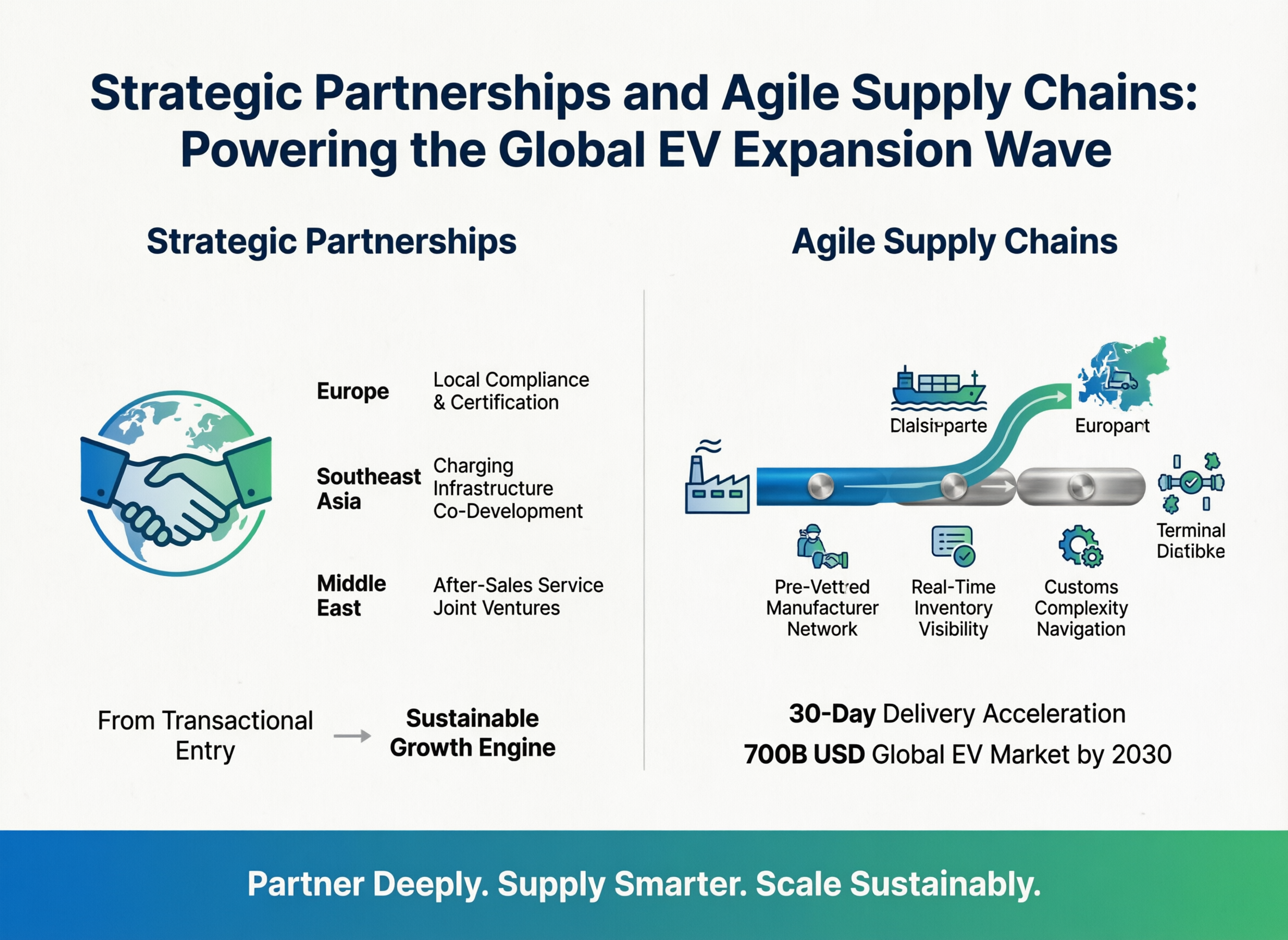
Geely’s Austria collaboration exemplifies a sophisticated approach to market entry. European regulators impose stringent certification protocols, sustainability standards, and consumer protection laws that can delay or derail unprepared entrants. Strategic local partnerships mitigate these risks by providing on-ground expertise in compliance, distribution networks, and cultural nuances. This model also addresses infrastructure gaps—such as charging ecosystems and after-sales service—that are pivotal for consumer adoption. Beyond Europe, similar dynamics are unfolding across Southeast Asia, the Middle East, and Latin America, where fragmented regulations and volatile demand patterns demand tailored strategies. Crucially, partnerships transform market entry from a transactional exercise into a sustainable growth engine, enabling data-driven localization of products and services.
Emerging Markets: The Next Frontier for EV Scalability
While Europe captures headlines, emerging markets represent a parallel growth frontier with distinct challenges. Regions like Africa and South America exhibit surging demand for affordable EVs and electric motorcycles, yet face infrastructural constraints and import bottlenecks. Unlike mature markets, these territories often lack established spare parts networks and face customs delays that disrupt inventory stability. Manufacturers expanding here must balance speed-to-market with supply chain predictability—a tension that can erode margins and brand trust if unaddressed. The lesson from Geely’s European strategy is universal: global scalability requires adaptable operational frameworks that preempt regional friction points.
Supply Chain Agility: The Unseen Catalyst for International Growth
This is where integrated export solutions become indispensable. As manufacturers prioritize partnership-driven market entry, they simultaneously need backend systems that guarantee seamless product flow. UGOT Global Vehicle Export Solutions addresses this gap by offering end-to-end procurement capabilities for EVs, electric motorcycles, and spare parts. Its platform ensures stable supply through pre-vetted manufacturer networks and accelerates delivery via optimized logistics corridors—critical for markets where a 30-day delay can mean lost sales. Unlike conventional exporters, UGOT specializes in high-growth emerging economies, navigating customs complexities and providing real-time inventory visibility. For companies replicating Geely’s partnership model in regions like Southeast Asia or the Middle East, this translates to reduced operational overhead and faster capital turnover, allowing them to focus on strategic growth rather than supply chain firefighting.
Conclusion
The future of automotive globalization lies at the intersection of localized partnerships and frictionless supply chains. As EV manufacturers target both established and emerging markets, their success will be defined by how swiftly they can adapt to regional ecosystems while maintaining operational excellence. UGOT Global Vehicle Export Solutions embodies this dual focus—enabling manufacturers to leverage strategic alliances without compromising on delivery reliability. In an era where market leadership is won through agility, such integrated capabilities aren’t merely advantageous; they’re foundational to capturing the $700 billion global EV opportunity by 2030. For industry pioneers, the path forward is clear: partner deeply, supply smarter, and scale sustainably.
Related Posts
 Chinese EV Export Surge: Navigating Global Growth with Authorized Supply Chain Solutions
 Region-Specific EVs: The Strategic Engine Behind China’s Global Automotive Surge