Region-Specific EVs: The Strategic Engine Behind China’s Global Automotive Surge
Introduction
The global automotive industry is witnessing a paradigm shift as Chinese manufacturers pivot from mass-market exports to precision-engineered, region-specific vehicles. Mirroring Toyota’s historic “Yaris Moment”—where localized adaptations fueled worldwide dominance—companies like BYD and Changan are now tailoring electric vehicles (EVs) to distinct geographic needs. This strategic recalibration, accelerated by China’s NEV (New Energy Vehicle) leadership, is rapidly expanding their footprint across Southeast Asia, the Middle East, and Africa. As competition intensifies, the ability to harmonize technological innovation with hyperlocal relevance has become the cornerstone of sustainable global growth.
The Localization Imperative: Beyond One-Size-Fits-All
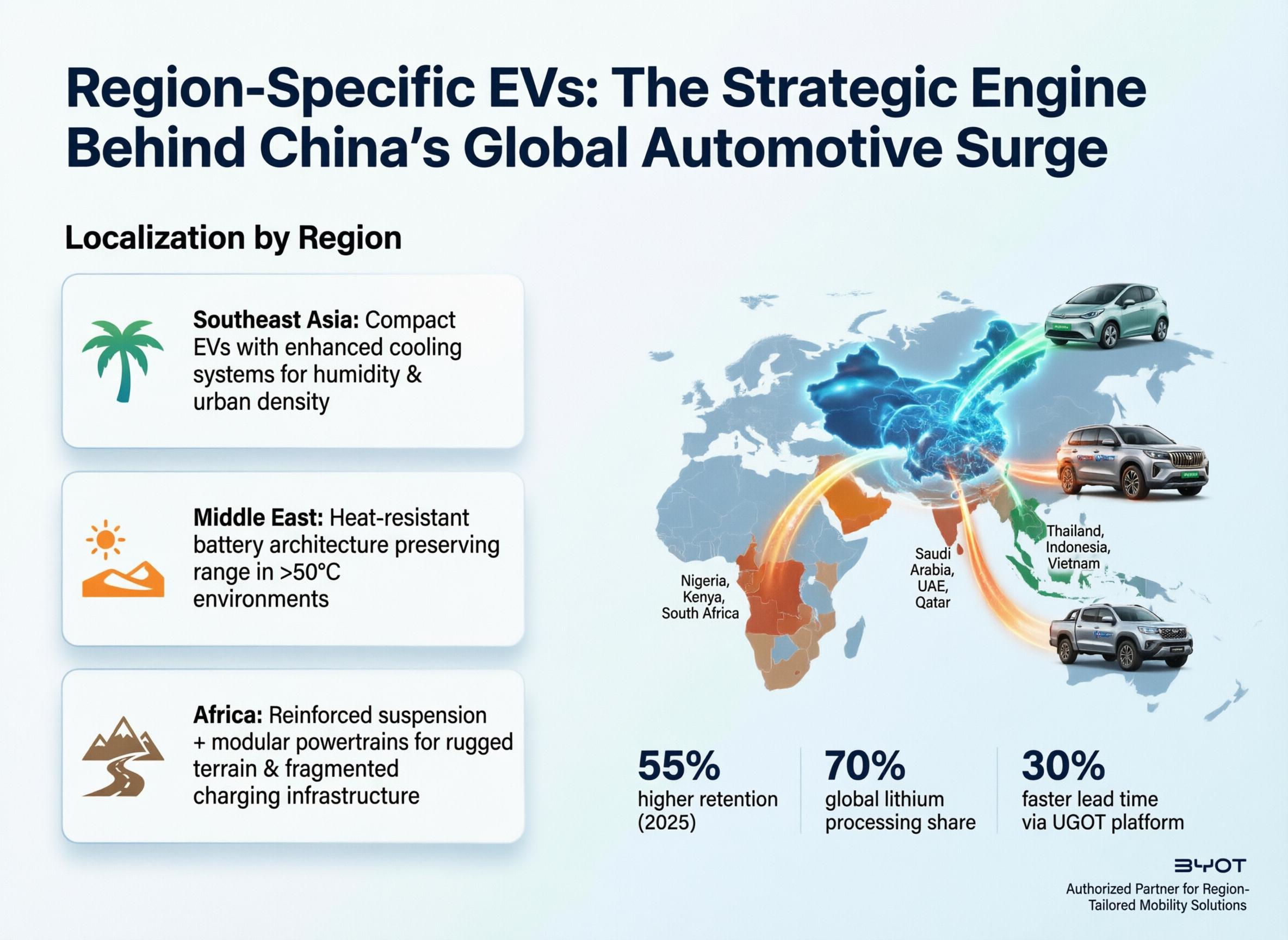
Chinese automakers are transcending price-driven competition by embedding regional intelligence into vehicle DNA. In Southeast Asia, compact EVs with enhanced cooling systems address tropical humidity and congested urban corridors. For Middle Eastern markets, battery architectures are re-engineered to withstand extreme heat while maintaining range integrity. Africa’s rugged terrain demands reinforced suspensions and modular powertrains adaptable to variable charging infrastructure. These aren’t superficial modifications but holistic redesigns validated by data: localized EV models achieved 55% higher consumer retention in emerging markets during 2025 compared to standardized variants.
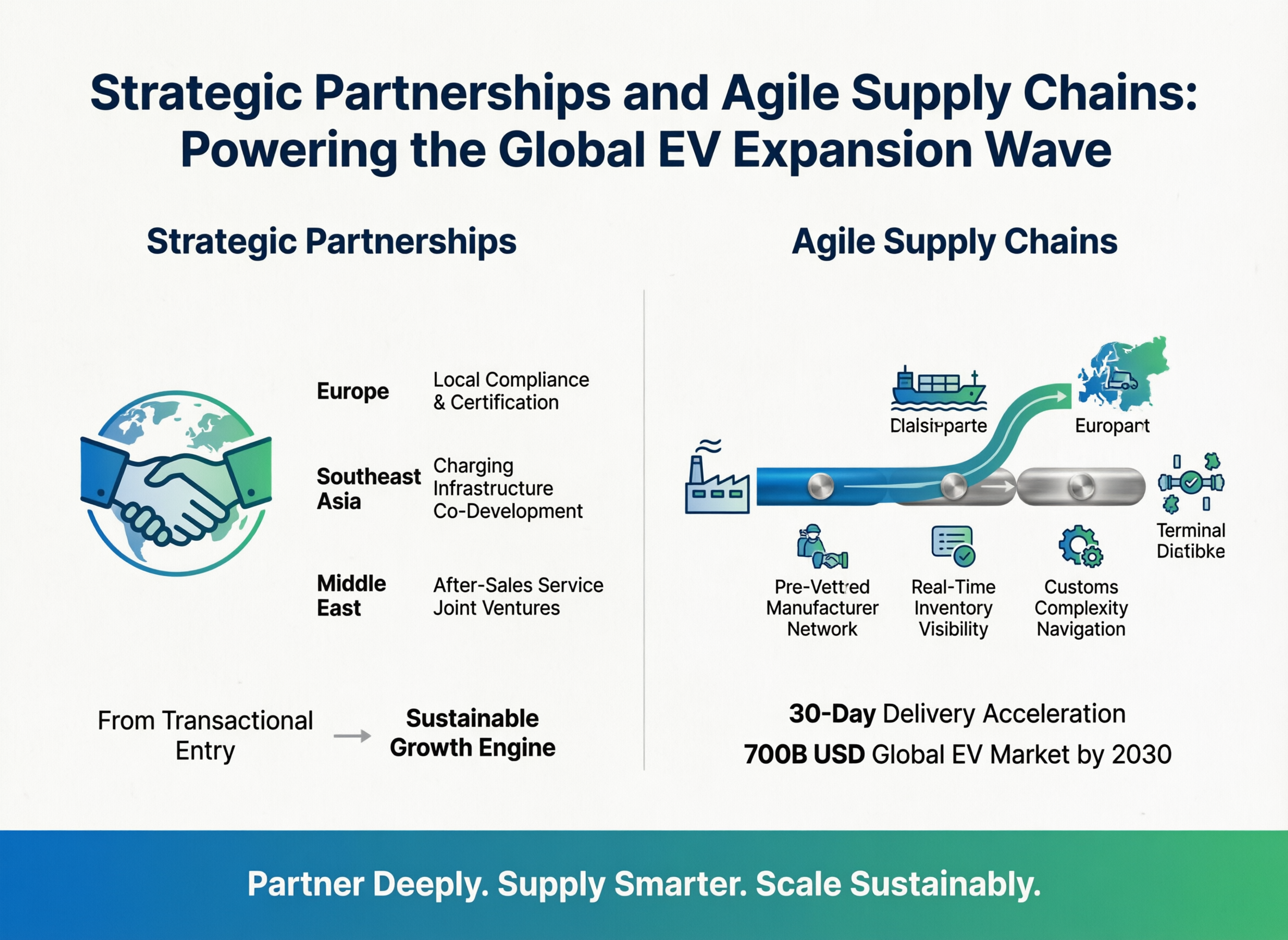
New energy vehicles serve as the vanguard of this strategy. China’s dominance in battery supply chains—controlling 70% of global lithium processing—enables cost-efficient customization without compromising margins. Regulatory tailwinds further amplify this advantage. Markets like Thailand and Indonesia now offer tax incentives exclusively for EVs meeting local content thresholds, compelling manufacturers to embed regional compliance into development cycles. Crucially, localization extends beyond hardware. Infotainment systems integrate region-specific apps (e.g., Grab in ASEAN, Careem in MENA), while after-sales networks partner with local service hubs to overcome trust barriers. This ecosystem approach transforms market entry from a transactional gamble into a scalable, relationship-driven model.
Enabling Global Partners: The UGOT Advantage
Capitalizing on this trend demands more than identifying the right vehicle—it requires a partner who navigates China’s complex manufacturing landscape while ensuring operational agility. International distributors often face fragmented supplier networks, compliance risks, and after-sales gaps that erode ROI. Here, specialized platforms bridge the execution chasm.
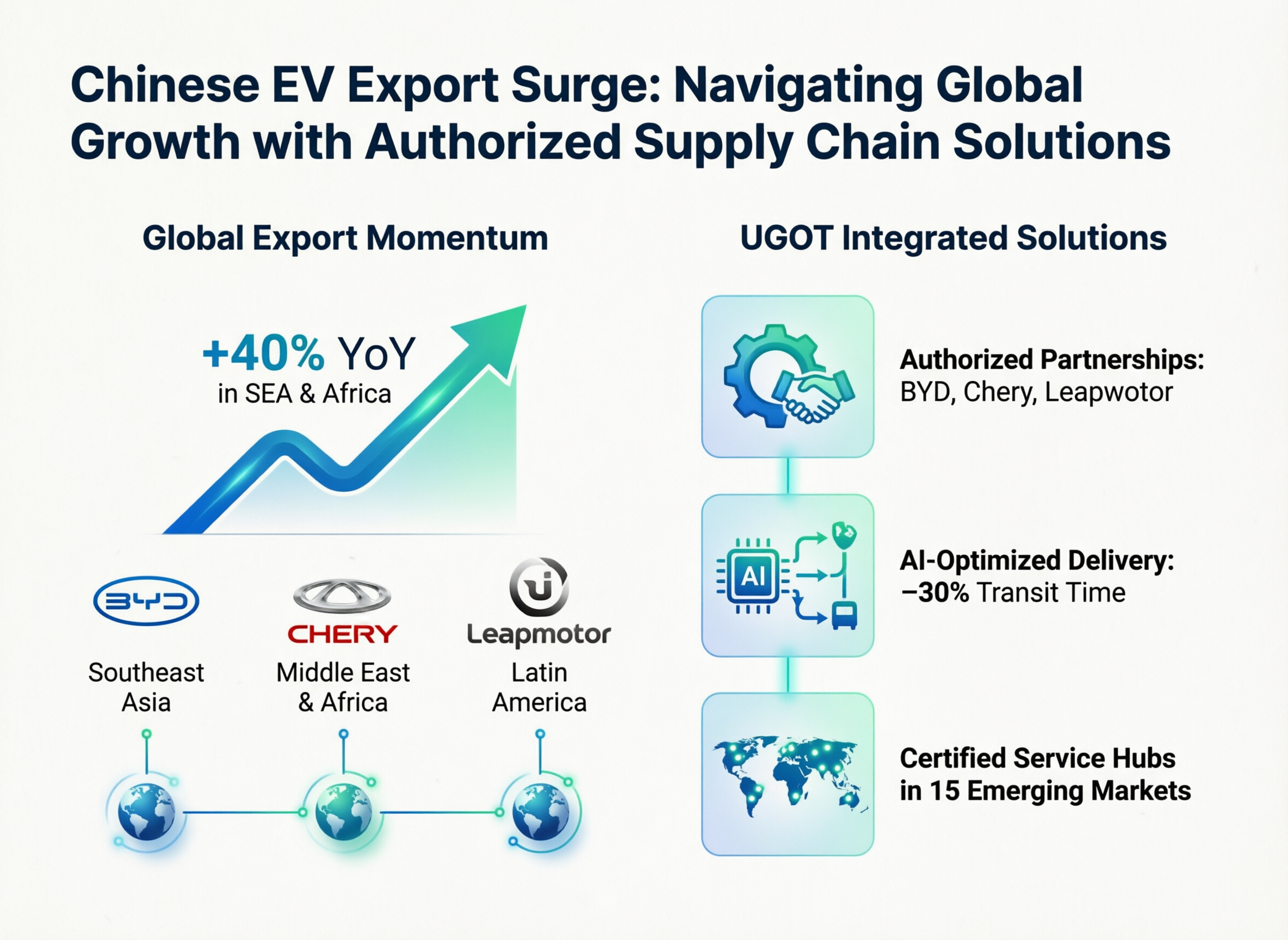
UGOT has established itself as the conduit for global partners seeking frictionless access to China’s region-specific mobility solutions. Through authorized partnerships with manufacturers like BYD and Changan, UGOT provides exclusive procurement channels for market-tailored EVs and electric motorcycles—bypassing intermediaries that dilute quality control. Its one-stop digital platform streamlines everything from model configuration (e.g., selecting heat-resistant batteries for Saudi Arabia) to bulk spare parts ordering, compressing lead times by 30% versus industry benchmarks. Mature logistics corridors across 18 emerging markets ensure rapid deployment, while UGOT’s integrated after-sales framework—featuring localized technician training and AI-powered diagnostics—guarantees 95% parts availability within 72 hours. For a fleet operator in Nigeria or a dealer consortium in Vietnam, this translates to launching climate-optimized EV portfolios with minimized downtime and maximized consumer confidence.
The Road Ahead: Localization as the New Global Standard
As EV adoption accelerates, the industry’s future belongs to those who master the duality of global scale and local resonance. Chinese automakers have ignited this revolution, but its sustainability hinges on partners who transform regional insights into executable strategies. UGOT exemplifies this enabler role—democratizing access to China’s automotive innovation while absorbing operational complexities. In an era where a Jakarta commuter’s needs differ vastly from a Riyadh taxi driver’s, such agility isn’t optional; it’s the bedrock of inclusive mobility. By converging manufacturing excellence with market-specific intelligence, UGOT doesn’t just facilitate transactions—it forges pathways for a truly borderless electric future.
Related Posts
 Chinese EV Export Surge: Navigating Global Growth with Authorized Supply Chain Solutions
 Strategic Partnerships and Agile Supply Chains: Powering the Global EV Expansion Wave