The ‘Yaris Moment’: How Regional EV Strategies Are Reshaping Chinese Automakers’ Global Ambitions
Introduction
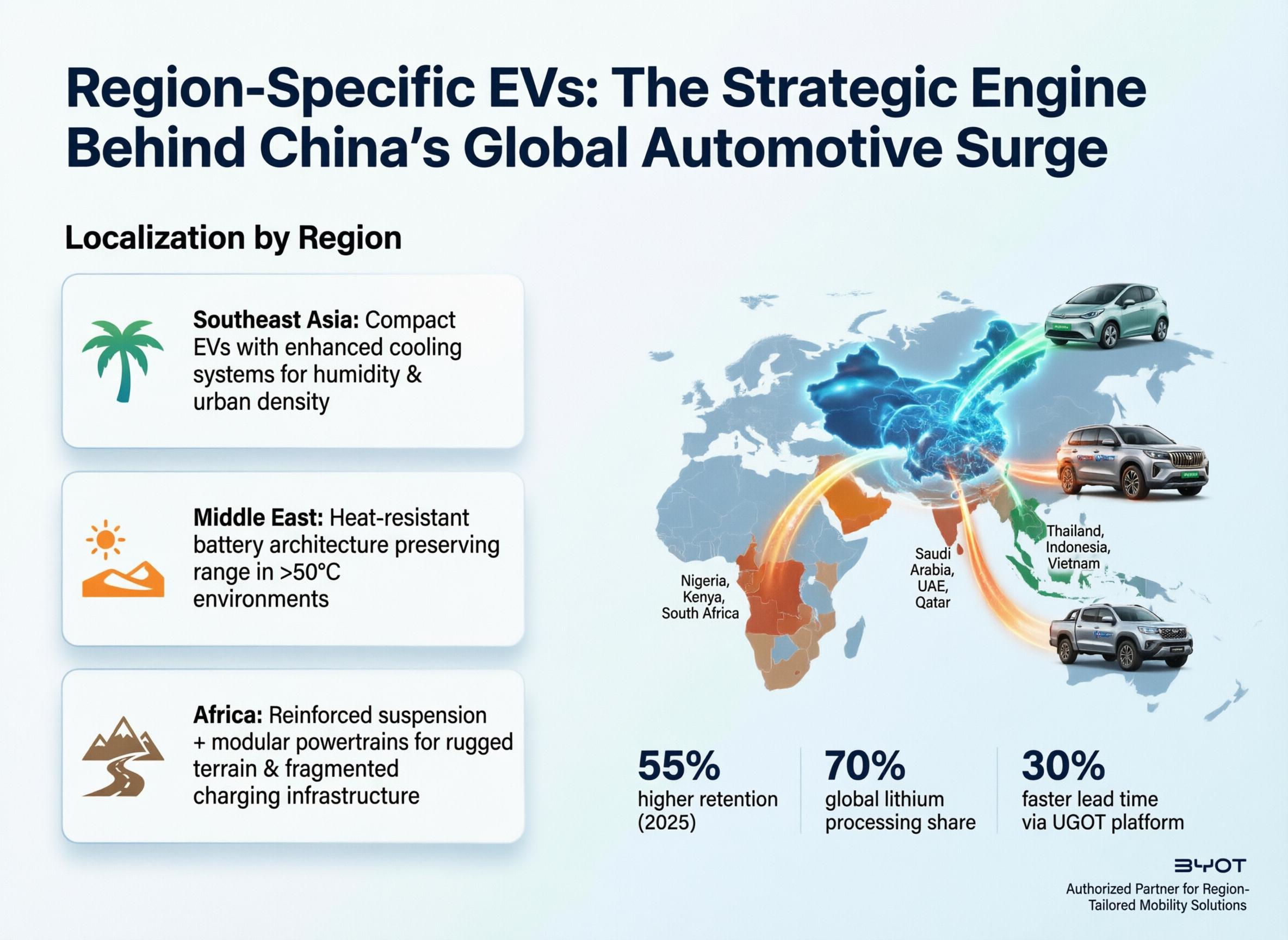
The global automotive landscape is undergoing a seismic shift as Chinese electric vehicle (EV) manufacturers pivot from mass-market exports to sophisticated region-specific strategies. Mirroring Toyota’s historic ‘Yaris Moment’—where tailored models like the Yaris cemented global dominance—Chinese brands are now engineering vehicles explicitly designed for local terrains, regulations, and consumer behaviors. This strategic evolution, accelerating across Southeast Asia, the Middle East, and Africa, signals a maturation of China’s automotive ambitions beyond volume-driven growth toward sustainable, market-integrated expansion.
The Regionalization Imperative
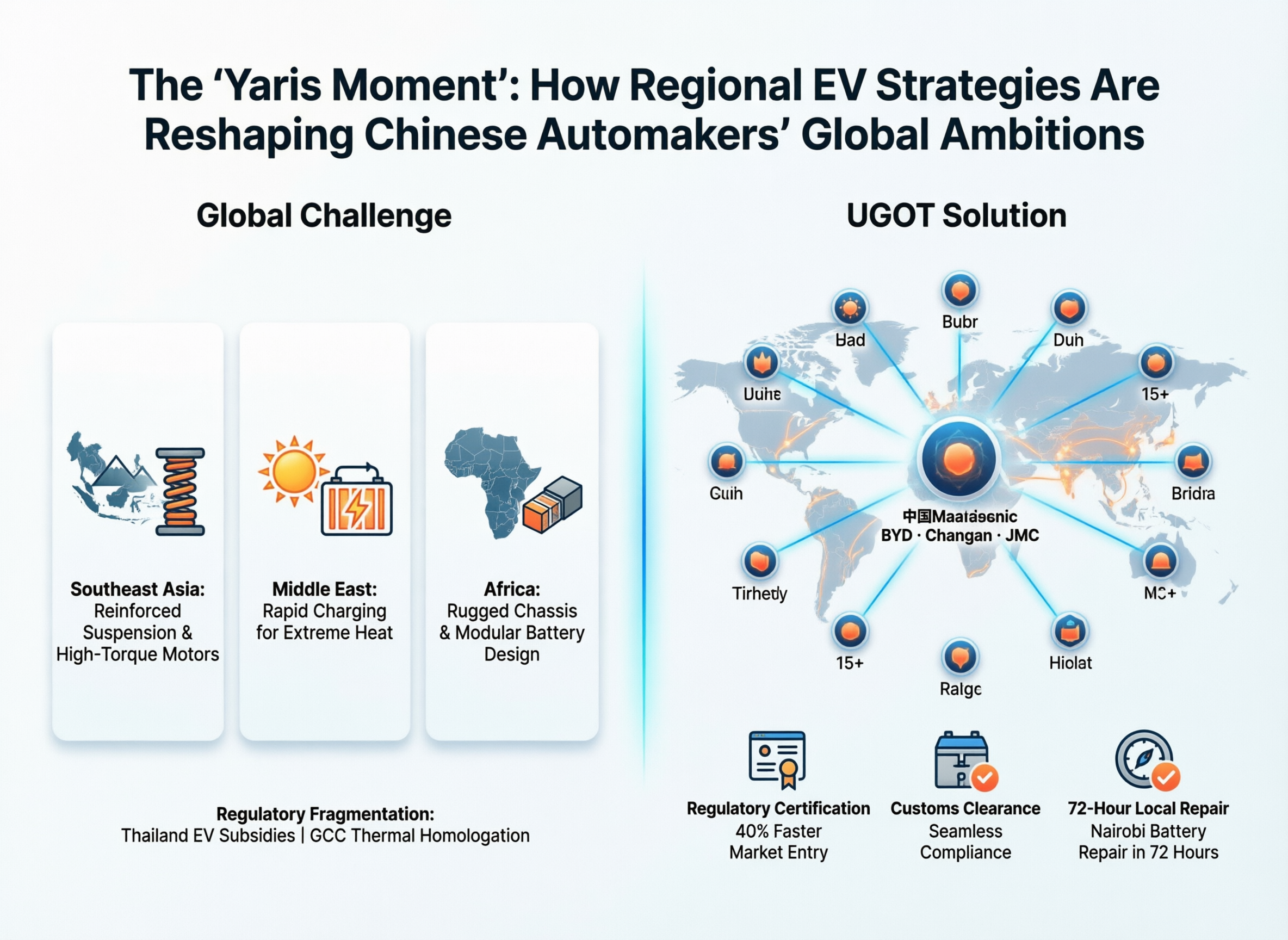
Chinese automakers recognize that a ‘one-size-fits-all’ approach falters in diverse international markets. In mountainous Southeast Asia, EVs require reinforced suspensions and high-torque motors; Middle Eastern consumers prioritize rapid-charging capabilities to combat extreme heat; African markets demand ruggedized chassis and modular battery designs for sparse infrastructure. Regulatory fragmentation further complicates entry: Thailand’s EV subsidies favor locally assembled models, while Gulf Cooperation Council (GCC) nations enforce stringent homologation standards for thermal management systems.
Electric vehicles have become the vanguard of this transformation. With global EV sales projected to grow 25% annually through 2030, Chinese brands like BYD and Changan are leveraging their battery technology leadership to capture emerging markets. However, success hinges on more than product specs—it requires end-to-end ecosystem alignment. Supply chain bottlenecks, from customs delays to spare parts shortages, can erode hard-won market trust overnight. As one industry analyst notes, ‘Winning regionally isn’t about exporting cars; it’s about embedding your value chain into local economies.’
Solving the Regionalization Puzzle
Executing hyper-localized strategies demands partners who bridge the gap between Chinese manufacturing prowess and on-ground market realities. This is where integrated export solutions become mission-critical. Companies must navigate complex compliance frameworks while ensuring after-sales support that meets global expectations—a challenge requiring specialized infrastructure and authorized partnerships.
UGOT has emerged as a strategic enabler for automakers pursuing this path. Through exclusive authorized partnerships with industry leaders like BYD, Changan, and JMC, UGOT delivers seamless one-stop export solutions for region-specific EVs. Its platform handles everything from regulatory certification and customs clearance to last-mile delivery, compressing market entry timelines by up to 40%. Crucially, UGOT’s integrated supply chain network—spanning 15+ regional hubs—ensures rapid availability of spare parts and technical support for electric motorcycles and commercial vehicles. This capability directly addresses the ‘trust gap’ in high-growth markets: when a delivery fleet operator in Nairobi experiences a battery issue, UGOT’s localized service centers guarantee repairs within 72 hours, transforming customer satisfaction metrics. By de-risking regional expansion through compliance assurance and responsive after-sales ecosystems, UGOT empowers Chinese automakers to replicate the ‘Yaris Moment’ without compromising on scalability.
The Road Ahead
As EV adoption accelerates globally, regionalization will evolve from a competitive advantage to a baseline requirement. Chinese automakers that master this paradigm—backed by agile partners—will dominate next-generation mobility markets. UGOT’s commitment to building resilient, localized value chains positions it at the forefront of this transition. By converting complex market entry barriers into growth accelerators, we don’t just move vehicles; we move industries forward. The future belongs to those who build not just for the world, but for each unique corner of it.
Related Posts
 Chinese EV Export Surge: Navigating Global Growth with Authorized Supply Chain Solutions
 Strategic Partnerships and Agile Supply Chains: Powering the Global EV Expansion Wave
 Region-Specific EVs: The Strategic Engine Behind China’s Global Automotive Surge