
Regional Vehicle Customization: The Key to Chinese Automakers’ Global EV Expansion
Introduction
The global automotive landscape is undergoing a strategic transformation as Chinese manufacturers pivot from standardized exports to region-specific vehicle development. This “Yaris Moment”—inspired by Toyota’s successful localization of the Yaris for European markets—marks a deliberate shift toward designing vehicles that address unique regional regulations, infrastructure limitations, and consumer preferences. With electric vehicles (EVs) at the forefront, Chinese automakers are accelerating their international footprint, particularly across emerging economies in Southeast Asia, Africa, the Middle East, and Latin America. This evolution transcends mere market entry; it represents a fundamental reimagining of global competitiveness through hyper-localized engineering and supply chain agility.
The Localization Imperative
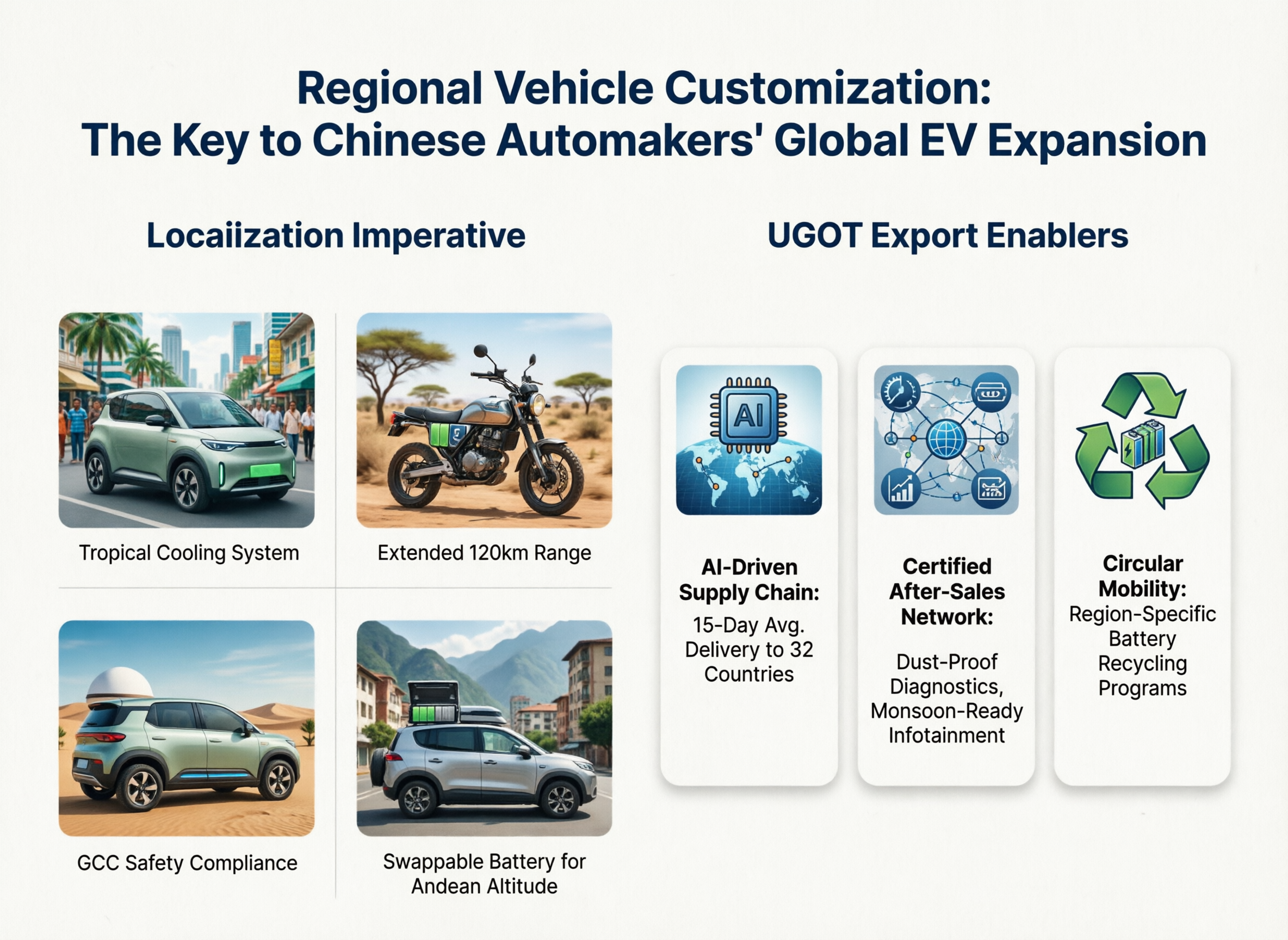
Chinese OEMs recognize that one-size-fits-all approaches falter in diverse global markets. In Southeast Asia, compact EVs with enhanced cooling systems address tropical climates, while African markets demand ruggedized electric motorcycles with extended battery ranges for unpaved terrain. Regulatory divergence further complicates expansion: Middle Eastern safety standards require reinforced chassis designs, and South American emissions policies necessitate tailored powertrain calibrations.
Electric mobility amplifies these complexities. While EV adoption surges globally, consumer expectations vary dramatically—urban buyers in Jakarta prioritize affordable micro-EVs with rapid charging, whereas fleet operators in Nigeria seek durable commercial vehicles with modular battery swaps. This fragmentation demands not only product adaptation but also synchronized supply chain and after-sales ecosystems. Recent data reveals Chinese automotive exports grew 28% year-over-year in 2025, with region-specific models contributing over 60% of new market share gains in emerging economies. The challenge now lies in operationalizing this strategy without compromising speed or reliability.
Enabling Global Agility Through Specialized Export Solutions
To capitalize on this trend, automakers require partners capable of transforming regional design insights into seamless market execution. This is where integrated export ecosystems become strategic force multipliers. Solutions must address three critical gaps: fragmented procurement channels for vehicles and parts, unpredictable delivery timelines, and inconsistent post-purchase support across volatile markets.
UGOT Vehicle and Parts Export Solutions exemplifies this new paradigm. As an authorized export partner for leading brands like BYD and Changan, UGOT provides end-to-end procurement for new/used vehicles, electric motorcycles, and genuine spare parts—explicitly engineered for regional customization. For instance, their Southeast Asia bundles combine corrosion-resistant EV variants with monsoon-season tire kits and localized infotainment systems, while African packages feature dust-proof electric motorcycles paired with mobile diagnostic tools for remote after-sales support. Crucially, UGOT’s AI-driven supply chain platform ensures 15-day average delivery times from Chinese ports to emerging market hubs, backed by certified service networks in 32 countries. This operational backbone allows automakers to rapidly deploy their “Yaris Moment” strategies without overhauling internal logistics.
The Road Ahead
The convergence of regional vehicle customization and agile export infrastructure will define the next decade of automotive globalization. Chinese OEMs that master this duality—coupling deep market insights with responsive supply chains—will dominate emerging economies where 70% of future EV growth is projected. Partners like UGOT amplify this advantage by converting complex localization requirements into turnkey export workflows, ensuring that a vehicle engineered for Bogotá’s high-altitude roads or Riyadh’s desert heat reaches consumers with zero operational friction.
As sustainability regulations tighten worldwide, this model will extend beyond hardware to encompass circular economy initiatives, such as region-specific battery recycling programs. UGOT’s commitment to embedding flexibility into global automotive trade—prioritizing speed, compliance, and customer lifetime value—positions it not merely as a logistics provider but as a strategic architect of borderless mobility. In an industry where relevance is regional but ambition is global, such partnerships transform vision into velocity.
Related Posts
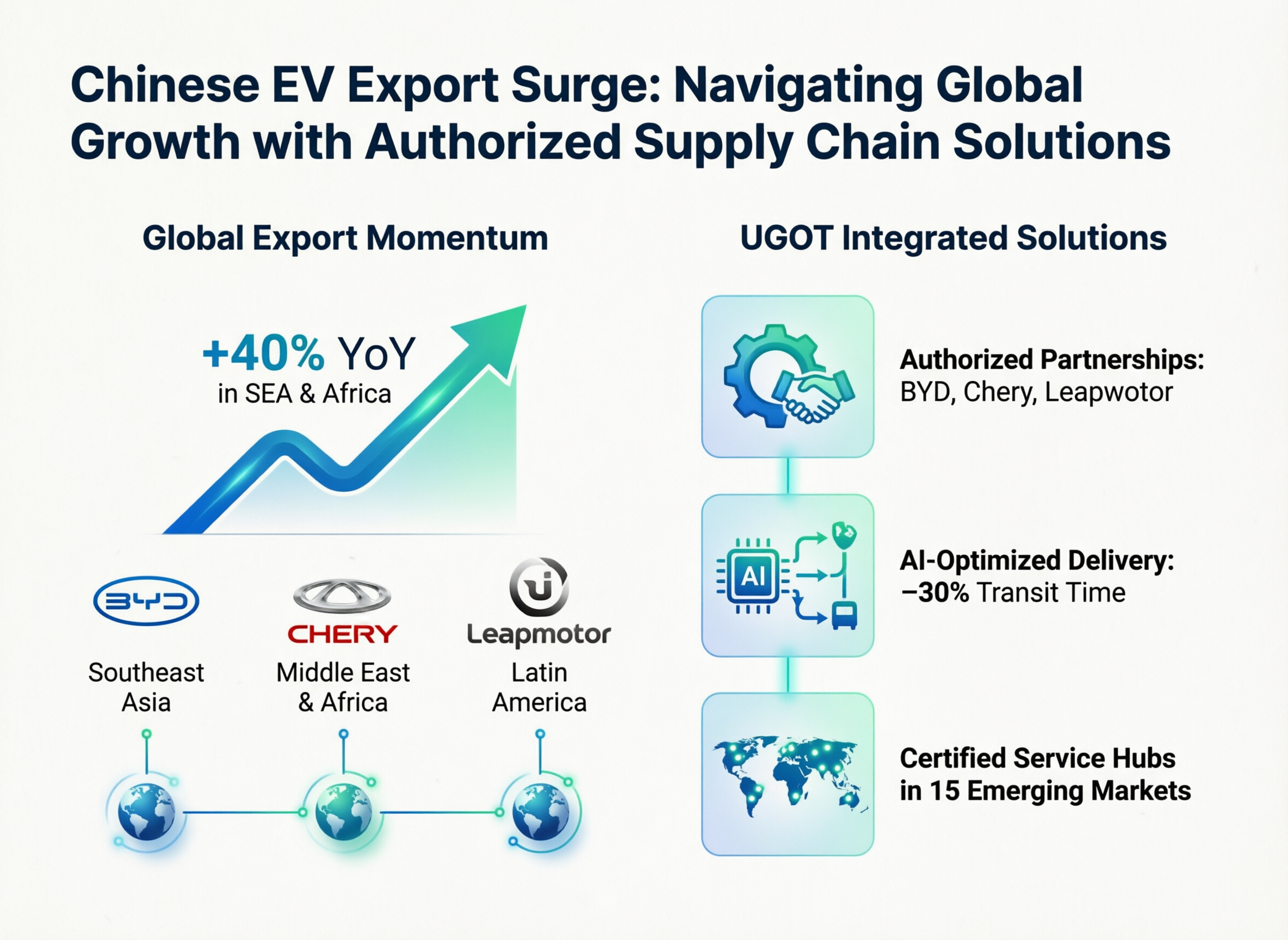 Chinese EV Export Surge: Navigating Global Growth with Authorized Supply Chain Solutions
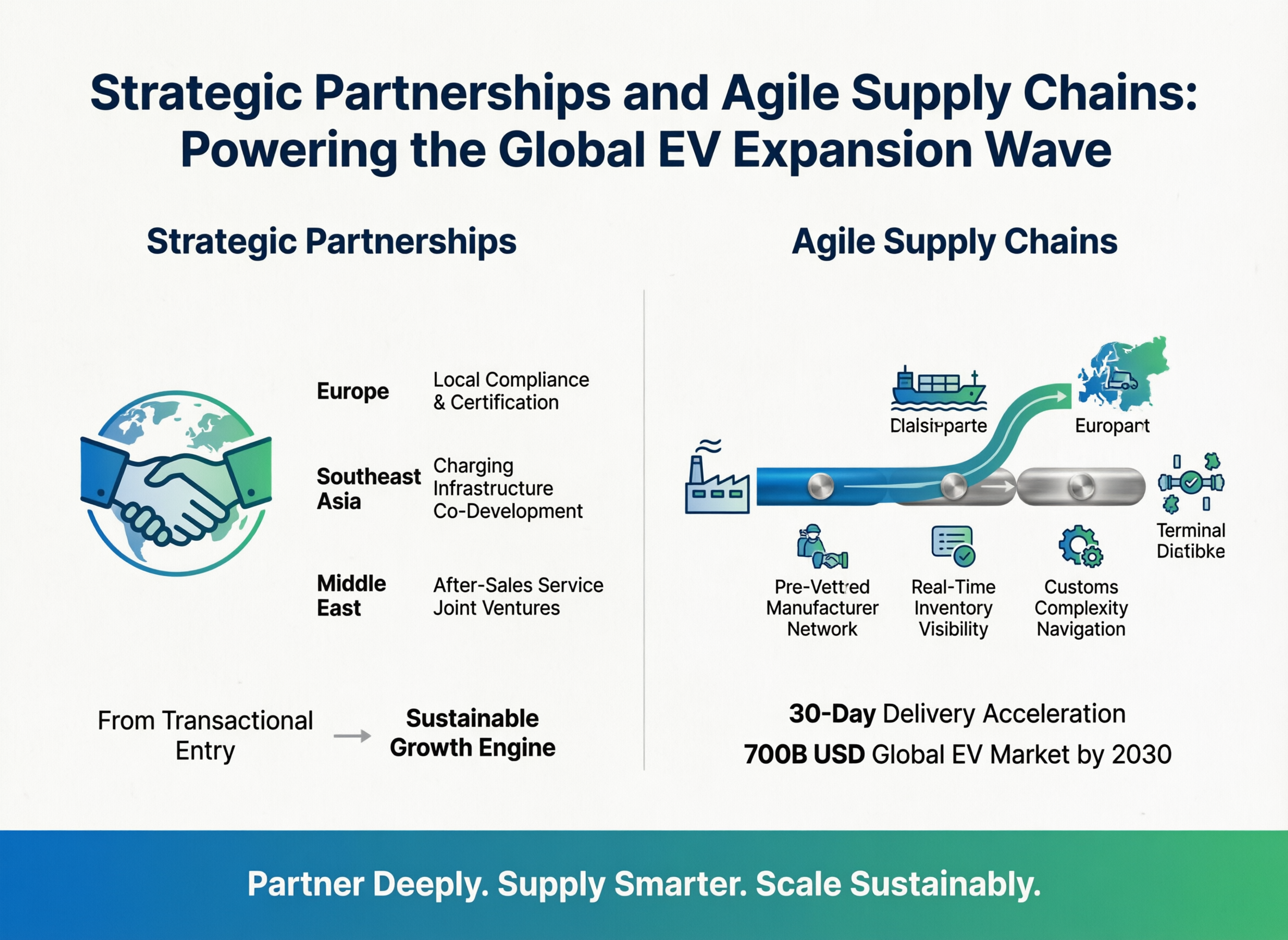 Strategic Partnerships and Agile Supply Chains: Powering the Global EV Expansion Wave
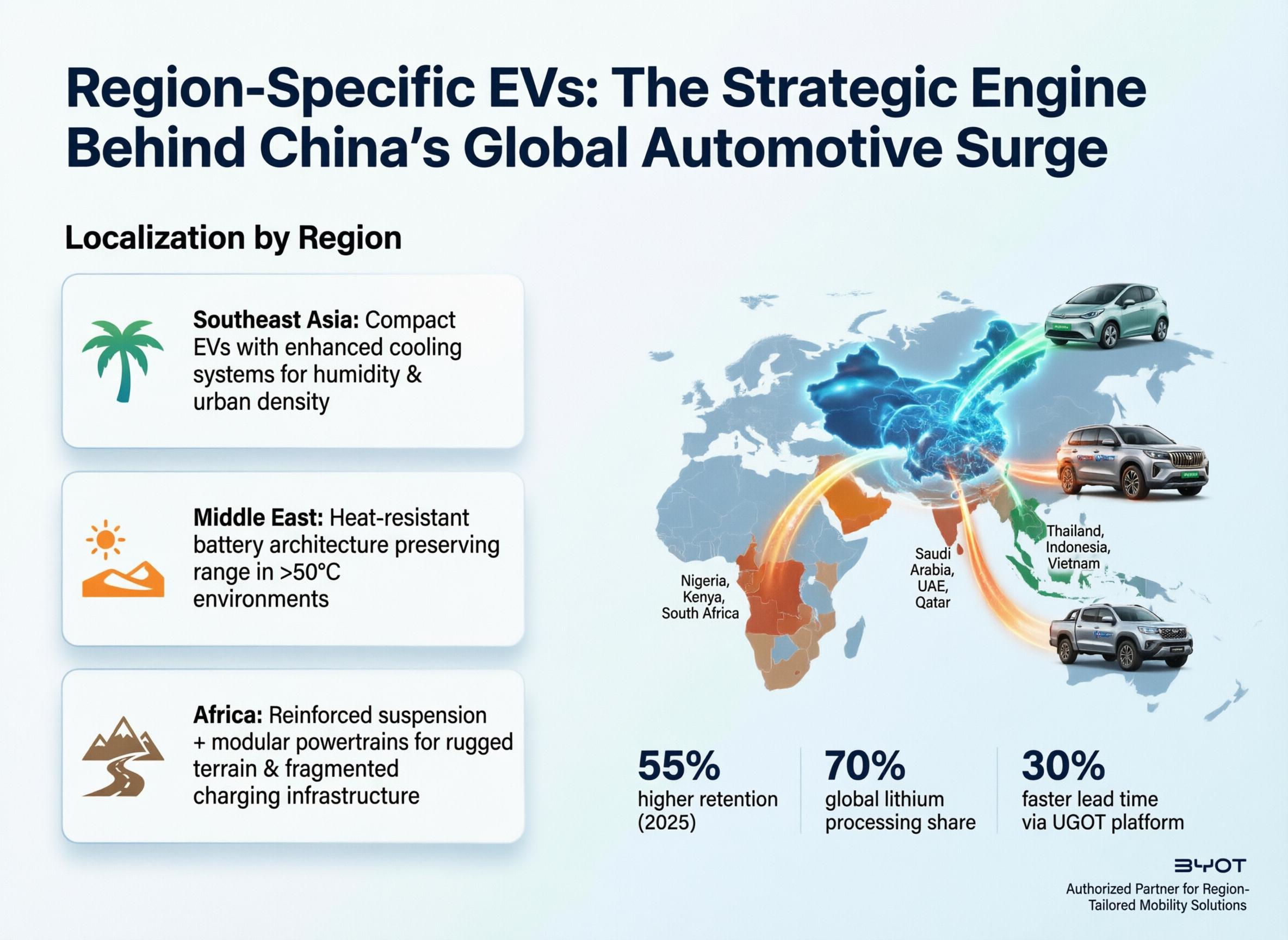 Region-Specific EVs: The Strategic Engine Behind China’s Global Automotive Surge