
The ‘Yaris Moment’ Strategy: How Regional Customization Powers Chinese EV Global Expansion
Introduction
Chinese automakers are undergoing a strategic metamorphosis, drawing inspiration from Toyota’s legendary “Yaris Moment”—where localized adaptation propelled global dominance. Companies like BYD and Changan are now developing region-specific electric vehicles (EVs) to penetrate diverse markets, from Europe’s regulatory-intensive landscapes to emerging economies in Southeast Asia and Africa. This shift, accelerated by the surge in new energy vehicle (NEV) exports, is redefining global automotive competition. In 2025 alone, NEVs accounted for over 60% of China’s automotive exports, signaling a pivotal evolution where customization meets sustainability to drive international growth.
Industry Trends and Analysis
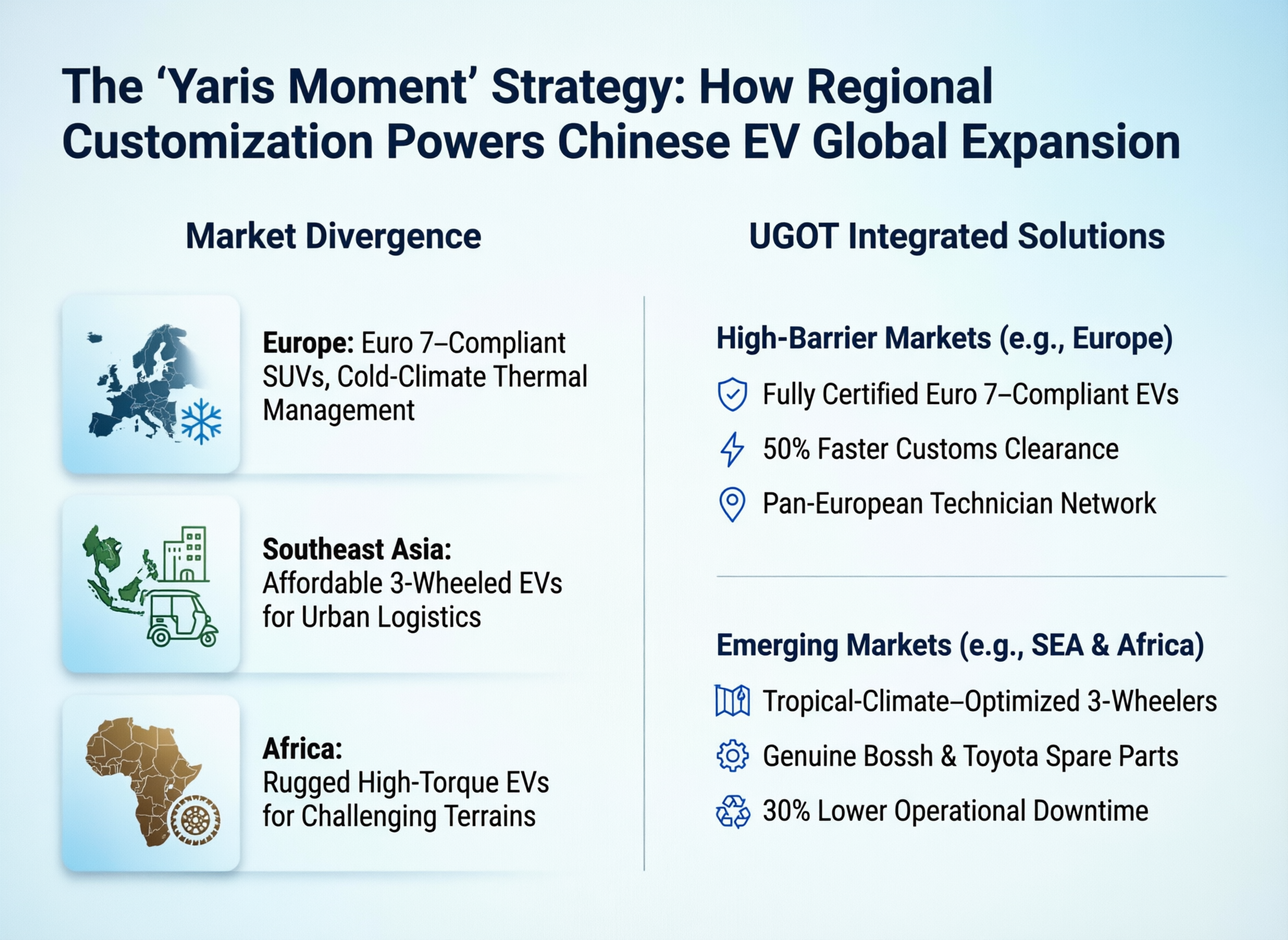
The push for regional customization stems from critical market divergences. In Europe, stringent environmental regulations—such as Euro 7 emissions standards—and consumer preferences for compact, efficient EVs necessitate tailored engineering. For instance, Chinese manufacturers are adapting battery thermal management systems for colder climates and redesigning infotainment interfaces to align with local usability norms. Simultaneously, emerging markets present contrasting demands: Southeast Asia favors affordable three-wheeled EVs for urban logistics, while African regions prioritize rugged, high-torque models for challenging terrains. This fragmentation intensifies operational complexities. Certification processes can delay market entry by 6–12 months, and fragmented after-sales networks often erode consumer trust. Leading automakers are countering this by establishing regional R&D hubs—like BYD’s center in Germany—and forging local partnerships to build resilient supply chains. Yet, scaling these efforts requires specialized intermediaries to navigate regulatory mazes and ensure seamless execution.
Strategic Solutions for Market Entry
Bridging these gaps demands integrated expertise. UGOT, as an authorized export partner for industry leaders including BYD and Changan, offers a holistic ecosystem tailored to regional nuances. For high-barrier markets like Europe, UGOT provides fully certified electric vehicles—such as customized SUVs compliant with Euro 7 standards—coupled with end-to-end services. This includes expedited customs clearance (reducing processing times by up to 50%), dedicated after-sales support through a pan-European technician network, and pre-certification guidance to mitigate compliance risks. In emerging regions, UGOT leverages its agility with high-adaptability solutions: electric three-wheelers engineered for tropical climates and uneven roads, paired with genuine spare parts from trusted brands like Bosch and Toyota. This approach not only slashes operational costs by 30% through reduced downtime but also transforms regulatory hurdles into competitive advantages, enabling dealers and fleet operators to scale efficiently.
Conclusion and Future Outlook
As electrification reshapes global mobility, regional customization will remain central to automotive success. Chinese EV makers are poised for sustained expansion, and partners like UGOT will be instrumental in turning this vision into reality. By combining deep market insights with a comprehensive service ecosystem—from certified vehicle sourcing to localized after-sales support—UGOT empowers businesses to navigate complexities and seize growth opportunities. Looking ahead, innovations in AI-driven personalization and circular economy models (e.g., battery recycling) will further redefine the landscape. UGOT’s commitment to pioneering these advancements ensures clients not only thrive in today’s dynamic markets but also lead the charge toward an inclusive, electrified future. In this era of hyper-localized competition, collaboration is the ultimate catalyst for shared prosperity.
Related Posts
 Chinese EV Export Surge: Navigating Global Growth with Authorized Supply Chain Solutions
 Strategic Partnerships and Agile Supply Chains: Powering the Global EV Expansion Wave
 Region-Specific EVs: The Strategic Engine Behind China’s Global Automotive Surge