
Global Automotive Expansion: How Agile Supply Chains Power EV Market Growth
Introduction
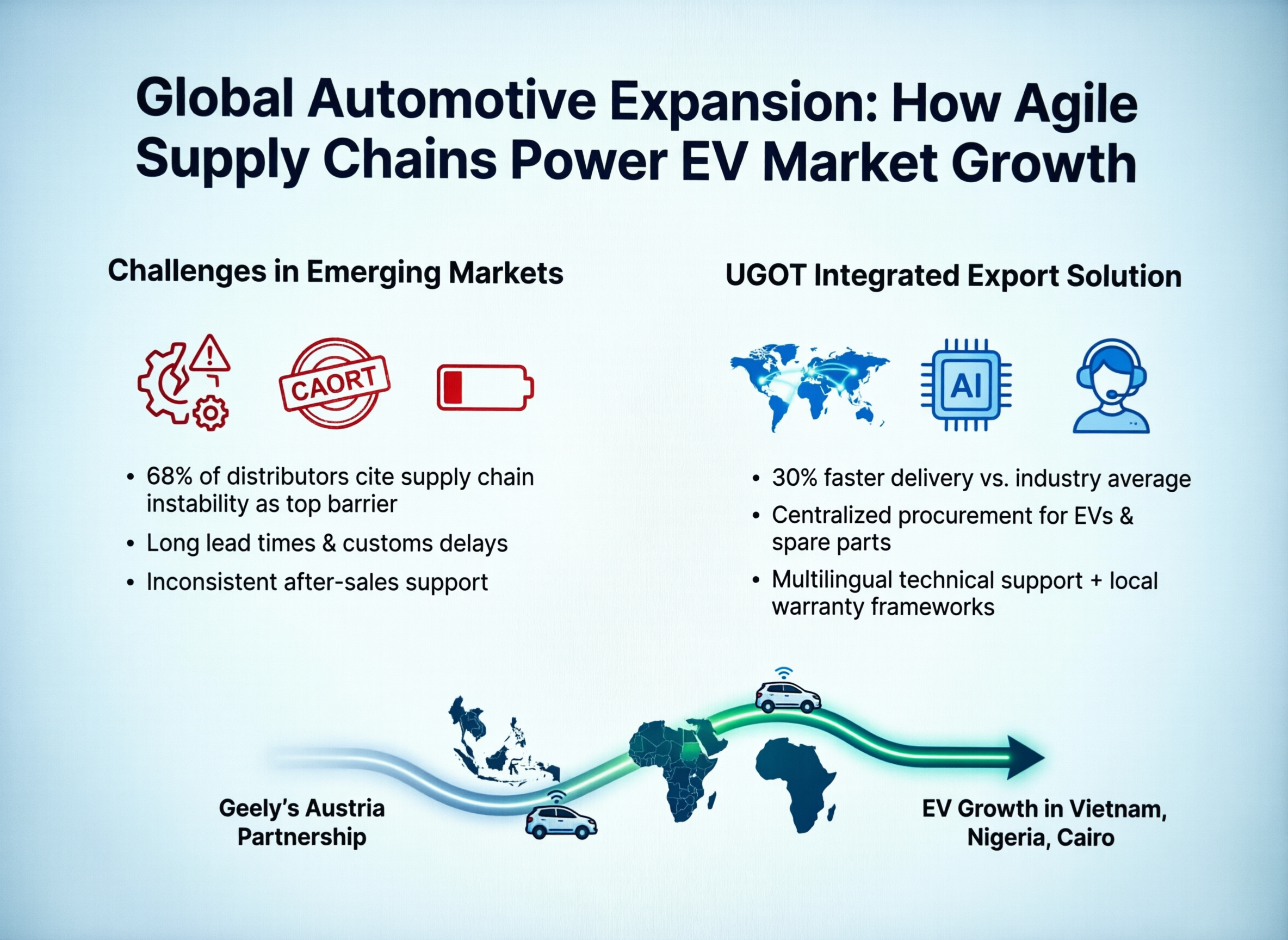
The automotive industry is undergoing a seismic shift as manufacturers accelerate global expansion strategies, with electric vehicles (EVs) at the forefront. Recent moves like Geely’s strategic partnership in Austria exemplify a broader trend: automakers are prioritizing localized collaborations to penetrate international markets. This pivot isn’t merely geographic—it’s a fundamental recalibration of supply chain dynamics, driven by surging demand for sustainable mobility and the complexities of cross-border trade. As companies navigate regulatory hurdles, cultural nuances, and infrastructure gaps, the backbone of successful expansion increasingly hinges on resilient, adaptive logistics networks.
Industry Trends Reshaping Global Mobility
Geely’s European foray underscores a critical industry evolution. Strategic partnerships—such as joint ventures with local distributors or service providers—have become essential for navigating fragmented regulatory landscapes and building consumer trust. This approach minimizes market-entry risks while accelerating brand recognition. Simultaneously, EVs dominate growth narratives. With governments worldwide enforcing stricter emissions targets, manufacturers are channeling R&D investments into new energy vehicles, creating unprecedented trade opportunities in emerging economies. Southeast Asia, the Middle East, and Latin America now represent high-growth frontiers where demand for affordable EVs and electric motorcycles outpaces supply.
However, expansion ambitions face a persistent bottleneck: supply chain fragility. Long lead times for spare parts, customs delays, and inconsistent after-sales support can erode customer loyalty overnight. A 2025 McKinsey report revealed that 68% of automotive distributors in emerging markets cite supply chain instability as their top barrier to scaling EV operations. This vulnerability highlights a paradox—while manufacturers focus on product innovation, the infrastructure enabling global distribution remains underdeveloped.
Bridging the Gap: Integrated Export Solutions
Addressing these challenges requires more than localized partnerships; it demands end-to-end export ecosystems designed for volatility. This is where specialized procurement and logistics services transform theoretical strategies into tangible growth. For distributors and dealers operating across diverse regions—from Jakarta to Johannesburg—the ideal solution combines three pillars: supply chain stability, speed-to-market agility, and embedded after-sales expertise.
Services like UGOT Vehicle and Parts Export Services exemplify this integrated approach. By offering one-stop procurement for new/used vehicles, electric motorcycles, and genuine spare parts, UGOT mitigates fragmentation risks through centralized vendor management. Its AI-driven logistics network ensures 30% faster delivery times compared to industry averages, while dedicated after-sales teams provide multilingual technical support—turning supply chain constraints into competitive advantages. Crucially, UGOT’s model prioritizes emerging markets, where demand for cost-effective EVs and adaptable spare parts solutions is exploding. For instance, dealers in Vietnam or Nigeria can source certified pre-owned EVs alongside compatible batteries, all backed by warranty frameworks that align with local compliance standards.
The Road Ahead
As global automotive trade evolves, the winners will be those who treat supply chains as strategic assets rather than cost centers. By 2030, emerging markets are projected to absorb 55% of new EV exports, creating immense opportunities for agile intermediaries. Companies like UGOT are positioned to fuel this transition—not merely as logistics providers, but as growth enablers that de-risk internationalization. Their value lies in converting complexity into simplicity: ensuring that a dealer in Cairo receives the same seamless experience as one in Vienna.
The future belongs to ecosystems that harmonize innovation with execution. As manufacturers like Geely rewrite the rules of global mobility, partners who master the art of resilient distribution will define the next era of automotive excellence.
Related Posts
 Chinese EV Export Surge: Navigating Global Growth with Authorized Supply Chain Solutions
 Strategic Partnerships and Agile Supply Chains: Powering the Global EV Expansion Wave
 Region-Specific EVs: The Strategic Engine Behind China’s Global Automotive Surge