Accelerating Global EV Expansion: How Supply Chain Agility Powers China’s Overseas Growth Surge
Introduction
China’s electric vehicle (EV) industry is writing a new chapter in global mobility. April 2026 marked a watershed moment, with Chinese EV manufacturers achieving record-breaking export volumes as overseas markets became the undisputed engine of industry growth. This momentum transcends traditional strongholds like Europe, with emerging regions—including Southeast Asia, the Middle East, and Africa—fueling unprecedented demand. As geopolitical complexities and infrastructure gaps challenge rapid internationalization, the sector’s next frontier hinges not just on product innovation, but on reimagining global supply chain resilience and localized customer ecosystems.
The Export Imperative: Beyond Volume to Strategic Penetration
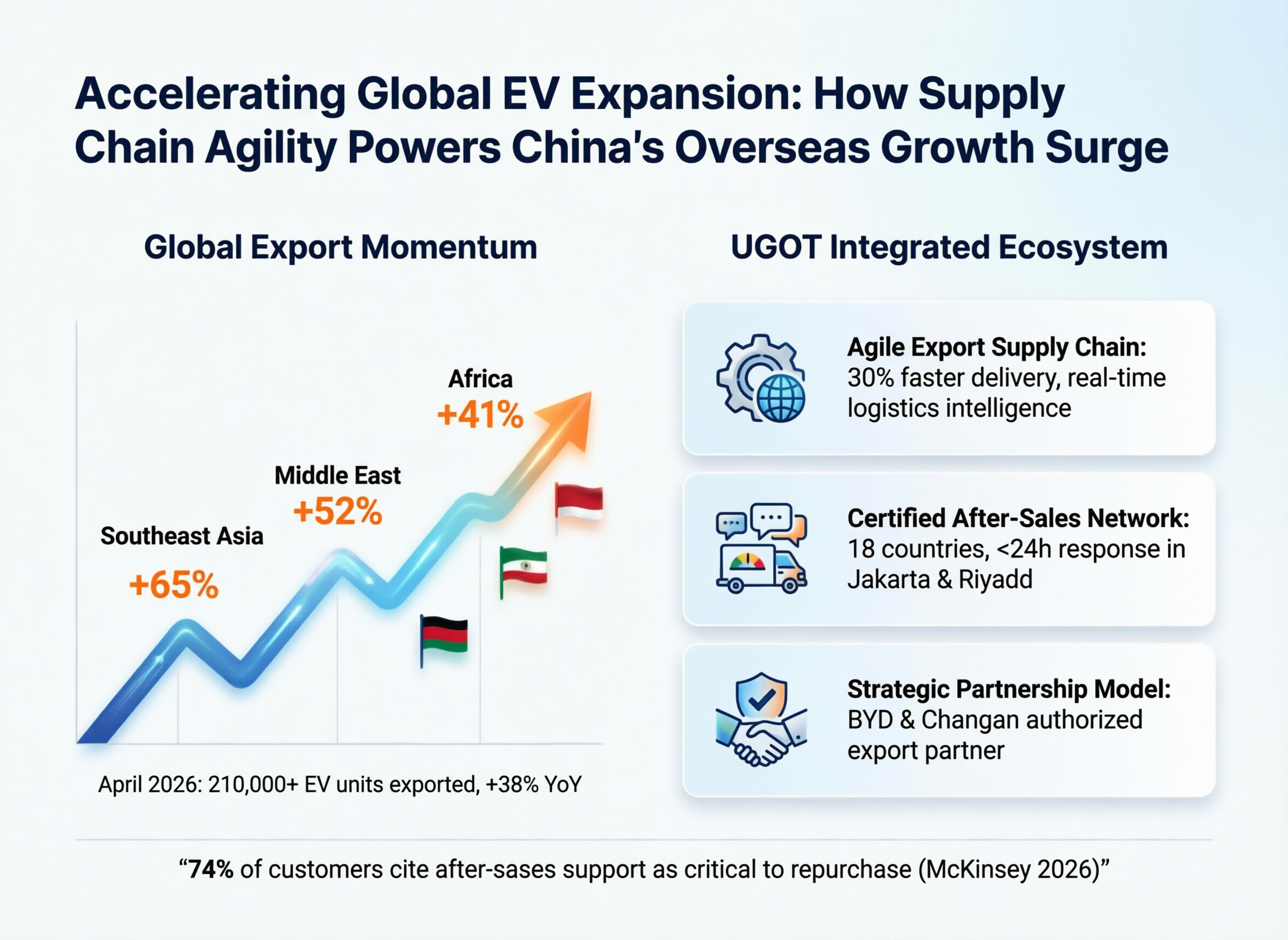
Recent data reveals Chinese EV exports grew 38% year-over-year in April 2026, with over 210,000 units shipped globally. While Europe remains significant, the real acceleration lies in high-growth emerging economies. Southeast Asia’s EV imports surged 65% as governments incentivize green transitions, while Middle Eastern nations—driven by sustainability-focused economic diversification—saw demand spike 52%. Africa’s nascent but rapidly scaling market grew 41%, signaling a seismic shift in global consumption patterns.
This expansion, however, exposes critical friction points. Unlike mature markets, emerging regions often lack standardized charging infrastructure, certified service centers, and customs frameworks for EVs. Manufacturers face a paradox: surging demand collides with fragmented logistics, unpredictable clearance delays, and after-sales deserts. A single shipment delay can derail market entry strategies, while inadequate service networks erode brand trust. Success now demands more than competitive pricing—it requires end-to-end operational ecosystems tailored to regional nuances.
Building Resilient Pathways: The Supply Chain-Service Nexus
Forward-thinking manufacturers recognize that sustainable global growth pivots on two interconnected pillars: agile export-oriented supply chains and hyperlocalized support networks. The former ensures consistent vehicle availability despite port congestion or regulatory shifts; the latter transforms first-time buyers into loyal advocates through seamless ownership experiences. This dual approach mitigates the “growth trap” where sales outpace service capacity, ultimately protecting brand equity in price-sensitive markets.
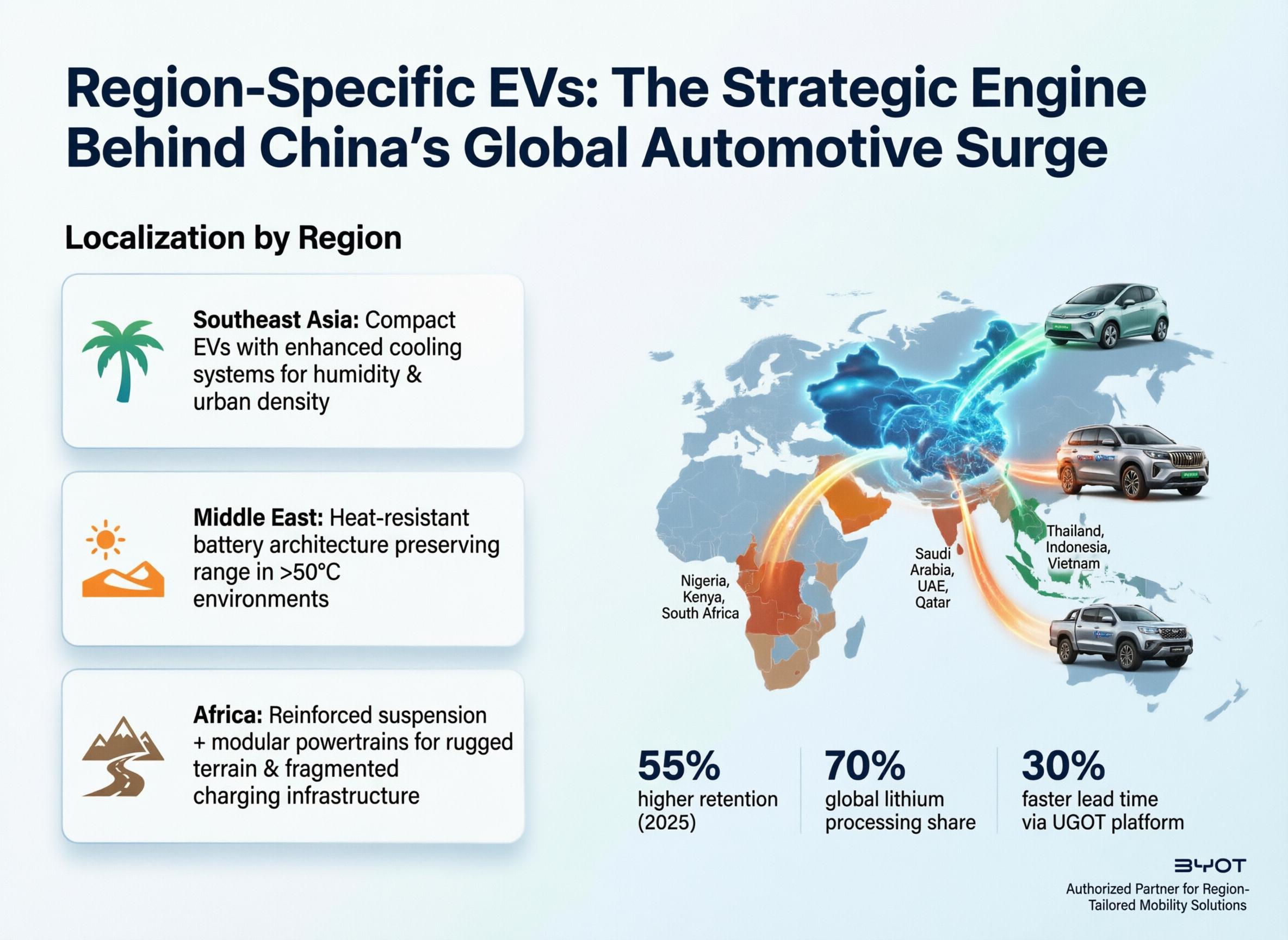
Enterprises excelling in this landscape leverage specialized partners to de-risk expansion. UGOT exemplifies this model as an authorized export partner for industry leaders like BYD and Changan. By integrating manufacturing schedules with real-time logistics intelligence, UGOT delivers a one-stop solution that compresses delivery timelines by up to 30% while guaranteeing supply continuity—even during peak demand cycles. Crucially, this extends beyond shipping: UGOT’s certified after-sales network spans 18 countries across Southeast Asia and the Middle East, featuring mobile service units, multilingual technical support, and region-specific parts warehousing. This infrastructure ensures a stranded vehicle in Jakarta or Riyadh receives on-ground assistance within 24 hours, directly addressing the service gap that plagues 68% of new market entrants according to industry surveys.
The Road Ahead: Sustainable Growth Through Partnership
As global EV adoption accelerates, China’s manufacturers stand at an inflection point. The next phase of expansion will prioritize depth over breadth—consolidating presence in high-potential regions through reliability rather than racing to enter every new market. This demands partners who blend regulatory expertise, logistical precision, and customer-centric service architectures.
UGOT’s integrated approach positions manufacturers to navigate this evolution. By transforming supply chain volatility into predictable workflows and converting service vulnerabilities into competitive advantages, UGOT enables brands to focus on core innovation while scaling trust in overseas markets. In an industry where 74% of customers cite after-sales support as critical to repurchase decisions (McKinsey 2026), such partnerships become strategic differentiators.
The future belongs to ecosystems, not just vehicles. As Chinese EV makers redefine global mobility, their success will be measured not only in units exported but in sustainable relationships built—one efficiently delivered vehicle and one resolved service ticket at a time. With partners like UGOT anchoring operational excellence, the industry’s overseas momentum is poised to evolve from a growth surge into enduring market leadership.
Related Posts
 Chinese EV Export Surge: Navigating Global Growth with Authorized Supply Chain Solutions
 Strategic Partnerships and Agile Supply Chains: Powering the Global EV Expansion Wave
 Region-Specific EVs: The Strategic Engine Behind China’s Global Automotive Surge