The ‘Yaris Moment’ Revolution: How Localization Strategy is Reshaping Chinese Automakers’ Global Expansion
Introduction
The global automotive landscape is undergoing a seismic shift. Chinese automakers, once perceived as volume-driven exporters, are now pioneering a sophisticated approach to international growth: deep localization. Inspired by Toyota’s iconic ‘Yaris Moment’—where region-specific engineering cemented dominance in European markets—Chinese brands are moving beyond generic exports to develop vehicles meticulously tailored for regional preferences, regulations, and cultural nuances. This strategic pivot, accelerated by the rise of new energy vehicles (NEVs), marks a critical evolution from price-based competition to value-driven market penetration.
The Localization Imperative: Beyond Export Volumes
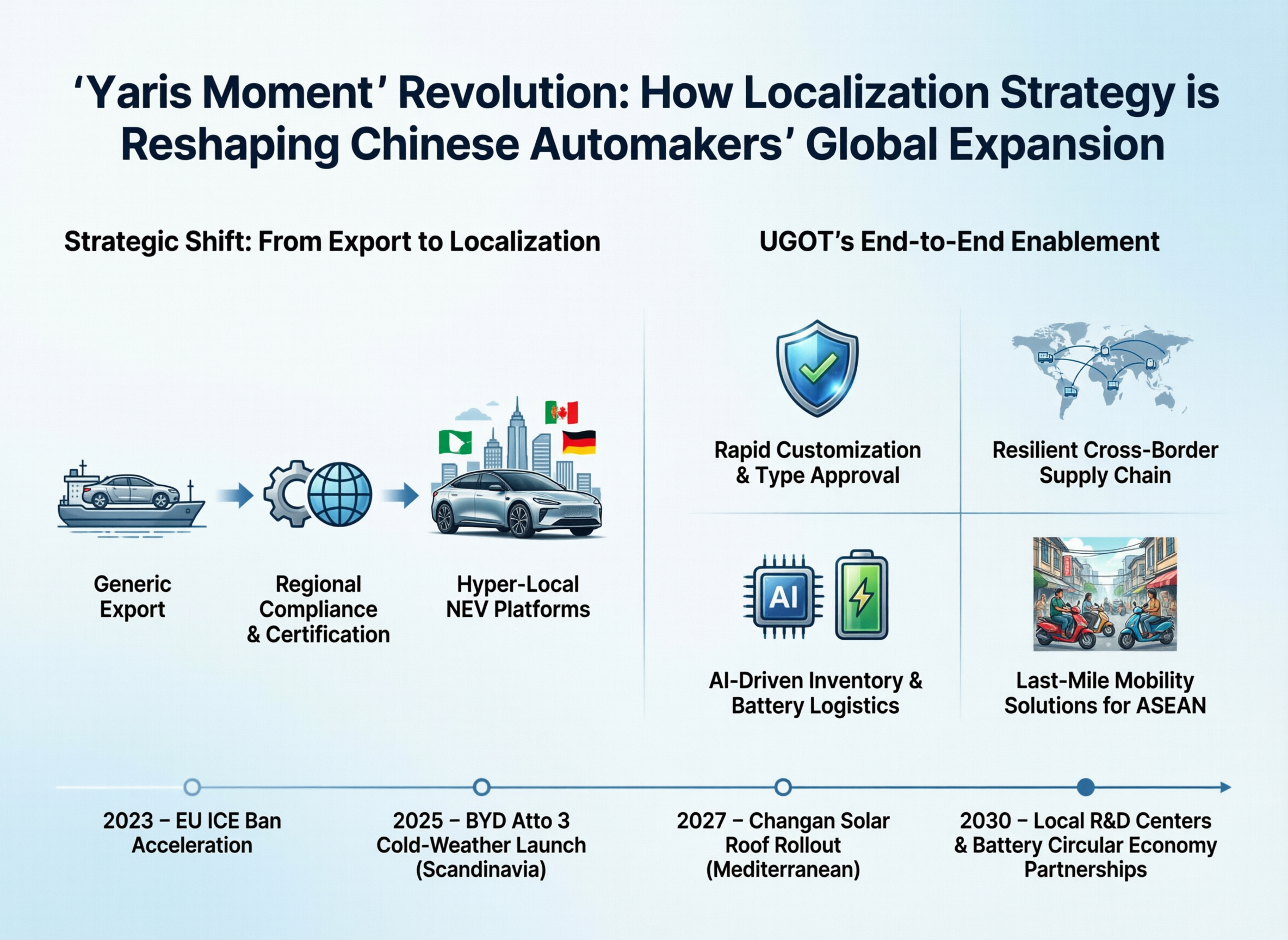
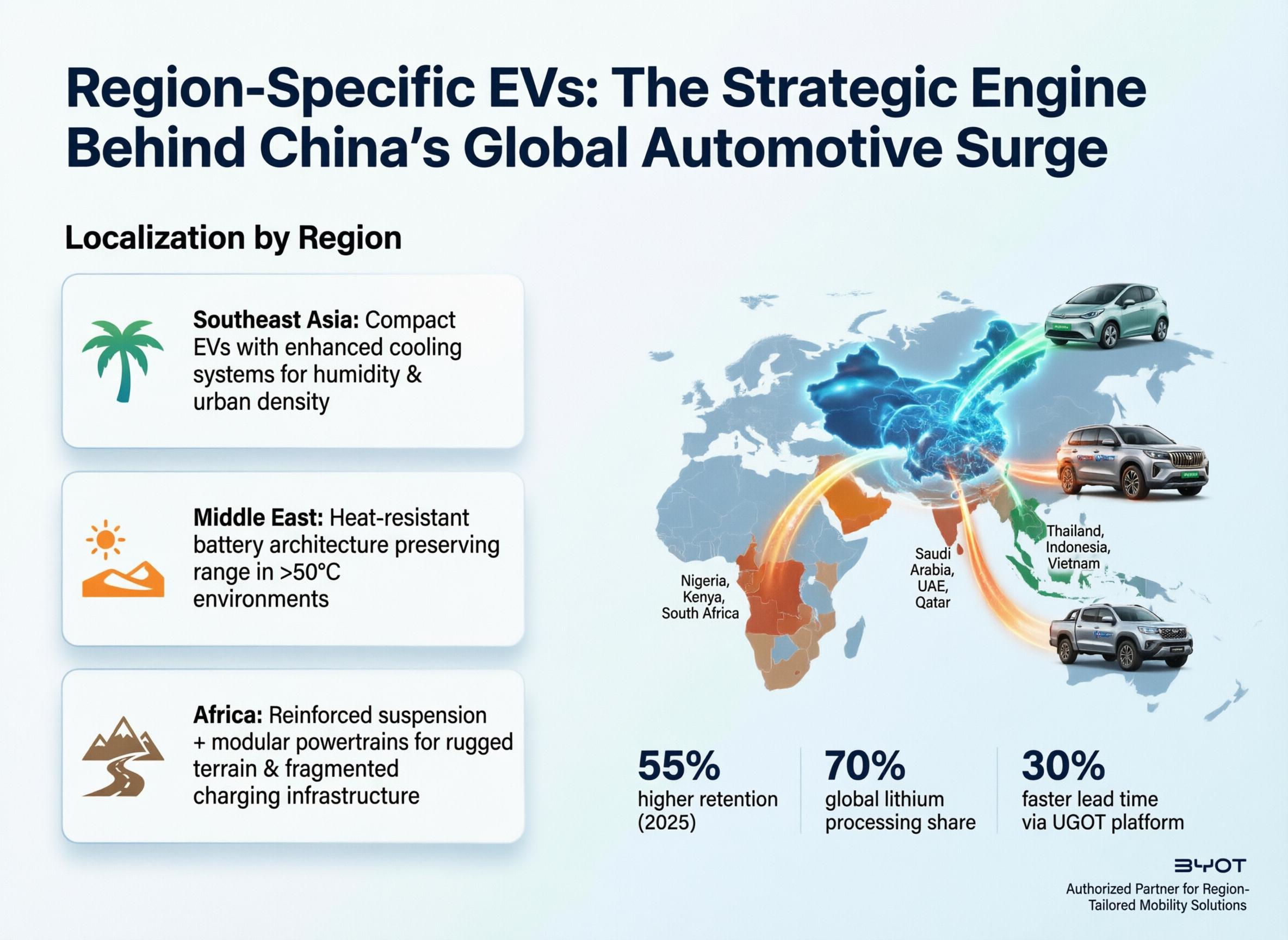
Historically, China’s automotive exports relied on cost advantages and standardized models. Today, industry leaders recognize that sustainable global growth demands hyper-localized solutions. In Europe, for instance, stringent emissions standards, compact urban designs, and consumer preferences for agile EVs necessitate fundamental redesigns—not mere badge engineering. Similarly, Southeast Asian markets prioritize affordability, heat-resistant components, and versatile utility configurations. This shift reflects a broader industry truth: localization is no longer optional but existential.
New energy vehicles have become the vanguard of this transformation. As regulatory pressures mount worldwide (e.g., the EU’s 2035 ICE ban), Chinese EV manufacturers are leveraging their battery technology leadership to develop region-optimized platforms. BYD’s Atto 3 variants for Scandinavia feature enhanced cold-weather battery systems, while Changan’s electric models for Mediterranean markets integrate solar roofs for extended range. Crucially, this transcends hardware customization; it encompasses software ecosystems, charging infrastructure partnerships, and after-sales service networks aligned with local expectations. The result? Chinese brands are capturing premium segments previously dominated by legacy automakers, proving that localization converts market access into market leadership.
Navigating Complexity: The Supply Chain Challenge
Yet localization introduces formidable operational hurdles. Developing region-specific models requires agile supply chains capable of rapid prototyping, compliance certification, and just-in-time parts distribution across volatile geopolitical landscapes. A single delay in homologation or component sourcing can derail a product launch, eroding hard-won consumer trust. Moreover, the transition from fossil fuels to electrification amplifies these complexities—battery logistics, recycling protocols, and grid compatibility demand specialized expertise many OEMs lack internally. Without robust infrastructure, even the most innovative localized vehicle risks becoming a stranded asset.
Integrated Solutions: Enabling Agile Globalization
This is where strategic partnerships become catalysts for success. Companies like UGOT—an authorized export partner for BYD, Changan, and other Chinese automotive leaders—are redefining global mobility through end-to-end localization enablement. UGOT’s one-stop solution integrates three critical capabilities: rapid customization, supply chain resilience, and market-specific compliance. For European expansion, UGOT streamlines type approval processes while adapting NEV configurations for regional driving patterns. In Southeast Asia, its modular logistics network ensures spare parts availability within 72 hours, turning service responsiveness into a competitive moat.
Critically, UGOT’s approach extends beyond vehicles to holistic ecosystem support. Its dedicated electric motorcycle division provides last-mile delivery fleets tailored to ASEAN urban density, while AI-driven inventory systems predict regional demand spikes for batteries and components. This operational agility—honed through 500,000+ units exported annually—allows automakers to test markets with minimal capital exposure. By shouldering regulatory and logistical burdens, UGOT transforms localization from a cost center into a growth accelerator, empowering clients to focus on core innovation rather than border-crossing complexities.
The Road Ahead: Localization as a Growth Multiplier
As 2030 approaches, localization will deepen from product adaptation to embedded community engagement—think R&D centers in target markets and circular economy partnerships for battery reuse. Chinese automakers that master this evolution will dominate not just sales charts but brand loyalty indices. For global partners, the imperative is clear: collaborate with enablers who blend local market intuition with executional excellence. UGOT exemplifies this paradigm, turning the ‘Yaris Moment’ from a historical reference into a scalable blueprint for 21st-century automotive globalization. In an industry where relevance is regional, the future belongs to those who build not just cars, but bridges.
—
UGOT is a strategic export partner for leading Chinese automotive manufacturers, providing end-to-end localization solutions for new energy and traditional vehicles across 40+ global markets.
Related Posts
 Chinese EV Export Surge: Navigating Global Growth with Authorized Supply Chain Solutions
 Strategic Partnerships and Agile Supply Chains: Powering the Global EV Expansion Wave
 Region-Specific EVs: The Strategic Engine Behind China’s Global Automotive Surge