Global EV Surge: How Agile Supply Chains Power China’s Export Momentum
Introduction
April 2026 marked a watershed moment for China’s electric vehicle industry, with manufacturers achieving unprecedented overseas growth. Data reveals exports remain the sector’s primary growth engine, driven by accelerating global expansion across emerging and developed markets alike. Brands like BYD, Chery, Leapmotor, and Zeekr are spearheading this charge, transforming China from a manufacturing hub into a nexus of EV innovation with worldwide resonance. This momentum isn’t merely transactional—it signals a structural shift in global automotive dynamics, where supply chain resilience and market adaptability determine competitive advantage.
The Anatomy of Export Dominance
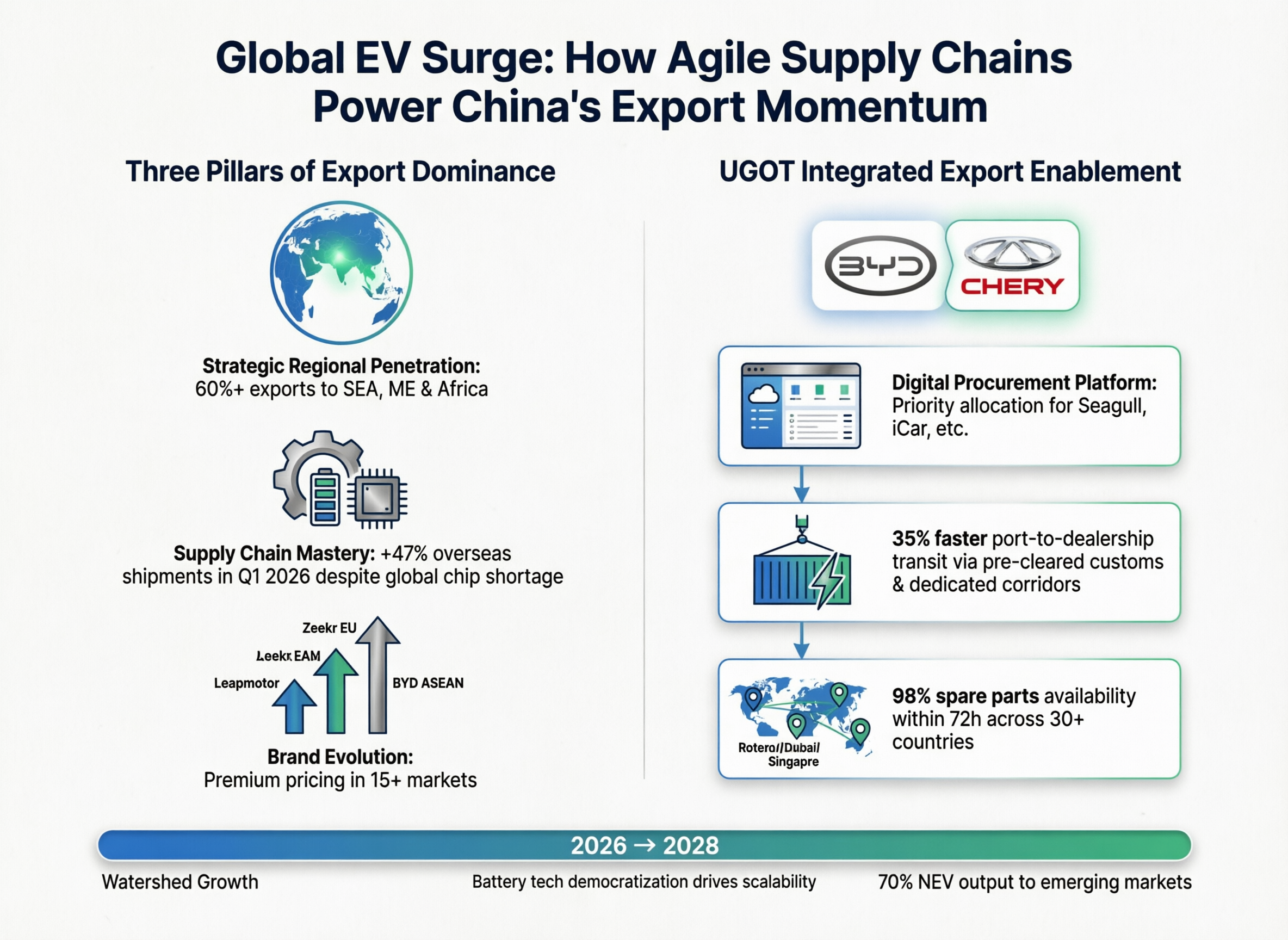
China’s EV export surge stems from three converging forces. First, strategic regional penetration: Southeast Asia, the Middle East, and Africa now account for over 60% of outbound volumes, attracted by vehicles engineered for diverse climates and price-sensitive markets. BYD’s Atto series and Chery’s eQ models exemplify this—offering 400+ km range at 30% lower costs than Western equivalents. Second, supply chain mastery: vertically integrated production enables manufacturers to absorb raw material volatility while maintaining output. During Q1 2026 alone, Chinese EV makers increased overseas shipments by 47% despite global semiconductor constraints. Third, brand evolution: Zeekr’s premium positioning in Europe and Leapmotor’s tech-focused appeal in Latin America demonstrate a departure from commoditization, with Chinese brands now commanding premium pricing in 15+ markets.
Critically, this expansion faces friction points. Logistics bottlenecks delay deliveries by 15–20 days on average, while fragmented after-sales networks undermine consumer trust. A recent ASEAN dealer survey cited spare parts accessibility as the top barrier to EV adoption—highlighting that manufacturing prowess alone can’t sustain growth without ecosystem support.
Enabling Seamless Global Access
As export volumes scale, the industry’s next frontier lies in operationalizing supply chain agility. This is where specialized export partners become force multipliers. UGOT, as an authorized export partner for BYD and Chery, bridges this gap through integrated solutions designed for velocity and reliability. Our one-stop procurement platform consolidates high-demand NEVs—from BYD’s Seagull to Chery’s iCar—guaranteeing allocation priority during peak demand cycles. Unlike conventional distributors, UGOT’s digital logistics orchestration reduces port-to-dealership transit time by 35% through pre-cleared customs documentation and dedicated shipping corridors.
Beyond delivery, UGOT future-proofs partnerships with embedded after-sales infrastructure. Our global spare parts hubs in Rotterdam, Dubai, and Singapore ensure 98% component availability within 72 hours, while certified technician training programs in 30+ countries standardize service quality. For dealers navigating China’s EV boom, this eliminates the traditional trade-off between growth speed and customer retention.
The Road Ahead
China’s EV export trajectory will intensify as battery technology democratizes performance capabilities. By 2028, emerging markets could absorb 70% of Chinese NEV production, but only if supply chains evolve beyond transactional relationships. UGOT’s model—combining manufacturer authorization with end-to-end operational control—offers a blueprint for sustainable expansion. We don’t just move vehicles; we deploy market-ready ecosystems that turn export volumes into lasting brand equity. As global roads electrify, the winners will be those who master not just engineering, but the art of frictionless global access. In this new era, UGOT stands ready to power partners’ ambitions with supply chain certainty.
Related Posts
 SAIC-GM-Wuling’s 1M+ Sales Milestone: UGOT’s Integrated Solutions Power Global EV Expansion
 Changan NEVO’s Million-Unit Milestone Signals Global EV Demand Surge; UGOT Powers Export Growth
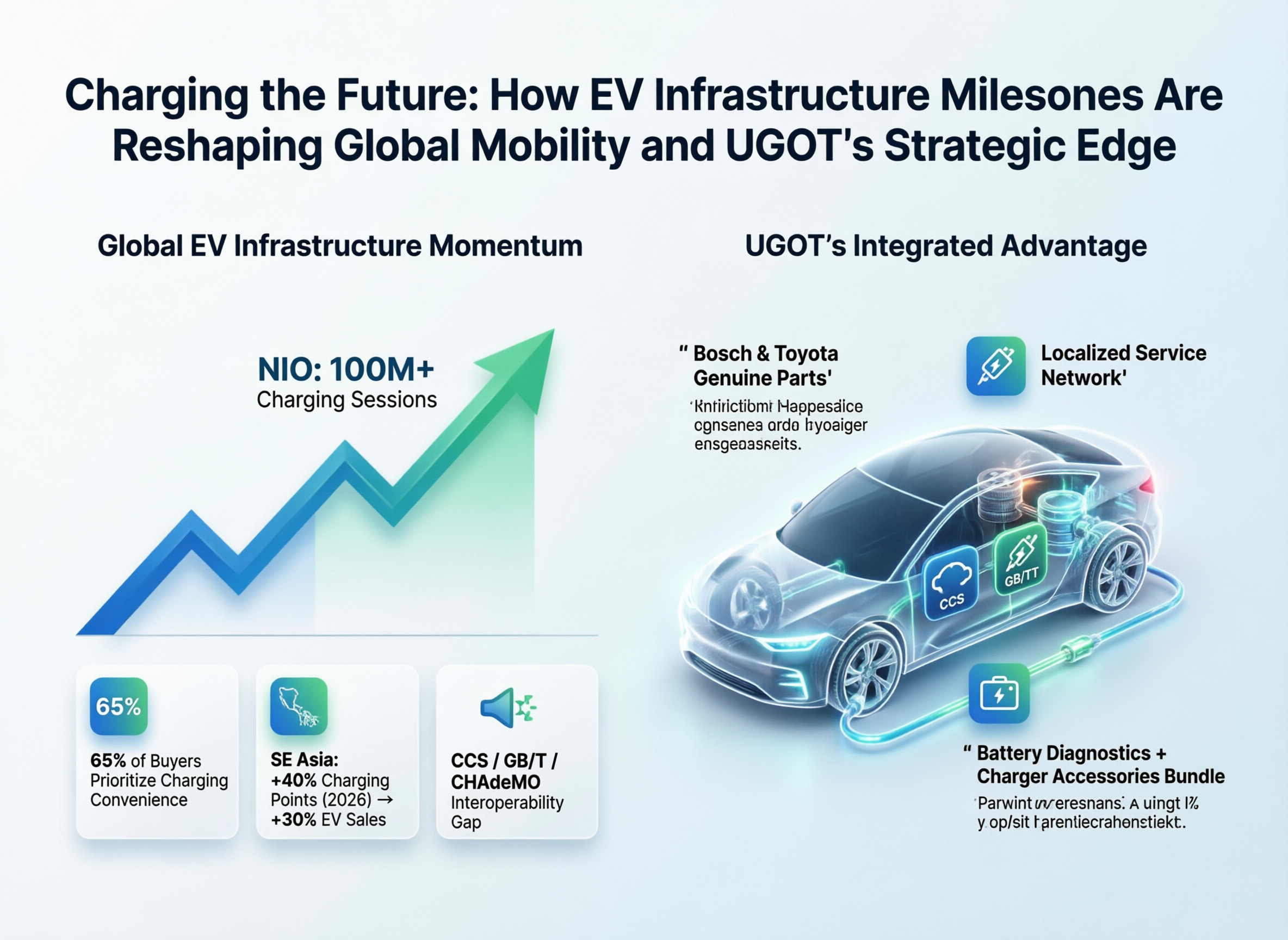 Charging the Future: How EV Infrastructure Milestones Are Reshaping Global Mobility and UGOT’s Strategic Edge