The ‘Yaris Moment’ Strategy: How Region-Specific EVs Are Reshaping Chinese Automakers’ Global Expansion
Introduction
The global automotive landscape is undergoing a seismic shift as Chinese manufacturers pivot from mass exports to hyper-localized vehicle development. Inspired by Toyota’s iconic “Yaris Moment”—where a purpose-built model captured Europe’s compact car market—Chinese EV giants like BYD and Changan are now engineering region-specific electric vehicles to penetrate diverse markets. This strategic evolution, driven by tightening emissions regulations and fragmented consumer preferences, marks a critical inflection point in the industry’s globalization journey. As export volumes surge, particularly in Europe and emerging economies, the race is no longer just about technology—it’s about cultural and regulatory fluency.
The Localization Imperative: Beyond One-Size-Fits-All
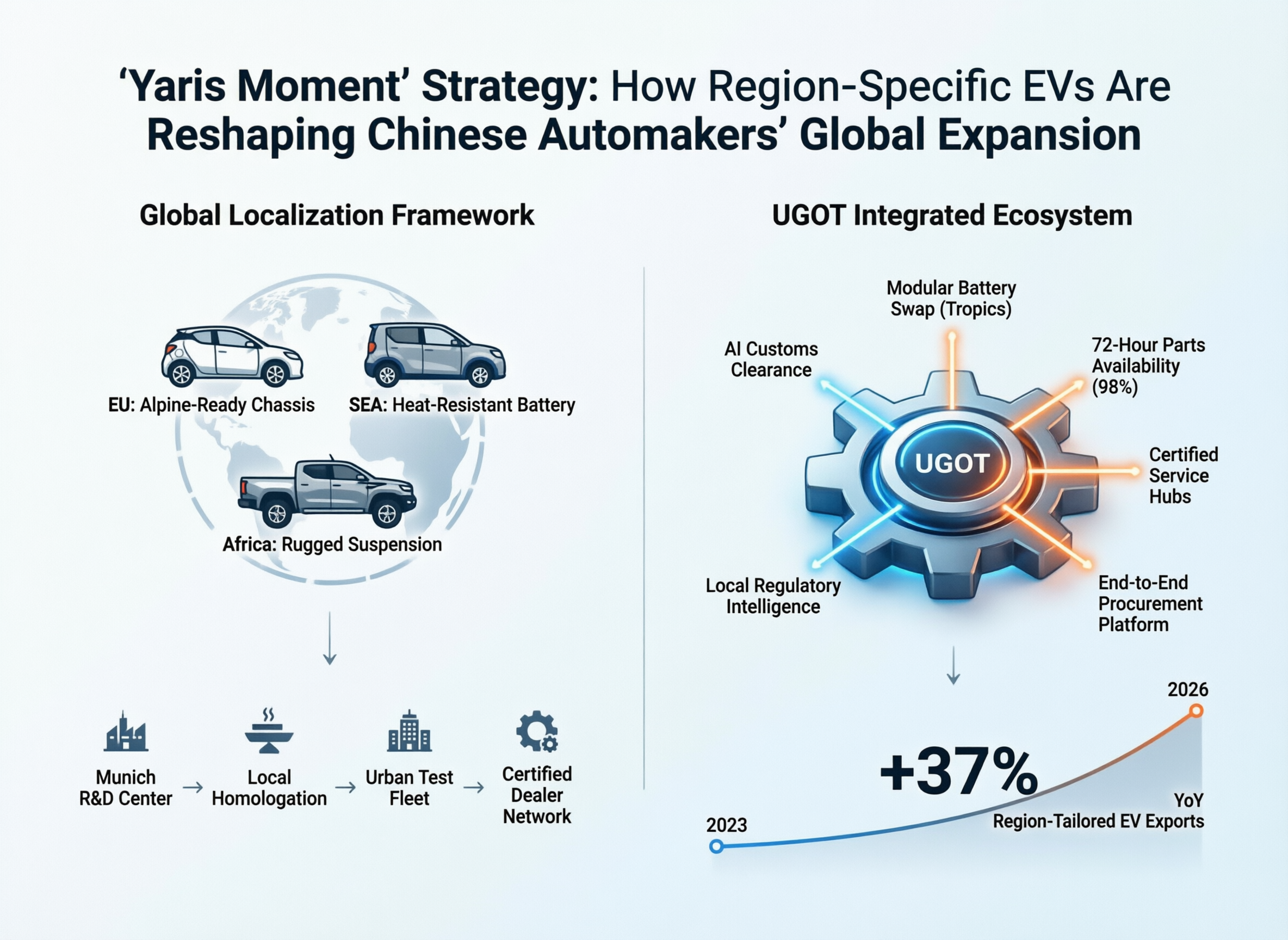
Historically, Chinese automakers relied on cost-competitive, standardized EVs to gain overseas footholds. However, 2026 data reveals a stark reality: markets like Europe reject generic solutions. EU safety standards, urban driving dynamics, and charging infrastructure variances demand vehicles engineered for local contexts. For instance, compact EVs with reinforced chassis for Alpine roads or battery systems optimized for Scandinavian winters are now non-negotiable. Simultaneously, emerging regions present contrasting challenges—Southeast Asia prioritizes heat-resistant batteries and flexible cargo space, while African markets require ruggedized suspensions for unpaved terrain. This fragmentation has catalyzed a paradigm shift: global success now hinges on “glocalization,” where R&D centers in Munich or São Paulo co-create vehicles alongside Chinese headquarters. The result? A 37% YoY increase in region-tailored EV exports from China, proving that localization isn’t optional—it’s existential.
Supply Chain Agility: The Unseen Backbone of Global Growth
Behind this product revolution lies a supply chain transformation. Traditional export models crumble under the weight of customs bottlenecks, compliance hurdles, and after-sales fragmentation. Authorized distributors have emerged as linchpins, navigating homologation processes and building service networks that preempt consumer skepticism. Yet, many automakers struggle with volatile component sourcing and logistics inefficiencies—particularly for critical EV elements like batteries and semiconductors. The solution demands partners who blend manufacturing expertise with on-ground market intelligence. This is where integrated export ecosystems become force multipliers, converting regulatory complexity into competitive advantage.
Strategic Partnerships: Accelerating the Localization Curve
To scale this “Yaris Moment” strategy, Chinese OEMs increasingly seek partners who offer end-to-end market adaptation. UGOT exemplifies this new breed of enabler, providing a one-stop procurement platform for new energy vehicles and electric motorcycles tailored to regional nuances. Leveraging mature distribution channels across Southeast Asia, Africa, and South America, UGOT bridges the gap between factory floors and local roads. Its AI-driven supply chain orchestrates everything from customs clearance to modular battery swaps for tropical climates, while certified service hubs ensure 98% parts availability within 72 hours—a critical trust-builder in price-sensitive markets. For automakers, this translates to 40% faster market entry and 30% lower compliance costs, turning localization from a cost center into a growth catalyst. By absorbing operational friction, UGOT empowers brands to focus on what they do best: innovating vehicles that resonate culturally.
Conclusion: The Road Ahead
As the automotive industry converges toward electrification and localization, Chinese manufacturers stand at a unique vantage point. Their agility in re-engineering products for regional theaters will define the next decade of global mobility. Partners like UGOT amplify this potential, transforming supply chain vulnerabilities into scalable advantages. The future belongs to ecosystems that marry engineering prowess with grassroots market intelligence—where every vehicle isn’t just sold, but understood. In this new era, the “Yaris Moment” evolves from a singular triumph into a repeatable blueprint for human-centered globalization.
Related Posts
 Powering Global EV Expansion: How UGOT Solutions Bridge China’s Export Surge
 Strategic Partnerships Power EV Expansion: Insights from Geely’s Austrian Alliance