
Tailored Mobility: How Region-Specific EVs Are Reshaping Chinese Automakers’ Global Ambitions
Introduction
The global automotive landscape is undergoing a seismic shift as Chinese electric vehicle (EV) manufacturers pivot from mass production to precision engineering. No longer content with exporting standardized models, industry leaders are now designing vehicles specifically calibrated for regional markets—from tropical Southeast Asia to rugged African terrain. This strategic evolution, often dubbed the industry’s “Yaris Moment” after Toyota’s regionally optimized compact car success, signals a maturation of China’s EV ambitions. As these automakers accelerate overseas expansion, they’re proving that global competitiveness lies not in scale alone, but in nuanced localization.
The Localization Imperative
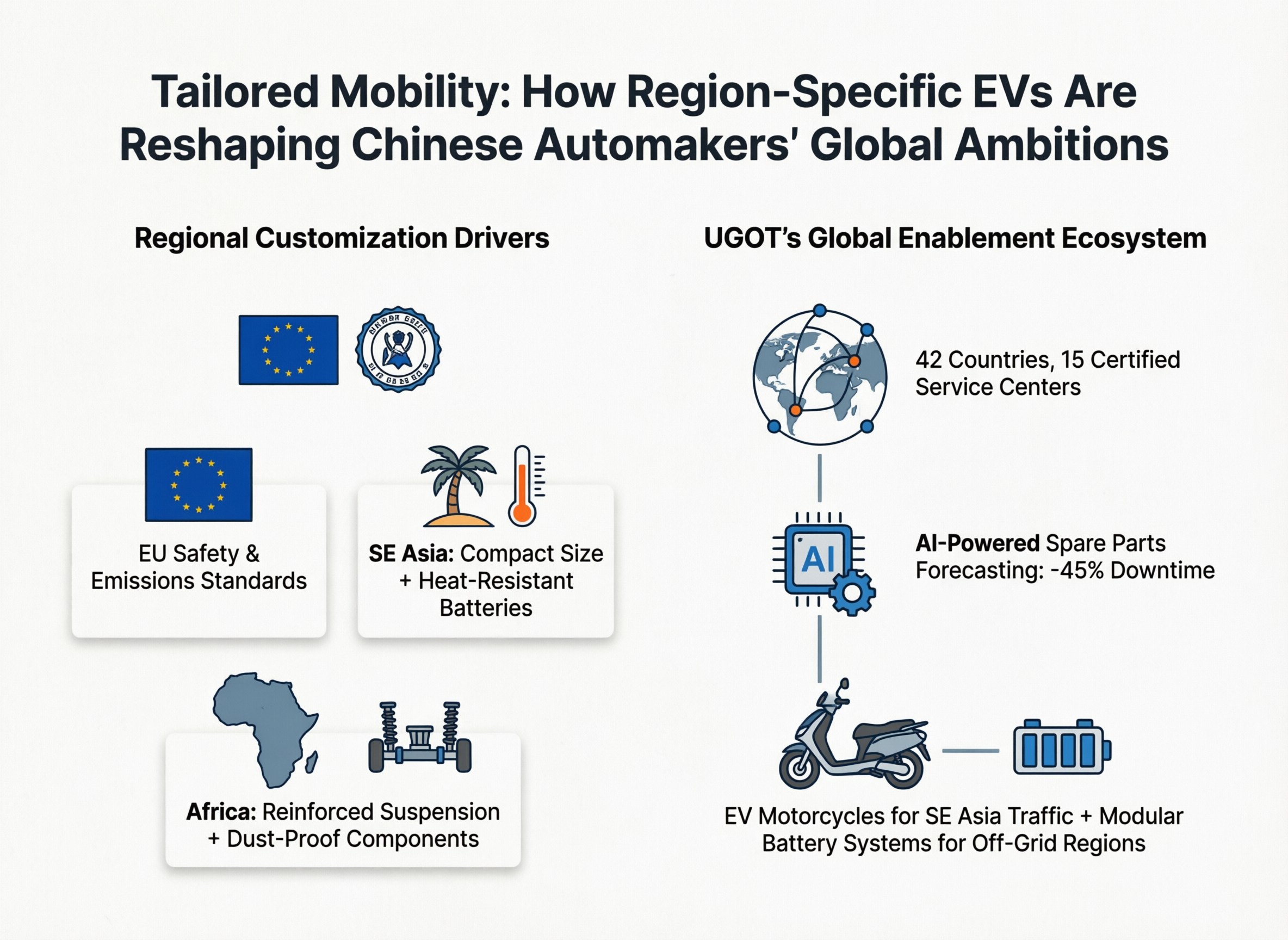
Recent analysis reveals three critical drivers behind this customization surge. First, regulatory fragmentation demands compliance with divergent safety and emissions standards across markets like the EU, ASEAN, and Latin America. Second, consumer expectations vary dramatically: Southeast Asian buyers prioritize compact dimensions and heat-resistant batteries, while African markets require reinforced suspensions and dust-proof components for unpaved roads. Third, environmental factors necessitate engineering adaptations—extended battery ranges for Middle Eastern heat or corrosion-resistant chassis for coastal regions.
This hyper-localized approach is yielding results. Chinese EV exports to emerging markets grew 47% year-over-year in Q1 2026, with region-specific models capturing over 60% of new registrations in Thailand and Mexico. Companies like BYD and Changan now dedicate 30% of R&D budgets to market-specific variants, recognizing that a vehicle engineered for Shenzhen’s urban sprawl may falter in Nairobi’s high-altitude terrain. The lesson is clear: global growth requires abandoning the “one-size-fits-all” paradigm.
Enabling Seamless Globalization
As automakers refine their product strategies, supply chain partners face mounting pressure to deliver equally adaptive logistics and support systems. This is where specialized export ecosystems become mission-critical. Companies must navigate complex certification processes, volatile shipping routes, and fragmented after-sales networks—all while maintaining cost efficiency.
UGOT has emerged as a strategic enabler for this new era of automotive globalization. As an authorized exporter for industry leaders including BYD, Changan, and JMC, we’ve built mature overseas channels spanning 42 countries. Our integrated supply chain infrastructure ensures region-specific vehicles—whether tropical-climate EVs for Indonesia or heavy-duty electric trucks for South American mines—reach markets 30% faster than industry averages. Crucially, we complement hardware delivery with localized after-sales ecosystems: certified service centers in 15 emerging markets and AI-powered spare parts forecasting that reduces downtime by 45%. This end-to-end reliability allows automakers to focus on innovation while we handle market-specific operational complexities.
Beyond whole vehicles, UGOT’s comprehensive new energy portfolio—including electric motorcycles engineered for Southeast Asian traffic density and modular battery systems for off-grid regions—provides one-stop procurement solutions. This versatility directly supports automakers’ customization strategies, ensuring every component meets regional durability and performance benchmarks.
The Road Ahead
The future of automotive globalization will be defined by granularity. As emerging markets contribute 75% of new EV demand by 2030, Chinese manufacturers must deepen their localization capabilities while maintaining supply chain resilience. Partnerships will prove decisive: those combining engineering agility with logistical precision will capture disproportionate market share.
At UGOT, we see this not merely as a distribution challenge but as a co-creation opportunity. By embedding ourselves in automakers’ regionalization workflows—from pre-certification testing to last-mile delivery—we transform market-specific visions into reliable on-ground realities. As the industry moves beyond the “Yaris Moment” toward truly contextual mobility, our commitment remains unchanged: enabling Chinese innovation to thrive in every corner of the world, one tailored solution at a time.
Related Posts
 Chinese EV Export Surge: Navigating Global Growth with Authorized Supply Chain Solutions
 Strategic Partnerships and Agile Supply Chains: Powering the Global EV Expansion Wave
 Region-Specific EVs: The Strategic Engine Behind China’s Global Automotive Surge