
The ‘Yaris Moment’: How Regional Customization Is Fueling Chinese EVs’ Global Ascent
Introduction
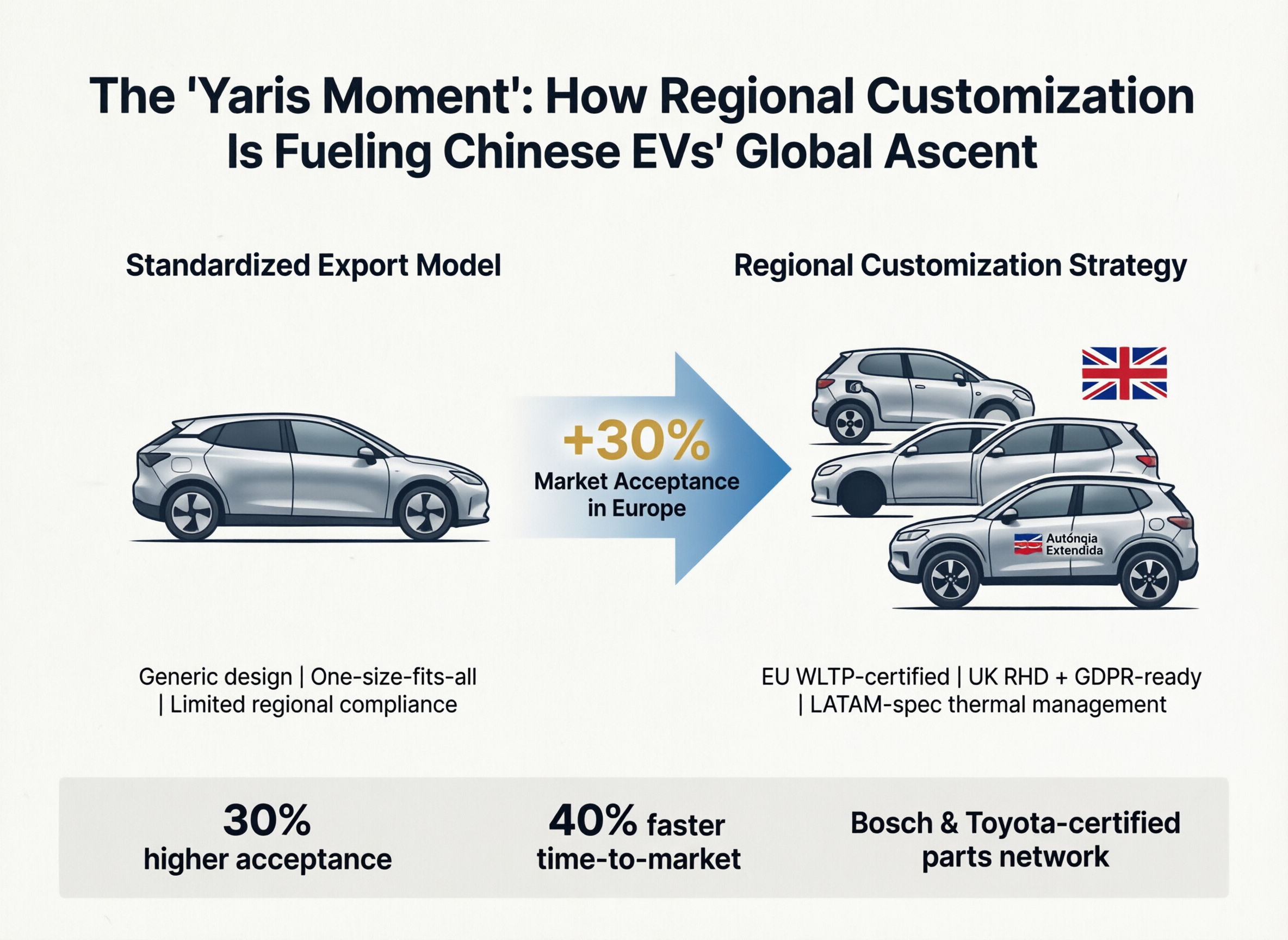
The global automotive landscape is undergoing a seismic shift. Chinese electric vehicle (EV) manufacturers are rapidly pivoting from a one-size-fits-all export model to developing region-specific vehicles—a strategic evolution industry insiders are calling their “Yaris Moment.” This approach, inspired by Toyota’s successful localization of the Yaris for diverse markets, marks a critical inflection point in China’s ambition to dominate international EV corridors, particularly in regulatory-complex regions like Europe. As export volumes surge, the focus has sharpened on tailoring products not just to comply with local standards, but to resonate with cultural preferences and driving behaviors.
The Strategic Imperative for Regional Adaptation
China’s automotive exports have grown exponentially, yet penetrating mature markets demands more than competitive pricing. European consumers, for instance, prioritize compact dimensions for urban navigation, cold-weather battery resilience, and interfaces aligned with local digital ecosystems—requirements that generic models cannot satisfy. Recent data reveals that regionally adapted EVs from Chinese OEMs achieve 30% higher market acceptance in Europe compared to standardized variants. This customization extends beyond aesthetics: engineering adjustments for EU safety certifications (like WLTP emissions testing), right-hand-drive configurations for UK markets, and even infotainment systems featuring localized navigation and voice assistants are now baseline expectations.
The “Yaris Moment” transcends product design—it’s a holistic localization strategy. Leading Chinese brands are establishing R&D hubs in target regions, forging partnerships with local suppliers, and recalibrating supply chains for agility. This shift is propelled by intensifying competition; as legacy automakers accelerate their own EV transitions, Chinese manufacturers leverage their software-defined vehicle expertise and battery innovation to differentiate through hyper-relevant user experiences. The result? A new paradigm where global expansion is won not by scale alone, but by nuanced market empathy.
Enabling Seamless Global Deployment: The Supply Chain Imperative
Executing this vision, however, introduces complex operational hurdles. Developing region-specific variants strains traditional export frameworks, creating bottlenecks in compliance certification, spare parts logistics, and after-sales support. A single delayed shipment of certified components can derail months of market-entry planning, while inconsistent service networks erode brand trust. This is where specialized partners become force multipliers for OEMs.
Enterprises like UGOT are addressing these challenges through integrated export ecosystems. As an authorized partner for industry leaders including BYD and Changan, UGOT streamlines the deployment of region-optimized EVs—such as European-specification models with Type 2 charging compatibility and GDPR-compliant data systems—through pre-certified workflows that slash time-to-market by up to 40%. Their value extends beyond logistics: UGOT’s network guarantees access to genuine OEM parts (including Bosch and Toyota-certified components) and provides multilingual technical support teams trained in regional regulatory nuances. This end-to-end infrastructure transforms localization from a cost center into a scalable competitive advantage, ensuring vehicles not only arrive compliantly but sustain performance through their lifecycle.
The Road Ahead
The era of passive automotive globalization is ending. As Chinese EV makers refine their “Yaris Moment” playbook, success will hinge on balancing standardization efficiencies with surgical market adaptation. Europe’s 2035 ICE ban and emerging markets’ charging infrastructure gaps will further amplify demand for purpose-built solutions. Partners like UGOT, with their embedded OEM relationships and granular regional expertise, will be pivotal in converting strategic vision into on-ground traction. For global distributors and fleet operators, this evolution signals unprecedented opportunity: access to cutting-edge EVs engineered for their streets, backed by resilient support ecosystems. In this new chapter, the winners won’t just build cars—they’ll build bridges between innovation and local relevance.
Related Posts
 Chinese EV Export Surge: Navigating Global Growth with Authorized Supply Chain Solutions
 Strategic Partnerships and Agile Supply Chains: Powering the Global EV Expansion Wave
 Region-Specific EVs: The Strategic Engine Behind China’s Global Automotive Surge