
Accelerating Carbon Neutrality in Battery Supply Chains: Digital Innovation and the 2035 Roadmap
Introduction
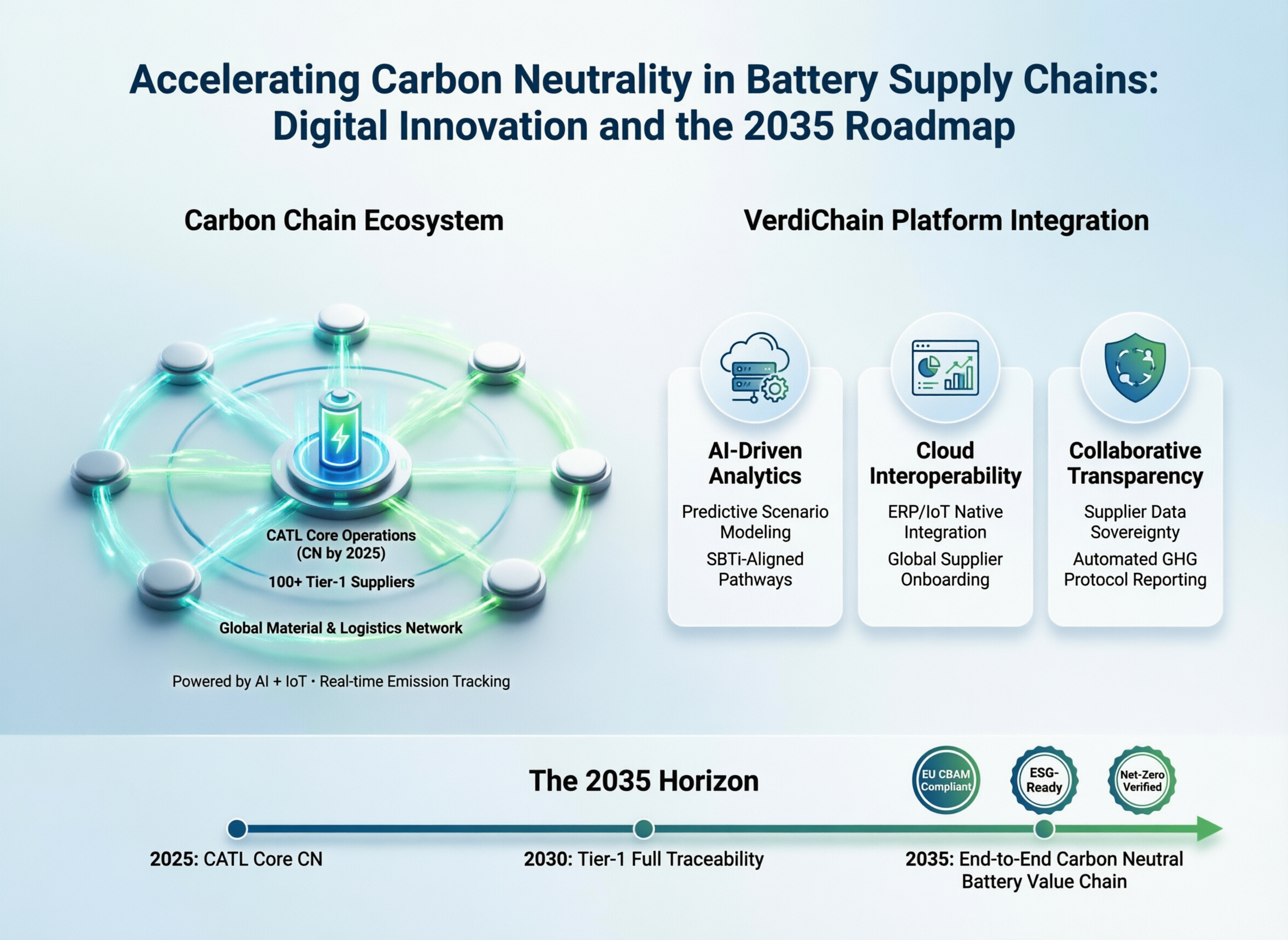
The global automotive industry is undergoing a seismic shift toward sustainability, with carbon neutrality emerging as a non-negotiable benchmark. Recent announcements from industry leaders like CATL underscore this transformation: after achieving carbon neutrality in core operations by 2025, CATL has unveiled an ambitious roadmap targeting a fully carbon-neutral battery value chain by 2035. This initiative, involving over 100 suppliers leveraging its ‘CATL Carbon Chain’ digital platform, signals a broader trend where environmental accountability extends far beyond factory walls. As regulatory pressures mount and consumer preferences pivot toward eco-conscious products, the race to decarbonize supply chains is no longer optional—it’s a strategic imperative reshaping competitiveness in the electric vehicle (EV) era.
Industry Trends and Technological Breakthroughs
CATL’s roadmap exemplifies a critical evolution in sustainability strategy. Historically, carbon reduction efforts focused on direct operations, but the new frontier lies in the entire value chain. Batteries, as the heart of EVs, account for a significant portion of a vehicle’s lifecycle emissions. Consequently, automakers face escalating pressure to ensure upstream and downstream partners align with net-zero goals. This shift is driven by three converging forces: stringent global regulations like the EU’s Carbon Border Adjustment Mechanism, rising consumer demand for transparent eco-labeling, and investor emphasis on ESG (Environmental, Social, Governance) metrics.
Technologically, digitalization is the linchpin enabling this transition. Platforms such as CATL’s Carbon Chain demonstrate how AI and IoT can standardize emission tracking across complex, multi-tiered supplier networks. By aggregating real-time data on energy use, material sourcing, and logistics, these tools transform opaque supply chains into transparent, auditable ecosystems. This standardization not only mitigates compliance risks but also unlocks efficiency gains—reducing waste, optimizing routes, and identifying high-impact decarbonization opportunities. However, scalability remains a hurdle; many suppliers lack the resources for seamless integration, highlighting a gap between ambition and execution.
Bridging the Gap with Integrated Solutions
Addressing these challenges requires more than isolated platforms—it demands end-to-end solutions that democratize access to carbon intelligence. This is where advanced digital tools become indispensable. For instance, VerdiChain Platform, our flagship carbon management solution, empowers enterprises to navigate this complexity with precision. Built on AI-driven analytics and cloud-based interoperability, VerdiChain seamlessly integrates with existing ERP and IoT systems to provide real-time emission tracking across global suppliers. Its core advantages include predictive scenario modeling—which forecasts reduction pathways aligned with science-based targets—and automated compliance reporting that simplifies adherence to frameworks like the GHG Protocol. Unlike fragmented tools, VerdiChain’s collaborative dashboard fosters transparency, enabling suppliers of all sizes to contribute data effortlessly while maintaining data sovereignty. By turning raw metrics into actionable insights, it transforms sustainability from a cost center into a value driver, accelerating progress toward milestones like CATL’s 2035 vision.
The Road Ahead
Looking forward, the convergence of regulatory rigor and technological innovation will make carbon-neutral supply chains the baseline expectation, not the exception. Companies that proactively embed digital resilience into their sustainability strategies will lead in market trust and operational agility. At our core, we believe technology should serve as a catalyst for collective progress. VerdiChain Platform embodies this ethos, offering not just software but a partnership in decarbonization—equipping businesses to turn ambitious roadmaps into measurable impact. As the battery industry pioneers this green transition, our commitment remains steadfast: to power a future where sustainability and scalability coexist, driving the automotive sector toward a net-zero horizon.
—
About the Author: This industry analysis is provided by EcoSolutions Inc., a leader in sustainable supply chain technology. Learn more about VerdiChain Platform at www.ecosolutions.com/verdichain.
Related Posts
 Chinese EV Export Surge: Navigating Global Growth with Authorized Supply Chain Solutions
 Strategic Partnerships and Agile Supply Chains: Powering the Global EV Expansion Wave
 Region-Specific EVs: The Strategic Engine Behind China’s Global Automotive Surge