Powering Global EV Adoption: How Chinese Export Momentum is Reshaping Mobility Markets
Introduction
April 2026 marked a watershed moment for China’s electric vehicle industry, with manufacturers achieving unprecedented overseas growth. According to industry reports, export volumes surged as global demand for sustainable transportation solutions intensified. This acceleration isn’t merely a quarterly anomaly—it signals a structural shift in how electric mobility is deployed worldwide. As Chinese EV brands deepen their footprint across emerging economies, they’re catalyzing a transformation in global automotive supply chains and consumer accessibility.
The Export Engine: Trends Driving Global EV Penetration
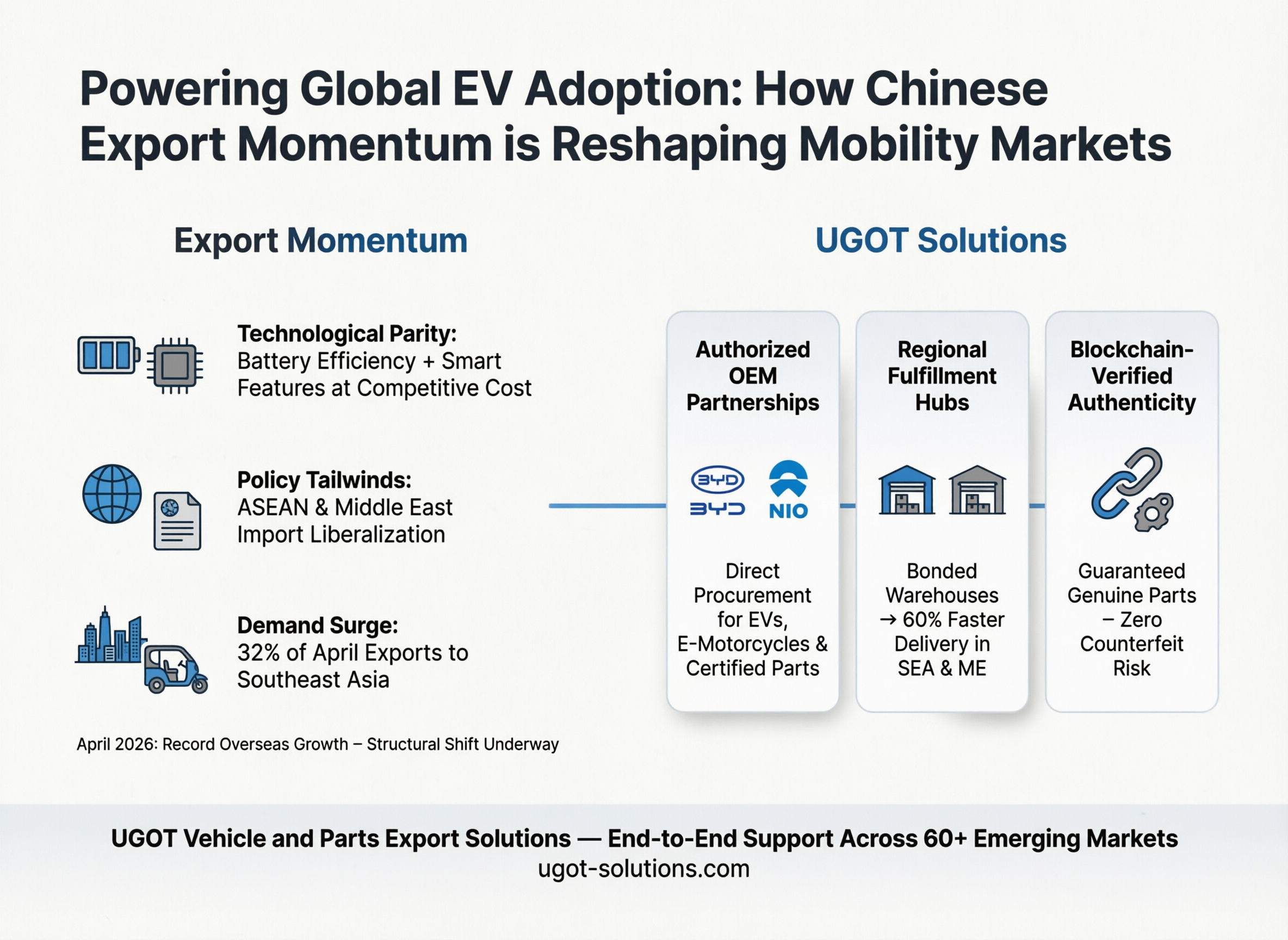
Chinese EV makers’ April performance underscores a strategic pivot toward international markets as a core growth pillar. Three converging trends explain this momentum: First, technological parity—Chinese manufacturers now rival legacy automakers in battery efficiency and smart features while maintaining cost advantages. Second, policy tailwinds, including relaxed import regulations in ASEAN and Middle Eastern nations seeking to meet decarbonization targets. Third, pent-up demand in price-sensitive regions where premium EVs were previously inaccessible. Southeast Asia alone absorbed 32% of China’s April exports, with markets like Thailand and Indonesia prioritizing electric two/three-wheelers for urban logistics—a segment where Chinese OEMs dominate with purpose-built designs.
However, rapid expansion exposes critical friction points. Distributors in emerging markets face volatile supply chains, authentication challenges for spare parts, and delivery delays that erode consumer trust. A Jakarta-based dealer recently reported 45-day wait times for battery replacements, highlighting how logistical bottlenecks threaten adoption rates despite strong product appeal. These pain points reveal a gap between manufacturing capability and on-ground execution—a gap demanding specialized intermediary solutions.
Bridging the Global Distribution Gap
As export volumes climb, the industry’s next competitive frontier lies not in production capacity but in distribution agility. This is where integrated export ecosystems become strategic imperatives. Companies like UGOT are addressing these challenges through authorized partnerships with leading Chinese EV brands, including BYD and NIO. Their Vehicle and Parts Export Solutions platform streamlines what was once a fragmented process: offering one-stop procurement for new/used EVs, electric motorcycles, and certified spare parts with guaranteed supply continuity.
UGOT’s model directly tackles the April surge’s underlying vulnerabilities. Their dedicated logistics corridors—featuring bonded warehouses in Dubai and Singapore—slash delivery lead times by 60% across Southeast Asia and the Middle East. For a Vietnamese fleet operator scaling electric deliveries, this meant transitioning 200 vehicles in 14 days versus the industry-average 35. Crucially, UGOT’s blockchain-verified parts authentication ensures technicians receive genuine components, eliminating safety risks from counterfeit replacements. Such capabilities transform export momentum from a volume metric into sustainable market penetration.
The Road Ahead: Scalable Partnerships for Sustainable Growth
The April export surge is merely the ignition phase. By 2028, emerging markets will account for 55% of global EV sales growth, with Chinese brands positioned as primary enablers. Yet success hinges on ecosystem collaboration—manufacturers cannot optimize last-mile delivery alone. Forward-looking distributors are prioritizing partners who combine OEM relationships with hyperlocal logistics intelligence.
UGOT exemplifies this evolution. By embedding quality control at source factories and pre-clearing customs documentation for 40+ target countries, they convert export volatility into predictable growth for clients. As one Saudi retail chain noted after tripling its EV inventory turnover: “Speed without authenticity is unsustainable; UGOT delivers both.” This philosophy—where supply chain resilience meets market responsiveness—will define the next era of electric mobility. For global entrepreneurs, the message is clear: the EV revolution’s true acceleration begins not at the assembly line, but at the intersection of production and precision distribution.
—
UGOT Vehicle and Parts Export Solutions provides end-to-end procurement and logistics support for EVs, electric motorcycles, and genuine spare parts across 60+ emerging markets. Learn how our authorized OEM partnerships and regional fulfillment hubs can de-risk your expansion at ugot-solutions.com.
Related Posts
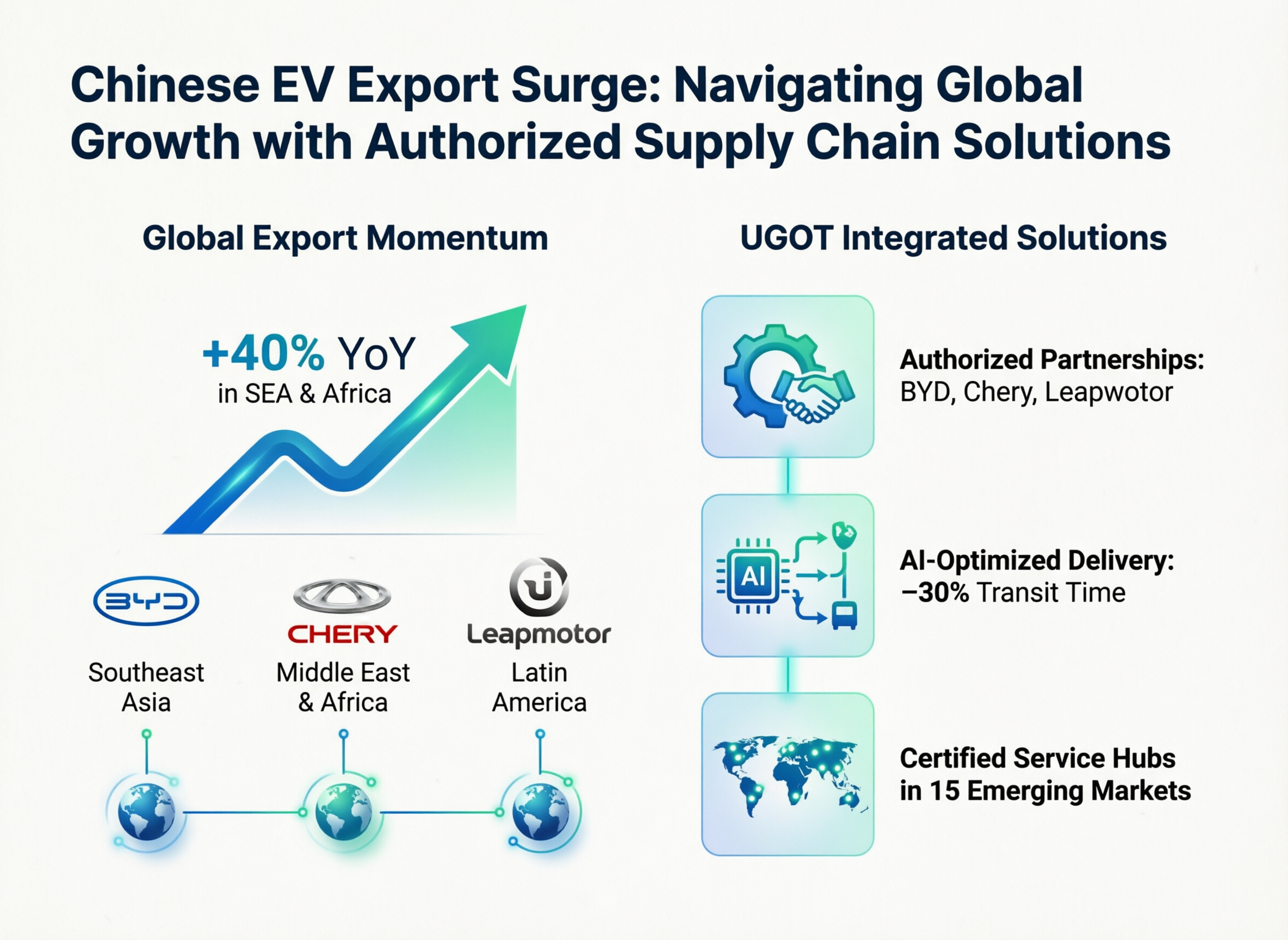 Chinese EV Export Surge: Navigating Global Growth with Authorized Supply Chain Solutions
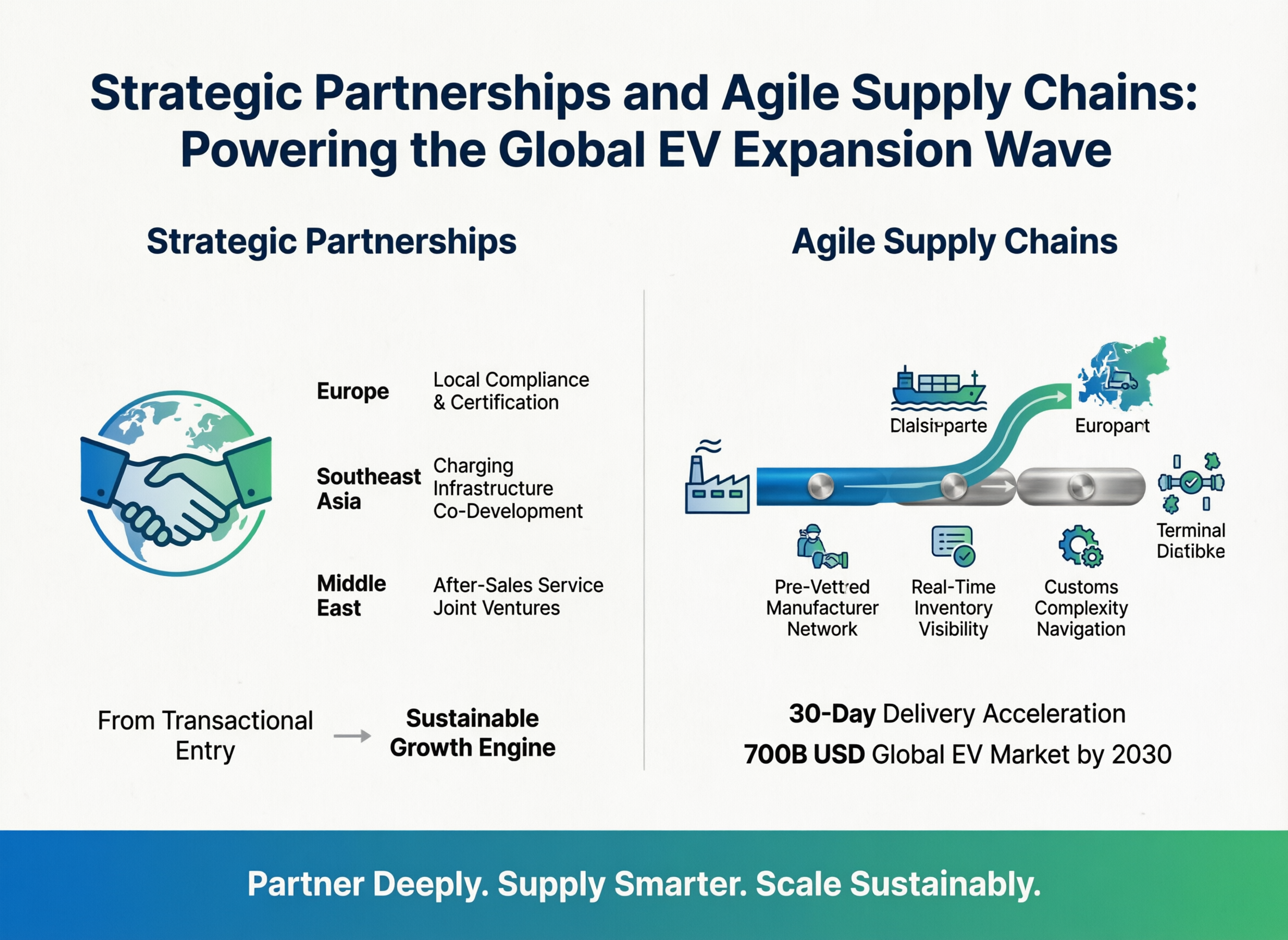 Strategic Partnerships and Agile Supply Chains: Powering the Global EV Expansion Wave
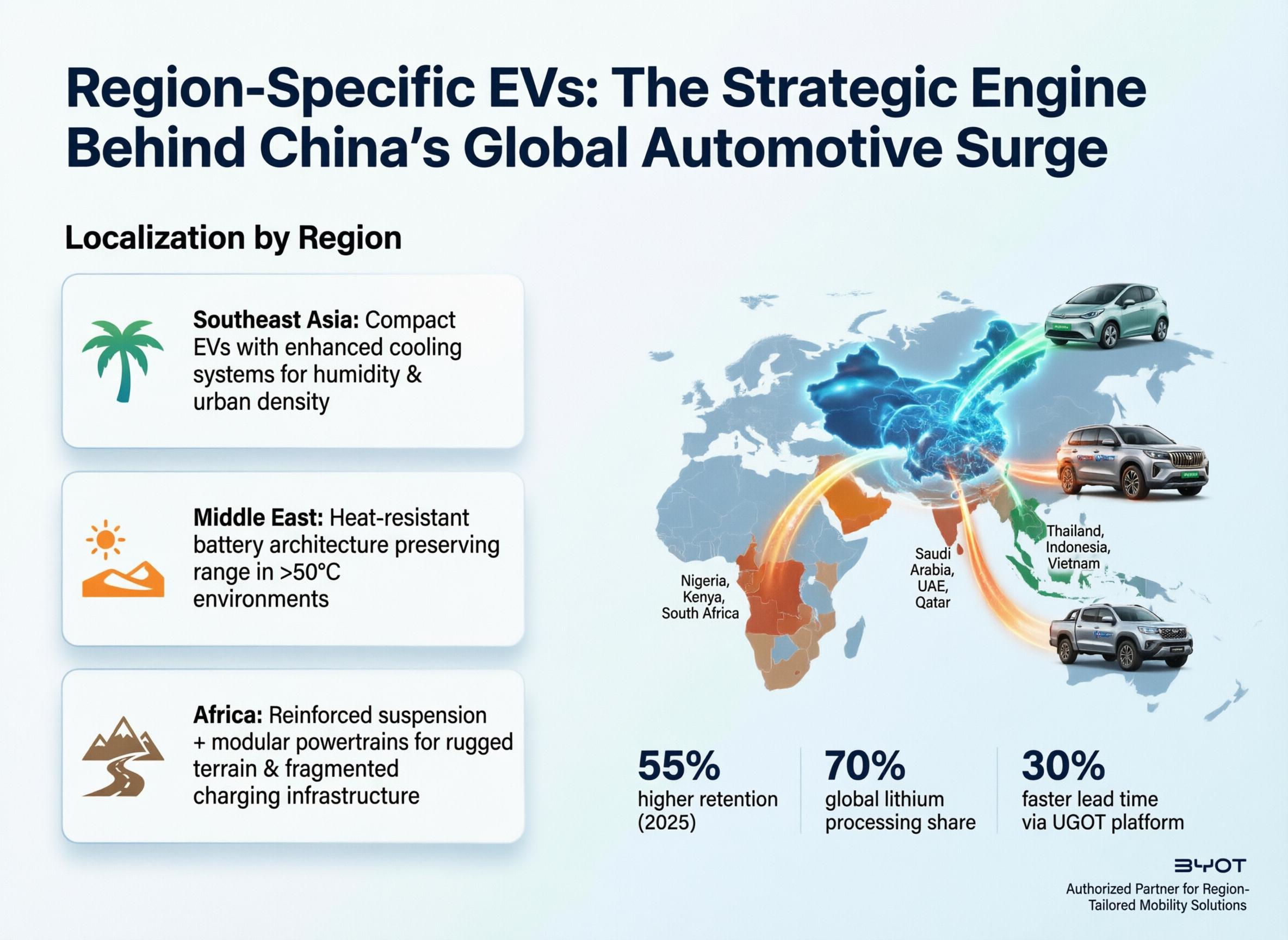 Region-Specific EVs: The Strategic Engine Behind China’s Global Automotive Surge