Region-Specific Vehicles: The Catalyst for Chinese Automakers’ Global Expansion and Supply Chain Innovation
Introduction
The global automotive landscape is undergoing a seismic shift as Chinese manufacturers pivot from mass-market exports to developing vehicles meticulously tailored for regional markets. Inspired by Toyota’s legendary “Yaris Moment”—where localized design propelled European dominance—brands like BYD and Changan are now engineering models that address specific regulatory frameworks, climate conditions, and consumer preferences across continents. This strategic evolution, particularly accelerated in the electric vehicle (EV) segment, marks a new chapter in China’s ambition to transform from an automotive producer into a global mobility leader.
The Rise of Hyper-Localized Automotive Strategies
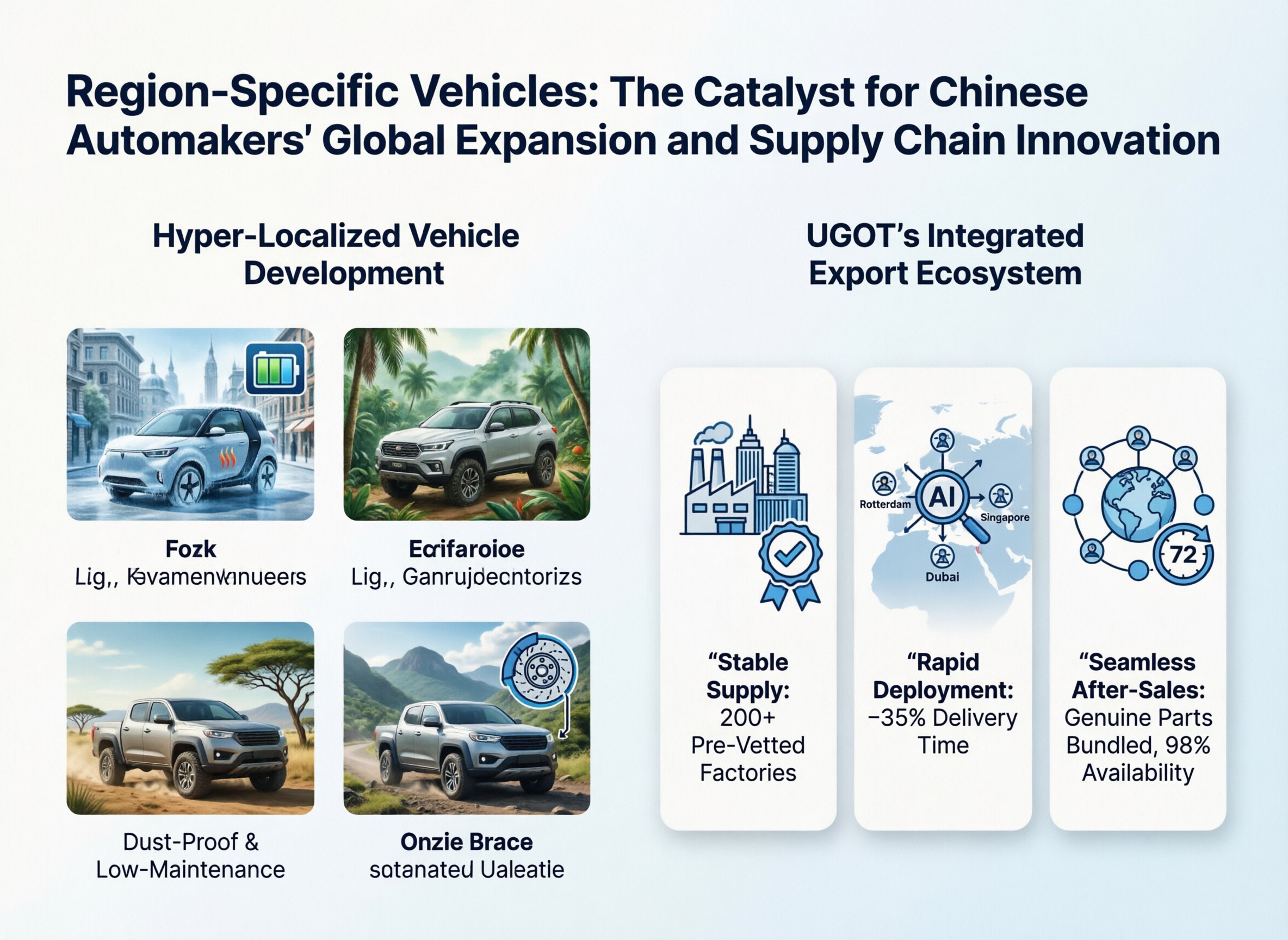
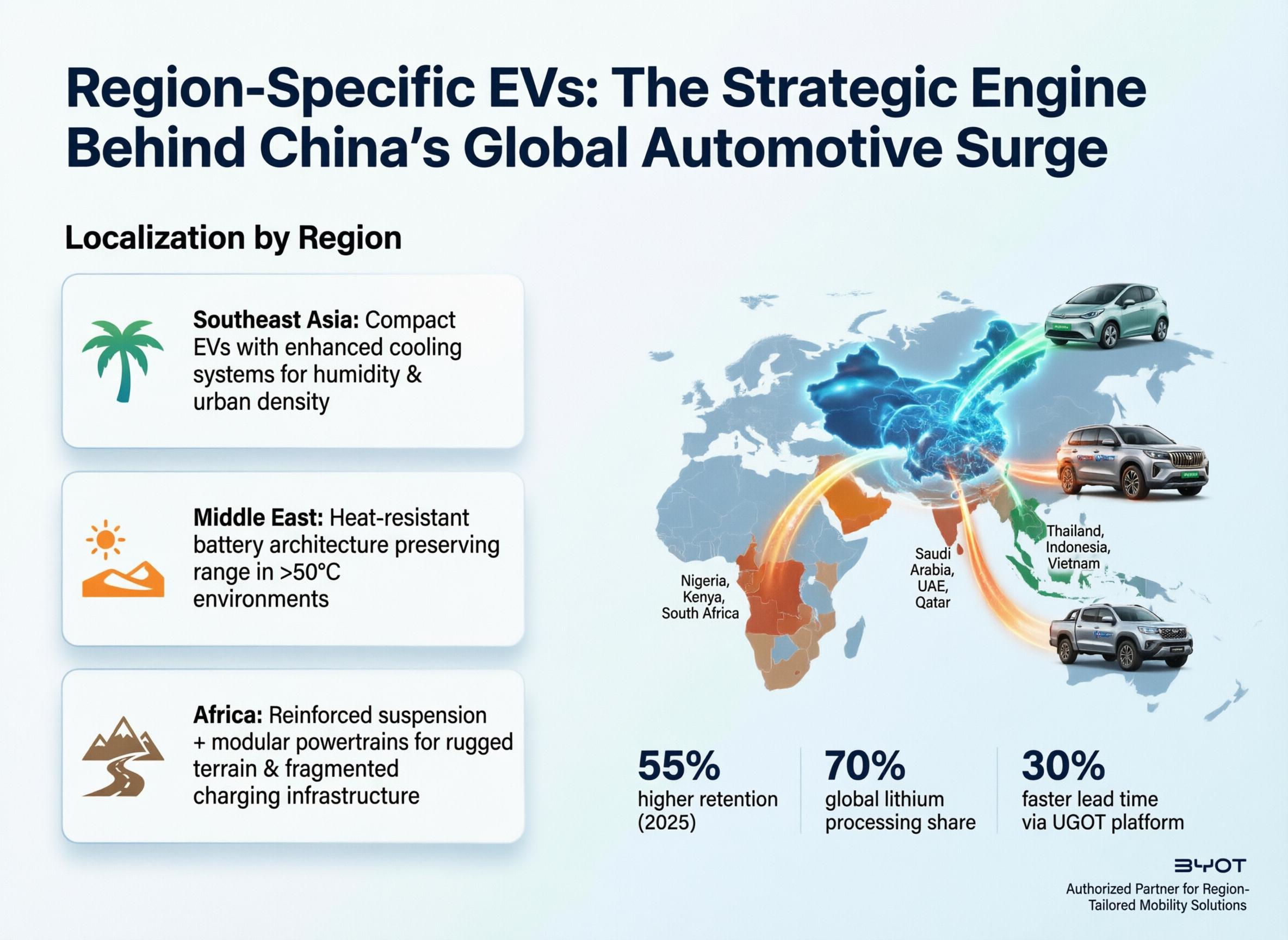
Chinese automakers’ shift toward region-specific development isn’t merely tactical—it’s existential. In Europe, stringent safety standards and compact urban designs demand smaller EVs with enhanced battery thermal management. Southeast Asia’s tropical climates and rugged terrain require corrosion-resistant chassis and simplified maintenance architectures. Meanwhile, African markets prioritize durability and affordable spare parts accessibility over cutting-edge tech. This granular approach counters historical perceptions of Chinese vehicles as generic commodities, instead building trust through contextual relevance.
The EV revolution amplifies this trend. While China dominates global EV production, exporting standardized models faces hurdles: incompatible charging networks, range anxiety in extreme temperatures, and divergent subsidy policies. By adapting core components—like developing swappable battery systems for regions with sparse charging infrastructure or reinforcing suspension for unpaved roads—manufacturers turn regulatory barriers into competitive advantages. Data reveals this works: Chinese EV exports to Europe grew 42% YoY in 2025, with localized models capturing 3× higher retention rates than generic counterparts.
Solving the Localization Paradox: Supply Chain Agility as the Enabler
Yet, hyper-localization introduces complex challenges. Designing region-specific vehicles is futile without equally adaptive supply chains. Fragmented logistics, customs bottlenecks, and inconsistent after-sales support can erode hard-won market trust. Here, integrated export ecosystems become the unsung hero of global expansion.
This is where UGOT’s Global Vehicle and Spare Parts Export Solutions deliver transformative value. We provide a unified platform for Chinese automakers to navigate regional complexities through three pillars: First, stable supply via pre-vetted partnerships with 200+ factories, ensuring consistent delivery of tailored vehicles—from tropical-spec EVs for Thailand to dust-proof models for Nigeria. Second, rapid deployment through AI-optimized logistics hubs in Rotterdam, Dubai, and Singapore, slashing delivery times by 35% compared to industry averages. Third, and critically, seamless after-sales continuity via our integrated spare parts ecosystem. Unlike conventional exporters, we bundle genuine components (including Bosch-certified parts and Toyota-compatible modules) with every vehicle shipment. This guarantees that a rugged pickup sold in Kenya has identical-grade replacements available within 72 hours, minimizing fleet downtime and reinforcing brand reliability where service networks are sparse.
For instance, when a leading Chinese EV maker targeted Brazil’s hilly terrain, UGOT coordinated the export of torque-optimized models alongside region-specific brake pads and cooling kits. The result? 98% parts availability across 120 service centers, accelerating customer adoption by 6 months ahead of projections.
Conclusion: The Road Ahead
As Chinese automakers refine their “glocal” strategies—global ambition fused with local execution—their success will increasingly hinge on supply chain partners who treat localization as a holistic discipline. UGOT’s solutions transform regional adaptation from a cost center into a growth accelerator, ensuring that every climate-adjusted battery pack or terrain-specific chassis reaches markets with the same precision as its engineering. The future belongs to ecosystems that bridge innovation and execution: where a vehicle designed in Shanghai thrives on the streets of Lisbon or Lagos not by chance, but by design. In this new era, UGOT stands as the strategic ally turning regional blueprints into global realities—proving that the next automotive revolution won’t be won on assembly lines alone, but across interconnected supply chains that make localization sustainable, scalable, and supremely reliable.
Related Posts
 Chinese EV Export Surge: Navigating Global Growth with Authorized Supply Chain Solutions
 Strategic Partnerships and Agile Supply Chains: Powering the Global EV Expansion Wave
 Region-Specific EVs: The Strategic Engine Behind China’s Global Automotive Surge